9 Best Bifacial Portable Solar Panels (November 2026)
The best bifacial portable solar panels include the Renogy 200W Portable Solar Panel for Power for direct device charging, the EF ECOFLOW 220W Portable Solar Panel (best overall bifacial panel), and the EF ECOFLOW DELTA 3 MAX Portable Power (best panel and station bundle).
On this page (4 sections)
The best bifacial portable solar panel for most buyers here is the EF ECOFLOW 220W, with a dual-sided design, adjustable stand and IP68 rating. Choose Jackery for its 200W bifacial panel, or a smaller 100W model when lighter packing matters more.
A bifacial panel can collect sunlight on its front and rear surfaces. That rear-side collection can make a difference when light reflects off the ground, but the extra energy depends on the surface and setup.
This roundup includes bifacial panels and a few portable alternatives whose described features do not specify a bifacial design. If rear-side collection is a must-have, focus on the picks explicitly described as bifacial.
To compare other designs, see our guide to what type of solar panel is best.
Our picks at a glance
-
1
 Best for direct device charging
Renogy 200W Portable Solar Panel for Power
9.7/10 our score
See it on Amazon -
2

-
3
 Best panel and station bundle
EF ECOFLOW DELTA 3 MAX Portable Power
9.5/10 our score
See it on Amazon
- 4
 Check it
Jackery SolarSaga 200W Portable Solar Panel
Best for Jackery power stations - 5
 Check it
EBL 200W Portable Solar Panel for Power
Best for included adapter options - 6
 Check it
Jackery SolarSaga 100W Air Solar Panel
Best for lighter bifacial packing - 7
 Check it
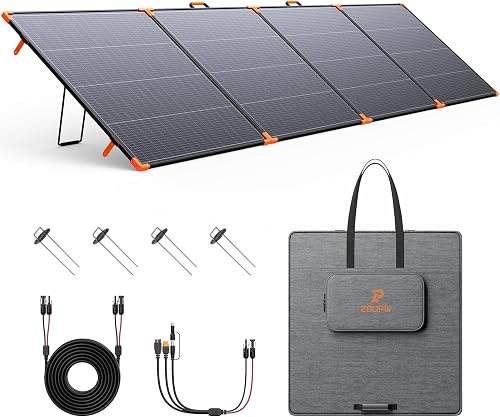
ZOUPW 480W Bifacial Portable Solar Panel N-Type
Best for higher rated output - 8
 Check it
Renogy 400W Portable Solar Panel
Best for a larger non-bifacial alternative - 9
 Check it
AFERIY 100W Portable Foldable Bifacial Solar Panel
Best for a compact 100W option
How we chose these bifacial portable solar panels
We compared the stated power, weight, folding or setup features, weather protection and connection details for each pick. We also considered whether the panel is explicitly described as bifacial, since a high wattage or N-type cell description alone does not guarantee rear-side collection.
Our score weighs specs, features and buyer feedback against what you’re shopping for. A higher score reflects a stronger fit for this roundup’s needs, not a guarantee of output in every location.
What matters when comparing bifacial portable solar panels?
A bifacial design can collect reflected light on the rear, but the usable gain depends on where you place the panel. Compare that feature with rated power, weight, connections and the input limits of your power station.
| Product | Best for | Rated power | Weight | Outputs | Our score |
|---|---|---|---|---|---|
| Renogy 200W Portable Solar Panel for Power | direct device charging | 200W | 13.89 lb | MC4, USB-C, dual USB-A | 9.7 |
| EF ECOFLOW 220W Portable Solar Panel | overall bifacial panel | 220W | 15.4 lb | 9.6 | |
| EF ECOFLOW DELTA 3 MAX Portable Power | panel and station bundle | 9.5 | |||
| Jackery SolarSaga 200W Portable Solar Panel | Jackery power stations | 200W | 14.3 lb | 9.5 | |
| EBL 200W Portable Solar Panel for Power | included adapter options | 200W | 17.95 lb | 8.8 | |
| Jackery SolarSaga 100W Air Solar Panel | lighter bifacial packing | 100W | 7.1 lb | 8.7 | |
| ZOUPW 480W Bifacial Portable Solar Panel N-Type | higher rated output | 480W | 22.5 lb | 8.5 | |
| Renogy 400W Portable Solar Panel | a larger non-bifacial alternative | 400W | 30.2 lb | 8.1 | |
| AFERIY 100W Portable Foldable Bifacial Solar Panel | a compact 100W option | 100W | 8.5 lb | 8.0 |
Rated power and your power station
Rated power gives you a starting point for comparison. This group ranges from 100W panels to the 480W ZOUPW, but the largest number is not automatically the best fit for your equipment.
Check the station’s maximum solar input voltage and current before connecting a panel. The ZOUPW reaches 42.5V, while the AFERIY lists a maximum voltage of 25.92V.
A connector that fits does not prove that the electrical limits match.
Rear-side light and panel placement
Bifacial panels need light to reach the back surface to collect reflected sunlight. A stand can help position a panel, but the ground and surrounding shade also affect what reaches the rear.
The EcoFlow 220W includes a 30–60° adjustable angle bracket and a solar angle guide. The Jackery 100W Air has an integrated stand, while AFERIY includes adjustable kickstands.
These details can help you position a panel, but they do not guarantee a specific rear-side gain.
Weight, folding and weather protection
Weight matters if you carry the panel between a vehicle, campsite and storage area. The Jackery 100W Air weighs 7.1 lb, compared with 15.4 lb for the EcoFlow 220W and 22.5 lb for the ZOUPW 480W.
Weather ratings vary among these products. The EcoFlow 220W and Jackery 200W list IP68 ratings, while AFERIY lists IP67.
For more options with water protection in focus, see our guide to best waterproof portable solar panels.
The best bifacial portable solar panels by use
These picks cover different needs, from a panel and power station bundle to a lighter 100W panel. Check each model’s connections and the power station’s input limits before deciding.
Renogy 200W Portable Solar Panel for Power: Best for direct device charging
- 200W output
- 25% efficiency
- USB-C PD 45W and dual USB-A ports
- 13.89 lb
This 200W Renogy is a useful alternative if you want direct USB charging and a light, folding panel. Its features do not describe a bifacial design, so choose another pick if rear-side collection is essential.
Pros
- USB-C PD 45W and two USB-A ports
- 25% efficiency
- Magnetic closure
Cons
- Bifacial design is not specified
- 4-in-1 adapter is sold separately
Renogy’s 200W panel stands out for direct device charging. Its USB-C port supports PD 45W, and it has two USB-A ports for phones, tablets, laptops, GPS devices and cameras.
It weighs 13.89 lb and folds to 23.72 x 22.99 x 1.97 in, with a magnetic closure and four kickstands. Renogy describes N-type cells and 25% efficiency, but the features here do not specify a bifacial design.
The panel has MC4 output, and the 4-in-1 adapter is sold separately. Check your power station’s connection requirements if you want to use it for station charging.
This is a strong alternative when direct USB charging matters more than rear-side collection. For a closer look at this model, see our Renogy 200W portable solar panel review.
EF ECOFLOW 220W Portable Solar Panel: Best overall bifacial panel
- 220W output
- Bifacial design
- Up to 25% conversion efficiency
- IP68 rating
The 220W EcoFlow combines a bifacial design with an adjustable angle bracket and IP68 water and dust protection. EcoFlow says the rear side can collect up to 28% more energy, though the gain depends on reflected light and setup.
Pros
- Bifacial design
- Adjustable stand and solar angle guide
- IP68 rating
Cons
- 15.4 lb to carry
- Rear-side gain depends on the site
The EF ECOFLOW 220W is the strongest all-around bifacial fit in this group. Its dual-sided design is paired with N-type solar technology, up to 25% conversion efficiency and a stand that adjusts from 30° to 60°.
EcoFlow says the bifacial design can collect up to 28% more energy. Treat that as a best-case claim rather than a result for every campsite, since reflected light depends on the surface and angle.
The panel weighs 15.4 lb and has an IP68 rating for water and dust protection. It uses MC4 connectors, so make sure your power station supports the connection and panel input.
Choose this model if you want a mid-size bifacial panel with an adjustable bracket and weather protection. It is less suitable if your priority is the lowest carry weight.
EF ECOFLOW DELTA 3 MAX Portable Power: Best panel and station bundle
- Includes a 220W bifacial solar panel
- 2,048Wh power station
- 2,400W output wattage
- Three power outlets
This bundle pairs a 220W bifacial panel with an EcoFlow DELTA 3 MAX power station. It suits buyers choosing the storage and panel together, rather than shoppers who only need a folding panel.
Pros
- Panel included with the power station
- 2,048Wh battery capacity
- Solar-powered charging
Cons
- Not a panel-only option
- Power station adds a separate item to move
The EF ECOFLOW DELTA 3 MAX bundle includes a 220W bifacial panel alongside a 2,048Wh power station. It suits buyers who want both solar collection and battery storage in one package.
The power station has a stated output wattage of 2,400W and three outlets. Its included panel gives you a starting point for charging the station, though you should still check the solar input limits and charging setup for your needs.
This is a larger purchase decision than choosing a panel alone, because you are selecting the storage system too. Compare the station’s capacity and output needs before making a choice.
Pick the bundle if you need a power station and panel together. If you already own a compatible station, the EcoFlow 220W panel-only option may be a more direct match.
Jackery SolarSaga 200W Portable Solar Panel: Best for Jackery power stations
- 200W output
- Bifacial design
- Up to 26.7% conversion efficiency
- IP68 rating
Jackery's 200W panel uses a bifacial design and includes USB-A, USB-C and DC8020 connections. Its stated compatibility includes several Jackery Explorer models, so check your station's input requirements before buying.
Pros
- Bifacial design
- USB-A and USB-C ports
- IP68 rating
Cons
- Compatibility should be checked against your station
- Charging cable is not weatherproof
Jackery’s SolarSaga 200W combines a bifacial design with a stated conversion efficiency of up to 26.7%. It weighs 14.3 lb and folds to 24 x 21.7 x 1.8 in.
The connections include USB-A, USB-C and DC8020. Jackery names Explorer 1000Plus, 2000Pro, 2000 Plus and 3000Pro among compatible power stations, so check the exact model and input requirements before connecting it.
The panel has an IP68 rating, but the included multi-function charging cable is not weatherproof. Keep that distinction in mind when setting up outdoors.
Choose it if you use a compatible Jackery Explorer and want a 200W bifacial panel with direct device ports. Its compatibility details make checking your exact station especially useful.
EBL 200W Portable Solar Panel for Power: Best for included adapter options
- 200W output
- Up to 23.5% conversion rate
- MC4 to 4-in-1 cable included
- Four kickstands
EBL includes an MC4 to 4-in-1 cable with XT60, Anderson, DC79*09mm and aviation connectors. Its described features do not specify a bifacial design, making it a connection-friendly alternative rather than a rear-side collection pick.
Pros
- 4-in-1 cable included
- Four kickstands
- Up to 23.5% conversion rate
Cons
- Bifacial design is not specified
- 17.95 lb weight
EBL’s 200W panel is a practical choice if included connection options are a priority. Its MC4-to-4-in-1 cable has XT60, Anderson, DC79*09mm and aviation connectors.
It weighs 17.95 lb, folds to 25.31 x 20.87 x 2.17 in and has four kickstands. EBL describes a conversion rate of up to 23.5%, but the described features do not specify a bifacial design.
The panel’s PET lamination and 840D Oxford cloth outer are described as providing waterproof protection. Its stated waterproofing is IP65, so compare that rating with your expected conditions.
Pick EBL if you want a 200W panel with several adapter options in the box. If rear-side collection is essential, choose one of the models explicitly described as bifacial.
Jackery SolarSaga 100W Air Solar Panel: Best for lighter bifacial packing
- 100W output
- Bifacial generation
- 7.1 lb
- IP68 rating
At 7.1 lb, the 100W SolarSaga Air is the lightest bifacial option in this group. Jackery says it uses both sides to collect sunlight and includes an integrated stand for setup.
Pros
- Lightest panel in this roundup
- Bifacial design
- Integrated aluminum stand
Cons
- 100W rated power
- Not compatible with Explorer 300 or 300 v2
The Jackery SolarSaga 100W Air is the lightest panel in this group at 7.1 lb. Its bifacial design is described as collecting sunlight on both sides, and the folding W shape is designed for compact storage.
The panel has a stated 23% conversion efficiency, an integrated aluminum stand and an IP68 rating. It also has two USB ports, with the product description saying it can charge three devices simultaneously.
There is one compatibility limit to remember: Jackery says the 100W Air is not compatible with Explorer 300 or 300 v2 models because of a voltage mismatch. Check other power station requirements as well.
Choose it when low carry weight matters more than 200W or higher rated output. It is a useful fit for lighter packing, provided your station is compatible.
ZOUPW 480W Bifacial Portable Solar Panel N-Type: Best for higher rated output
- 480W output
- Bifacial design
- 25% conversion rate
- 22.5 lb
ZOUPW offers the highest rated output here at 480W, with a bifacial design and included 4-in-1 connector cable. Check your power station's input voltage and limits before connecting this panel.
Pros
- Highest rated output in this group
- Bifacial design
- Includes connector and extension cables
Cons
- 22.5 lb weight
- Not recommended for long-term fixed installations
ZOUPW’s 480W panel has the highest rated output in this roundup and uses a bifacial design with N-type 16BB cells. It weighs 22.5 lb and includes a 4-in-1 connector cable, extension cable and ground stakes.
ZOUPW says the rear side can provide up to 30% extra power on highly reflective surfaces such as snow or sand. The company also describes a 10% boost as realistic on common grass or concrete, but actual output still depends on sunlight and the setup.
The panel’s maximum voltage is 42.5V. ZOUPW advises checking that a power station supports 50V+ input before connecting, so confirm your station’s specifications first.
The brand does not recommend long-term fixed installations or operation under shaded conditions. Choose this panel for higher rated output and portable use when your power station supports its electrical requirements.
Renogy 400W Portable Solar Panel: Best for a larger non-bifacial alternative
- 400W output
- IP67 waterproofing
- 30.2 lb
- Parallel wiring
Renogy's 400W folding panel is a higher-output alternative with IP67 protection and parallel wiring. Its described features do not specify bifacial collection, and its 30.2 lb weight is worth factoring into transport plans.
Pros
- 400W rated output
- IP67 waterproofing
- Carry case included
Cons
- Bifacial design is not specified
- Heaviest panel in this roundup
Renogy’s 400W panel is a higher-output portable option, but its described features do not specify a bifacial design. It may suit buyers comparing panel wattage and weather protection, rather than those who require rear-side collection.
It weighs 30.2 lb and folds to 33.7 x 27.95 in. Renogy describes IP67 waterproofing, fiberglass reinforcement and an ETFE coating, along with parallel wiring intended to help reduce the effect of individual shadows.
The panel has MC4 output cables only, and Renogy’s 4-in-1 adapter is sold separately. It is described as compatible with selected power stations when voltage, current and connector requirements match.
Choose this panel if 400W output and its stated construction matter more than a bifacial design. Its weight and folded size also make it a less compact choice than the 100W and 200W panels here.
AFERIY 100W Portable Foldable Bifacial Solar Panel: Best for a compact 100W option
- 100W output
- Bifacial design
- 25% conversion efficiency
- 8.5 lb
AFERIY's 100W panel uses a bifacial design to collect reflected sunlight from the rear, and it includes a carry bag and extension cords. Its 8.5 lb weight keeps it portable for camping and RV trips.
Pros
- Bifacial design
- 25% conversion efficiency
- Carry bag and extension cords included
Cons
- 100W rated output
- Check power station voltage compatibility
AFERIY’s 100W panel captures reflected sunlight through its bifacial rear surface. It weighs 8.5 lb and folds for transport, with a carry bag and extension cords included.
The panel uses N-type solar cells and lists 25% conversion efficiency. AFERIY says its bifacial design can boost power under suitable light conditions, but the amount depends on reflected sunlight and placement.
Its maximum voltage is 25.92V, and it has an IP67 rating. Check your power station’s input limits and connectors before connecting the panel.
Pick AFERIY if you want a portable 100W bifacial panel with a carry bag. The lighter Jackery 100W Air weighs less, while AFERIY lists a higher conversion efficiency.
Which bifacial panel fits your setup?
The best choice depends on how much power you need, how you plan to carry the panel and whether your power station supports its electrical output. A bifacial design can collect reflected sunlight, but positioning and the surface beneath the panel affect its potential benefit.
Choose the EcoFlow 220W for a balanced bifacial panel with an adjustable stand and IP68 rating. Choose the Jackery SolarSaga 100W Air if low weight matters most, or the ZOUPW 480W if you need the highest rated output here and your station supports its voltage.
If your next choice is between cell types, see our guide to portable solar panel N-type options. For broader home use, compare these picks with our guide to best portable solar panels for home.
When solar is part of a backup setup, also consider whether your needs call for a portable UPS or a solar UPS. A solar panel collects energy; the right storage and backup equipment depends on what you need to keep running.
Our top 3 picks at a glance
-
1
Best for direct device charging
Renogy 200W Portable Solar Panel for Power
9.7/10 our score
See it on Amazon -
2
-
3
Best panel and station bundle
EF ECOFLOW DELTA 3 MAX Portable Power
9.5/10 our score
See it on Amazon
Frequently asked questions
What is a bifacial portable solar panel?
A bifacial portable solar panel can collect sunlight from both its front and rear surfaces. The rear side can use light reflected from the ground or nearby surfaces, so the amount of extra energy depends on the panel's placement and how reflective the surroundings are.
For a general overview, read our portable solar panel buying guide.
Does a bifacial panel always produce more power?
No. A bifacial panel can collect extra reflected light, but the rear-side gain changes with the ground, panel angle and available sunlight.
A dark or shaded surface may reflect less light than a bright, open surface.
Compare rated output and setup needs alongside the bifacial feature.
How do I choose between 100W, 200W and 480W panels?
Choose by your power station's solar input limits, your carry needs and the amount of power you want to collect. A 100W panel weighs less, while 200W models offer a middle option and the 480W ZOUPW has the highest rated output here.
Confirm voltage, current and connector requirements before connecting a panel.
Can I use a bifacial panel with any power station?
No. Your station must support the panel's voltage, current and connector requirements.
Some panels include adapter cables, while others use MC4 outputs or list compatibility with selected station models.
Check the station's solar input limits and the panel's connection details before buying.