Portable Solar Panels: The Complete Buying Guide
A portable solar panel turns sunlight into electricity you can use or store. Choose one by its output, connection type, portability, and the input limits of the battery or power station you plan to charge.
On this page (10 sections)
- What is a portable solar panel, and how does it work?
- What kinds of portable solar panels can you choose?
- Which connections does a portable solar panel use?
- How many watts do you need?
- Where will you use a portable solar panel?
- What should you check before buying a portable solar panel?
- How do you position a portable panel for useful output?
- How do rain, water and cleaning affect a portable panel?
- Will a portable panel work in low light?
- Which portable solar panel should you choose?
A portable solar panel turns sunlight into electricity you can use or store. Choose one by its output, connections, portability, and the input limits of your battery or power station.
Portable panels can help charge a battery at a campsite, top up a power station during an outage, or provide power away from a wall outlet. They need sunlight, a compatible electrical path, and a safe place to sit while operating.
This guide explains panel types, connections, sizing, placement and care. If you want a quick comparison of panel technologies before choosing a format, see which type of solar panel is best for your needs.
What is a portable solar panel, and how does it work?
A portable solar panel is a movable photovoltaic panel that converts sunlight into direct-current electricity. That electricity can charge a compatible battery or power station, or run a device when the panel and device support a direct connection.
A solar cell produces electricity when light reaches it. The panel combines many cells, and its output depends on the light reaching them, their angle, temperature and other conditions.
A panel's watt rating describes its maximum rated power under specified conditions. It does not promise that much output every hour outdoors, because shade, clouds, angle and device limits can lower the power available.
Most portable setups have three main parts:
- Panel: turns sunlight into electrical power.
- Charge controller: manages charging between the panel and a battery, when the system needs one.
- Battery or power station: stores energy so you can use it after sunlight fades.
Some kits bundle a controller and cables. Others are panels only, or are designed to connect to a particular power station.
Before you buy, check which parts are included and whether they match your intended setup.
What kinds of portable solar panels can you choose?
Portable panels differ in how they fold, mount and connect. The right format is the one you can carry, set up, aim at the sun and store in your available space.
| Format | What it offers | Check before choosing |
|---|---|---|
| Foldable suitcase panel | Hinged sections and a carrying format, sometimes with a kickstand | Packed size, weight, stand angle and cable reach |
| Flexible panel | A bendable format that may suit a curved surface or fixed mounting | Mounting guidance, operating limits and whether you need to move it often |
| Blanket-style panel | Multiple sections that fold or roll for storage | How it rests on the ground and whether its connectors match your system |
| Rigid portable panel | A firm panel that may use a separate stand or mount | Storage space, safe handling and the stand or mounting method |
A foldable panel can be convenient when you want to move it between sun and shade. For a focused comparison of portable folding formats, see best foldable solar panels.
A flexible panel may fit a curved mounting surface, but flexibility does not make every roof or surface a suitable place to install one. Follow the maker’s mounting instructions and check whether the panel is meant for temporary portable use or a fixed installation.
Our best Renogy flexible solar panel guide covers that style.
Some panels use N-type cells. Cell type is one factor to compare, but it does not tell you whether a panel will fit your setup or be easy to carry.
Learn more in our guide to N-type portable solar panels.
Which connections does a portable solar panel use?
A portable panel needs a connection that matches the charge controller, battery system or power station. Check the connector, voltage range and input limits at both ends before you connect anything.
Panel kits may use solar connectors, SAE connectors, XT60 plugs, DC barrel plugs, alligator clips or USB ports. A cable that physically fits may still be the wrong electrical match, so compare the system instructions as well as the plug shape.
A charge controller helps manage charging a battery from a panel. Some kits include one; others require you to supply a compatible controller or connect to a power station with its own solar input management.
For a power station, check its solar input specifications before choosing a panel. A station may cap input below the panel’s rated output, so adding a higher-wattage panel does not necessarily make the station charge faster.
It may also require a specific connector or adapter.
The Renogy kit gives you a controller and alligator clip cables in one portable setup. Its product information describes compatibility with 12V power stations and several 12V battery types, but you should still confirm that your device and charging instructions match.
The DOKIO 100W kit can suit a lighter setup where its connectors and controller match your system. DOKIO also cautions that some power stations cap input, so check your station’s maximum solar input before choosing.
If your panel needs more reach, use a cable rated for the setup and long enough to place the panel in sun while keeping equipment where its instructions require. The BougeRV 20 Feet 10AWG Solar Extension Cable has solar connectors at one end and bare wire at the other, so confirm that its ends suit your planned connection.
How many watts do you need?
Choose panel wattage based on the energy you need and the time and sunlight available to collect it. A 100W panel is a manageable starting point for modest charging; consider a larger panel when you need more potential output and can handle the added size.
A panel’s watt rating is not the same as the amount of energy it will produce each day. Daily energy depends on conditions, the panel’s position and the limits of the connected equipment.
Start with the device or battery you want to charge. Look for its input specifications and estimate how much energy you need to replace, then compare panels that your system can accept.
| Panel rating | A useful starting point | Main trade-off |
|---|---|---|
| 100W | Phones, lights and modest battery top-ups | Easier to carry, with less potential output |
| 200W | Larger charging needs or shorter charging windows | More panel area and space to set up |
| 400W or more | Higher input needs with a compatible system | More bulk, space and connection planning |
These are starting points, not guarantees of charging speed. Actual results depend on sun and compatibility, and a station’s input limit may cap what it receives.
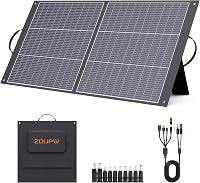
This DOKIO kit is listed as a 200W panel and includes a separate PWM controller. Its product information notes that some power stations cap input around 100–150W, so verify the station limit before paying for capacity it cannot use.
For a closer look at compact 100W options, compare best portable 100 watt solar panels. If you can accommodate more panel area, see best 200 watt portable solar panels and best 400 watt portable solar panels.
Where will you use a portable solar panel?
Choose a panel format and size that suit the place you will set it up. A panel for a backpacking trip needs a different balance of packed size and weight than a panel for an RV or a home backup setup.
For backpacking, carrying weight and packed dimensions matter on every trip. Compare best portable solar panels for backpacking and check how you will secure the panel while it collects sunlight.
For an RV, decide whether you need a movable ground panel or a panel for a fixed mounting plan. Our best portable solar panels for RVs guide can help narrow that choice.
At home, a portable panel may recharge a compatible power station in a sunny spot. It does not replace a full home solar installation, and the power station’s inputs still set the limits.
See best portable solar panels for home use for home backup considerations.
A portable panel can charge an electric vehicle only through a compatible charging system that can accept its output. A typical panel should not be treated as a direct connection to an EV.
Read can you use portable solar panels for EV charging? before planning that setup.
If your main goal is keeping essential electronics powered during an outage, compare the storage and outlet options in what is a portable UPS? The complete guide.
A solar panel collects energy, while a UPS or power station stores and delivers it.
What should you check before buying a portable solar panel?
Check the full setup, not just the panel’s wattage. A good match has a usable format, compatible electrical limits, suitable cables and a practical way to position the panel in sunlight.
Use this checklist before you choose:
- Confirm the power source. Write down the battery or power station’s voltage, input limits and supported connectors.
- Match the panel output. Check its rated power and electrical output against the receiving device.
- Find out what comes in the kit. Check for a controller, cables, clips, stand or carrying case if you need them.
- Measure for storage and transport. Compare the folded dimensions and weight with your car, pack or storage space.
- Plan the cable route. Make sure the cable can reach the sunny location without putting equipment somewhere unsafe.
- Check use and care instructions. Confirm where the panel may be placed and how its connections should be protected.
If you want a bundle of panel, controller and connecting parts, compare best portable solar panel kits. For stations with a compatible solar input, see best solar panels for portable power stations.
Owners of a specific power station should start with its own manual and solar input limits. Our guides cover best solar panels for Jackery, how to use an EcoFlow solar panel and best solar panels for Bluetti power stations.
A dual-sided panel may collect light from its back as well as its front, depending on the model and setup. Compare the design and placement needs in best bifacial portable solar panels.
How do you position a portable panel for useful output?
Place the panel where it receives direct sunlight, then adjust its angle as the sun moves. Avoid shade from trees, people, vehicles and nearby objects, because even partial shade can reduce a panel’s output.
Use a built-in kickstand if the panel has one, and set it on stable ground. If you need a separate support, check portable solar panel stands with wheels for options that make moving larger panels easier.
Keep controllers and power stations shaded when their instructions call for it, while leaving the panel in the sun. A long enough cable can make that arrangement easier, but use a compatible cable and keep connections secure.
Clouds and changing sunlight affect output, so do not plan around the panel’s rated wattage as a constant. Check the power station or charge controller’s readout, if available, and adjust the panel’s position when conditions change.
How do rain, water and cleaning affect a portable panel?
Water protection depends on the panel and its separate parts. Check the specific water-resistance rating and care instructions for the panel, junction box, connectors, controller and battery.
A rating for one part does not make every connection safe to leave wet. Keep plugs clean and dry as instructed, and disconnect or store equipment according to its manual when weather conditions exceed its limits.
Our guide to are solar panels waterproof? explains how to think about water protection. For models selected with water exposure in mind, see best waterproof portable solar panels.
Dust and dirt can block sunlight from reaching the cells. To keep the surface clear, follow how to keep portable solar panels clean and use the cleaning method recommended for your panel.
Will a portable panel work in low light?
A portable panel can still receive light in cloudy conditions, but its output may fall. No panel can guarantee a particular charging rate in shade or poor weather, so leave time for changing conditions.
Cell type, panel area and design can affect performance, but the receiving device’s limit still matters. A panel advertised for low-light use may be worth comparing if you often camp under changing skies, but check its real output specifications rather than relying on a broad claim.
See best solar panels for low light if cloudy conditions are common where you plan to use a panel. Position it in the brightest available area and check its output before relying on it for essential power.
Which portable solar panel should you choose?
Choose a portable panel by matching your power need, device input and carrying limits. A smaller foldable panel may suit short trips and light charging, while a larger kit may fit a power station that accepts more input.
For a ready-to-use 12V kit, consider the Renogy 100W panel if its controller, cables and connection type fit your system. For a lightweight foldable option with a separate controller, compare the DOKIO 100W kit; step up to the DOKIO 200W kit only when your station or battery can accept the extra input.
Pick a panel with the right connector and cable length for your planned location. Check your device’s limits first, then compare best portable power station solar chargers if a power station is part of your setup.
Frequently asked questions
What is a portable solar panel?
A portable solar panel is a movable panel that converts sunlight into electricity for a compatible battery, power station or small device. Some panels connect directly to a charge controller, while kits may include one.
Check the panel's output and connector against the device you plan to charge.
Can a portable solar panel charge a power station?
Yes, if the panel's output and connector work with the power station's solar input. Check the station's maximum input voltage, current and wattage, along with any cable or adapter requirements.
A station may accept less power than the panel can produce, even in strong sun.
How many watts should a portable solar panel have?
Choose wattage based on the energy you need, how long you have to charge, and the space and sunlight available. A 100W panel is a smaller, easier-to-carry starting point; higher-wattage panels can provide more potential output but are often larger.
Real output changes with conditions.
Are portable solar panels waterproof?
Water resistance varies by panel and by component. A panel's junction box or connectors may have an ingress rating, but that does not mean the whole panel can be submerged or left exposed in every storm.
Check the maker's care instructions and protect controllers, batteries and connections as directed.
Can you use a portable solar panel without a battery?
Some panels can power USB devices directly, but output can vary with sunlight and a connected device may stop charging when conditions change. For steadier use, connect a compatible battery or power station.
Follow the panel and controller instructions, and confirm the device accepts the panel's output.