9 Best Portable Solar Panel Chargers (November 2026)
The best portable solar panel chargers for direct device charging include the MARBERO Portable Solar Panel 30W Solar Panel for most campers, the ZOUPW 100W Portable Solar Panel for Power for power stations, and the Durecopow Solar Charger Power Bank for built-in storage.
On this page (9 sections)
- Our top portable solar panel charger picks
- Side-by-side: watts, size and ports
- How we compared these portable solar chargers
- How much wattage do you actually need?
- USB-C, USB-A or DC: which ports matter?
- Folded size and weight for backpacking vs car camping
- Waterproof ratings and cloudy-day output
- Direct charging vs built-in battery storage
- Verdict: which portable solar panel charger should you buy?
The best portable solar panel charger for most trips is the MARBERO 30W, because its mix of USB-C, QC3.0 and DC outputs covers more devices than a USB-only 30W panel.
You get direct charging now, with no waiting for a battery to fill first.
That direct design also sets the limit.
These panels do not store electricity, so power flows only while the sun hits the surface.
Pair the panel with a power bank or a portable power station if you want energy after sunset.
If you are new to solar, start with our guide explaining what is a portable solar panel and how wattage, ports and folded size affect real use.
It helps you match a panel to a phone, a laptop or a station before you compare models.
Our picks at a glance
-
1
 Best for most campers
MARBERO Portable Solar Panel 30W Solar Panel
9.7/10 our score
See it on Amazon -
2

-
3

- 4
 Check it
BigBlue 28W High-Efficiency Solar Panel Charger
Best for simple phone charging - 5
 Check it
FlexSolar 40W Foldable Solar Panel Charger
Best for backpacking - 6
 Check it
FlexSolar 60W Foldable Portable Solar Panel Charger
Best for road trips - 7
 Check it
SOLUPUP Solar Panels 30W Portable Foldable Solar
Best for two-device charging - 8
 Check it
Foricx 30W Portable Solar Panel Charger
Best for adjustable setup - 9
 Check it
GEYOTO 45W Solar Panel Charger Fast Charging
Best for fast USB-C charging
Our top portable solar panel charger picks
The MARBERO and ZOUPW lead on versatility and raw wattage.
Durecopow stands apart because it stores 20,000mAh, while the remaining picks trade station support for lighter weight and faster USB charging.
Our score weighs specs, features and buyer feedback against what you're shopping for.
Higher wattage helps stations, but weight, port mix and weather rating matter just as much for daily use.
MARBERO Portable Solar Panel 30W Solar Panel: Best for most campers
- 30W maximum power
- USB-C, QC3.0 USB and DC outputs
- Folds to 8.9 x 12 x 1.8 in
- Weighs 2.4 lb
- IP65 waterproof
A balanced 30W foldable panel with three output types for phones, laptops and small power stations.
Pros
- USB-C, QC3.0 and DC in one panel
- Lightweight laptop-bag size
- Carry handle and bag
Cons
- No built-in storage
- Output drops on cloudy days
MARBERO suits campers who want one panel for a phone, a tablet and a small power station.
Its 30W output is modest, yet the port mix is broad for this class.
The USB-C port supports 5V/3A, 9V/2.22A and 12V/1.67A.
The QC3.0 USB port supports 5V/3.4A, 9V/2.5A and 12V/2A.
A DC output adds 16.5V/1.81A max, with three DC adapter plugs for common solar generators.
It folds to 8.9 x 12 x 1.8 in and weighs 2.4 lb, close to a laptop bag.
MARBERO says it produces 25W to 30W in full sun at a 45 to 65 degree angle, and 15W to 20W on cloudy days.
The trade-off is clear against the 100W ZOUPW.
MARBERO carries easier and costs less effort to set up, but it will refill a station much more slowly.
It also has no internal battery, so you need direct sun while charging.
ZOUPW 100W Portable Solar Panel for Power: Best for power stations
- 100W maximum power
- 23.5% efficiency
- 5-in-1 connector cable
- IP67 waterproof ETFE coating
- Folds to 24.13 x 21.06 x 1.77 in
A 100W foldable panel built to refill Jackery, EcoFlow, Anker and Bluetti stations faster than 30W models.
Pros
- Five common station connectors included
- Adjustable kickstands
- USB-C and two USB-A ports
Cons
- Heaviest pick here
- Junction box needs dry storage
ZOUPW suits RV, car camping and backup use where a power station needs a faster refill.
Its 100W maximum power is more than triple the 30W picks here.
It uses Grade A+ monocrystalline cells with 23.5% efficiency.
Two adjustable kickstands let you tilt the panel at 45 degrees.
ZOUPW says that angle can capture up to 25% more sunlight than a flat layout in suitable conditions.
The included 5-in-1 cable covers DC8020, XT60, Anderson, DC7909 and DC5521 connectors.
That removes extra adapter purchases for Jackery, EcoFlow, Anker and Bluetti stations.
A built-in hub adds one USB-C PD port at 15V/3A and two USB-A ports, including a QC3.0 output.
At 9.48 lb and folded to 24.13 x 21.06 x 1.77 in, it is not a backpacking panel.
The panel body is IP67 waterproof, but the USB hub and cables should stay dry.
Check your station input limit, because a station capped at 60W will only draw 60W from this 100W panel.
Durecopow Solar Charger Power Bank: Best for built-in storage
- 20,000mAh battery
- 4 cables and 3 ports
- Can charge 6 devices at once
- Dual flashlight
- Solar or USB charging
A solar power bank that stores energy for night use, unlike direct-only panels.
Pros
- Stores 20,000mAh for later use
- Built-in Type-C, Lightning and Micro USB cables
- Flashlight and compass
Cons
- Solar refill is slow
- Cable-based design suits phones most
Durecopow suits people who need power at night or in a tent without sun.
It is the only pick here with a 20,000mAh built-in battery, so it stores energy instead of only passing it through.
It has three built-in output cables for Type-C, Lightning and Micro USB, plus an extra USB-A input cable.
Two more USB output ports bring the total to six devices at once.
That suits groups sharing one charger at a campsite.
A dual LED flashlight adds steady, SOS and strobe modes.
Five indicator lights show charge status, with a green light for solar charging and a blue light for USB charging.
The body uses ABS with silicone corners, and the port has a silicone cover.
The trade-off is charging speed.
A small solar surface on a power bank refills far more slowly than a 40W or 60W foldable panel.
Use it to top up phones and small electronics, not to refill a power station.
Its 30-year refund or replacement policy for quality issues not caused by human error is also part of the value here.
BigBlue 28W High-Efficiency Solar Panel Charger: Best for simple phone charging
- 28W maximum power
- 25.4% conversion efficiency
- Dual USB-C and one USB-A port
- Folds to 11 x 6 x 1.4 in
- Weighs 1.5 lb
A very light 28W panel with three USB ports for phones, GPS units and small electronics.
Pros
- Lightest direct panel here
- Three simultaneous USB outputs
- High 25.4% efficiency
Cons
- No DC output for stations
- No battery storage
BigBlue suits hikers and emergency kits where every ounce counts.
At 1.5 lb, it is the lightest direct panel in this roundup.
It folds to 11 x 6 x 1.4 in and delivers 28W with 25.4% conversion efficiency.
BigBlue says its shadow-free surface design, with no metal lines on the front, helps it produce 20% more power from the same sunlight.
Three ports cover dual USB-C and one USB-A.
Each port supports up to 5V/3A, with a combined 5V/4.8A limit.
That lets you charge two phones and a GPS unit together, though total output is shared.
The panel is IP44 waterproof, so it resists rain and fog but the USB junction box is not waterproof.
BigBlue notes this design is not sufficient for laptops or large power stations.
Keep your phone in the shade while it charges, because heat can trigger thermal protection and slow charging.
Compared with FlexSolar 40W, BigBlue gives up DC output and 12W of peak power.
It wins on weight and simplicity for phone-focused trips.
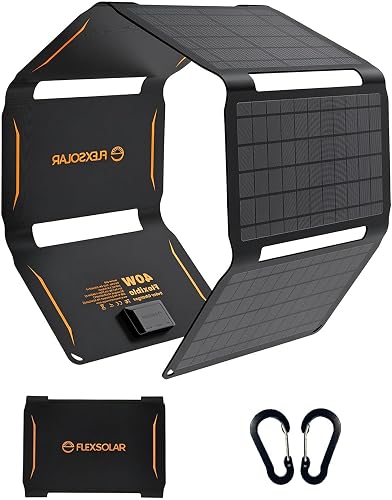
FlexSolar 40W Foldable Solar Panel Charger: Best for backpacking
- 40W maximum power
- 24% conversion efficiency
- QC3.0 USB-A, PD USB-C and 19V DC port
- Folds to 8.0 x 11.1 x 1.8 in
- Weighs 1.76 lb
A 40W panel that stays backpack-light while adding a DC port for small stations.
Pros
- More power than 30W rivals at similar weight
- IP67 rated construction
- Two carabiners included
Cons
- DC and USB use have limits
- No kickstand listed
FlexSolar 40W suits backpackers who want more power than a 28W or 30W panel without a big weight penalty.
At 1.76 lb, it stays light for long carries.
It folds to 8.0 x 11.1 x 1.8 in and uses monocrystalline cells with 24% conversion efficiency.
The ETFE laminate and IP67 construction resist rain, dust and abrasion better than standard PET surfaces.
Ports include QC3.0 USB-A and PD2.0 USB-C at 18W max each, plus a 19V DC port at 40W max.
That DC port can directly power small stations.
FlexSolar recommends single-port use for peak efficiency, and DC cannot be used together with USB.
An IC chip adjusts output for the connected device, with overcurrent, overheating and short-circuit protection.
An LED shows charging status.
The trade-off is positioning.
FlexSolar suggests a 45 degree angle facing direct sun, and shade can reduce performance by up to 70%.
At 40W it will charge phones quickly in good sun, but it will take much longer than the ZOUPW to refill a station.
Two carabiners help you hang it on a pack or tent line.
FlexSolar 60W Foldable Portable Solar Panel Charger: Best for road trips
- 60W maximum power
- Up to 24% conversion
- PD3.0 USB-C, QC3.0 USB-A and DC outputs
- Folds to 9.8 x 12 x 1 in
- Weighs 2.6 lb
A 60W foldable panel for car camping and small solar generators under 300Wh.
Pros
- Strong 60W output for its size
- 40W max USB-C port
- Fits in a backpack for short carries
Cons
- No kickstand
- Junction box is not waterproof
FlexSolar 60W suits road trips, car camping and home backup where you can drive the panel to a sunny spot.
Its 60W maximum power lands in the middle of this group.
It folds to 9.8 x 12 x 1 in and weighs 2.6 lb.
The unfold size is 54.8 x 12 x 1 in, with six folds for compact storage.
FlexSolar says it reaches 60W in direct sun and 30W to 40W when it is a little cloudy.
The port mix is stronger than most 30W panels.
USB-C supports PD3.0 at 40W max, USB-A supports QC3.0 at 18W max, and DC supports 60W max at 20V to 28V.
That makes it a fit for small to medium solar generators under 300Wh, plus tablets and phones.
The E film surface and A+ monocrystalline cells support up to 24% conversion.
FlexSolar rates the panel IP67 in the title data, but notes the junction box is not waterproof.
There is no kickstand, so you will lean it, hang it with the two carabiners, or prop it against a vehicle.
FlexSolar also notes a solar controller is needed for lead acid batteries and is not included.
For hiking, the maker says it is a little heavy for long carries.
SOLUPUP Solar Panels 30W Portable Foldable Solar: Best for two-device charging
- 30W maximum power
- 23%+ conversion efficiency
- USB-A and USB-C outputs at 5V/3A
- IPX5 waterproof
- Folds to about 10.63 in
A simple 30W foldable panel for charging two phones or a phone and a power bank at once.
Pros
- Dual USB outputs
- Adjustable stand
- Carabiners for pack use
Cons
- No DC station output
- Lower weather rating than IP67 rivals
SOLUPUP suits campers who want a simple dual-device charger without station cables.
Its 30W panel focuses on phones, tablets and power banks.
The USB-A and USB-C outputs each support 5V/3A, with 15W max.
Under ample sunlight it can charge two devices at once.
A built-in smart chip adjusts charging speed and guards against overcurrent, overvoltage and short circuits.
Monocrystalline cells deliver 23%+ conversion efficiency.
The panel weighs 2.4 lb and folds to a compact size near 10.63 in.
Two carabiners let you clip it to a backpack, and an adjustable stand helps you set the angle when you stop.
It carries an IPX5 waterproof and dustproof rating.
That handles rain and dust, but it is a step below IP67 and IP68 ratings on the FlexSolar and GEYOTO picks.
Keep the ports dry in heavy rain.
The trade-off is scope.
There is no DC output, so it cannot refill a power station.
SOLUPUP includes a USB to Type-C cable, two carabiners and a user manual.
For phone-only trips it is a clean choice.
For mixed gear, MARBERO or FlexSolar 40W gives you more output options.
Foricx 30W Portable Solar Panel Charger: Best for adjustable setup
- 30W maximum power
- 25%+ conversion efficiency
- 5-panel foldable design
- USB-C and USB-A outputs
- Adjustable kickstands
A 30W five-panel charger with kickstands for aiming at the sun through the day.
Pros
- Kickstands help re-aiming
- Dual USB output
- Nylon fabric build
Cons
- Fewer detailed specs than rivals
- No DC output
Foricx suits campers who re-aim their panel through the day.
Its adjustable kickstands make that habit easier than leaning a panel against a log or a car tire.
The 5-panel foldable design delivers up to 30W with 25%+ conversion efficiency.
Nylon fabric and a wear-resistant surface suit outdoor use, with hanging loops and folding straps for storage.
USB-C and USB-A outputs deliver up to 5V/6A total, at 5V/3A per port.
That covers smartphones, camping lights, cameras and GPS devices.
A USB-A to USB-C cable is included.
Foricx says the panel can provide up to 1.5 hours for a full charge under optimal sunlight conditions.
Treat that as a best-case figure, because output depends on sunlight, angle and the device itself.
The trade-off is detail and scope.
There is no DC output for stations, and the spec data is thinner than most rivals here.
If you want a stand built in and dual USB ports for phone charging, it fits.
If you need station charging or the strongest weather rating, FlexSolar 60W or ZOUPW covers those needs better.
GEYOTO 45W Solar Panel Charger Fast Charging: Best for fast USB-C charging
- 45W maximum power
- 26% conversion efficiency
- 25W PD USB-C port
- 2 USB-C and 1 USB-A port
- IP68 waterproof
- Folds to 8.44 x 12.52 x 1.26 in
A light 45W panel with a 25W PD USB-C port and three total outputs for fast phone charging.
Pros
- Highest efficiency here at 26%
- Three ports for simultaneous charging
- Storage pouch included
Cons
- USB-only, no station DC cable
- Keep charging ports dry
GEYOTO suits backpackers who want fast USB-C charging at low weight.
At 1.65 lb, it is lighter than every 30W panel here except BigBlue.
The 45W panel folds to 8.44 x 12.52 x 1.26 in, about iPad size.
Monocrystalline cells convert up to 26% of sunlight, the highest efficiency figure in this roundup.
Three ports support simultaneous charging.
Two USB-C ports include a 25W PD USB-C port for fast charging, plus one USB-A port.
That suits iPhone, iPad, Samsung Galaxy devices, power banks and other USB gear with no separate controller.
The laminated surface carries IP68 water and dust resistance.
GEYOTO still advises keeping the charging ports dry and wiping the panel before storage.
A storage pouch, USB-C extension cable, two carabiners and a user manual are included.
The trade-off is USB-only output.
There is no DC cable for power stations, so this is a phone and tablet panel, not a station refill tool.
The 2-year warranty gives it an edge over several rivals.
Pair it with a power bank if you want to collect energy during the day and use it at night.
Side-by-side: watts, size and ports
The table shows why the top picks differ.
ZOUPW wins on wattage and station connectors.
BigBlue and GEYOTO win on weight.
MARBERO sits in the middle with the broadest port mix for its size.
| Product | Best for | Maximum power | Folded size | Weight | Our score |
|---|---|---|---|---|---|
| MARBERO Portable Solar Panel 30W Solar Panel | most campers | 30 watts | 8.9 x 12 x 1.8 in | 2.4 lb | 9.7 |
| ZOUPW 100W Portable Solar Panel for Power | power stations | 100 watts | 24.13 x 21.06 x 1.77 in | 9.48 lb | 9.7 |
| Durecopow Solar Charger Power Bank | built-in storage | 250 g | 9.6 | ||
| BigBlue 28W High-Efficiency Solar Panel Charger | simple phone charging | 28 watts | 11 x 6 x 1.4 in | 1.5 lb | 9.5 |
| FlexSolar 40W Foldable Solar Panel Charger | backpacking | 40 watts | 8.0 x 11.1 x 1.8 in | 1.76 lb | 9.0 |
| FlexSolar 60W Foldable Portable Solar Panel Charger | road trips | 60 watts | 9.8 x 12 x 1 in | 2.6 lb | 8.8 |
| SOLUPUP Solar Panels 30W Portable Foldable Solar | two-device charging | 30 watts | 2.4 lb | 8.6 | |
| Foricx 30W Portable Solar Panel Charger | adjustable setup | 30 watts | 8.3 | ||
| GEYOTO 45W Solar Panel Charger Fast Charging | fast USB-C charging | 45 watts | 8.44 x 12.52 x 1.26 in | 1.65 lb | 8.0 |
How we compared these portable solar chargers
We compared specs, features and buyer feedback against what you are shopping for.
We checked maximum watts, folded dimensions, weight, port types, efficiency and water resistance for each model.
We gave more weight to port mix when wattage was close.
A 30W panel with USB-C, QC3.0 and DC can serve more devices than a 30W USB-only panel.
We also flagged when a panel cannot charge laptops or refill stations.
We did not test these panels.
Maker claims, such as efficiency rates and cloudy-day output, are labeled as claims.
Treat peak watts as a best-case figure in direct sun, not a promise for every day.
How much wattage do you actually need?
For phones and small electronics, 28W to 45W is enough in direct sun.
Your phone usually draws far less than a panel's peak output.
The panel's job is to keep up with that draw while the sun is out.
28W to 30W for phones and GPS units
BigBlue 28W, MARBERO 30W, SOLUPUP 30W and Foricx 30W fit this range.
They charge phones, GPS units, headlamps and small speakers well in good sun.
40W to 60W for tablets and faster charging
FlexSolar 40W, GEYOTO 45W and FlexSolar 60W add headroom.
That helps with tablets, faster USB-C charging and topping up a power bank while you use it.
100W for power stations
ZOUPW 100W is the only pick here built for station refills.
Check your station's input limit first.
A station capped at 60W will not draw more than 60W, even from a 100W panel.
USB-C, USB-A or DC: which ports matter?
Choose the ports that match your devices, because adapters add weight and failure points.
USB-C PD is best for modern phones and tablets.
DC matters only if you charge a station or car cooler.
USB-C PD for fast phone and tablet charging
GEYOTO offers 25W PD.
FlexSolar 60W offers 40W PD.
Those figures matter more than total panel watts for a single device.
Dual USB for charging two devices at once
BigBlue, SOLUPUP and Foricx support two or three USB devices together.
Total output is shared, so charging slows when you split it across ports.
DC for stations, coolers and pumps
MARBERO, ZOUPW and both FlexSolar panels include DC.
That opens up car coolers, air pumps and small solar generators that USB alone cannot power.
Folded size and weight for backpacking vs car camping
For backpacking, stay near 2 lb or less. For car camping, weight matters far less than wattage.
Folded size decides whether the panel fits in your bag or only in a trunk.
Under 2 lb for hiking and backpacking
BigBlue at 1.5 lb, GEYOTO at 1.65 lb and FlexSolar 40W at 1.76 lb are the lightest picks.
If you want more guidance for foot travel, read our best portable solar panels for backpacking guide.
Around 2.4 lb for mixed travel
MARBERO and SOLUPUP both weigh 2.4 lb.
They fold to roughly laptop size and suit camping, hiking and RV drawers.
Our what is a portable solar panel guide explains how folded size affects daily carry.
Over 9 lb for base camp and RV use
ZOUPW at 9.48 lb is a base-camp panel.
It folds to 24.13 x 21.06 x 1.77 in, so plan trunk or RV storage space before you buy.
Waterproof ratings and cloudy-day output
IP ratings tell you about water386 resistance, not about power output on cloudy days.
Both matter, but they solve different problems.
IP67 and IP68 for rain and dust
FlexSolar 40W, FlexSolar 60W, ZOUPW and GEYOTO carry IP67 or IP68 ratings.
Junction boxes and ports often need dry storage even when the panel surface is rated.
IP44 and IPX5 for light rain
BigBlue is IP44 and SOLUPUP is IPX5.
They handle rain and fog, but keep the USB junction box dry.
MARBERO is IP65, which sits between those tiers.
Cloudy-day claims need context
MARBERO says it gives 15W to 20W on cloudy days versus 25W to 30W in full sun.
FlexSolar 60W says 30W to 40W when it is a little cloudy.
Shade can reduce output by up to 70%, so position matters as much as the rating.
Direct charging vs built-in battery storage
Direct panels give power only in sunlight. A power bank stores power for night use.
Most picks here are direct-only, and buyers often pair them with a separate bank.
Direct-only panels for daytime use
Eight of these nine picks have no internal battery.
You charge a phone, tablet or station while the panel sits in the sun.
If you want to understand stored backup power, read What Is a Portable UPS? The Complete Guide for a related but different category.
Built-in storage for night and shade
Durecopow stores 20,000mAh and can charge six devices at once.
Its solar surface is small, so it refills slowly.
Use a wall outlet or USB to refill it before a trip, then use solar as a top-up.
Pairing a panel with a power bank
GEYOTO and other makers suggest pairing the panel with a power bank.
That lets you collect energy during the day and charge devices after sunset, without buying a heavier station.
Verdict: which portable solar panel charger should you buy?
Buy the MARBERO 30W for most campers, the ZOUPW 100W for power stations, and the BigBlue 28W for the lightest phone charging.
Each pick solves a different job, so match the panel to your devices first.
Pick Durecopow if night power matters more than refill speed.
Pick FlexSolar 40W or GEYOTO 45W if you backpack and want more output than a 30W panel.
Pick FlexSolar 60W for road trips with a small generator.
If you hike every weekend, compare our best portable solar panels for hiking picks next.
If you want USB-C speed above all, see our best foldable solar panel usb c guide.
For the smallest load, check our best small portable solar panel roundup before you order.
Our top 3 picks at a glance
-
1
Best for most campers
MARBERO Portable Solar Panel 30W Solar Panel
9.7/10 our score
See it on Amazon -
2
-
3


