How to Choose a 200W Solar Panel Kit with an Inverter
A 200 watt solar panel kit with inverter works best when the inverter is sized for your loads, the battery holds the energy you need overnight, and the panel can refill that battery in daylight. Match continuous watts to your devices first, then check surge, battery voltage and solar input limits.
On this page (12 sections)
- How does a 200 watt solar panel kit with inverter split power between panel, battery and loads?
- What inverter size should you buy for a 200W solar setup?
- How much battery storage do you need with 200 watts of solar?
- Do you need a charge controller, and which type fits?
- Fixed mount or portable foldable: which style fits your use?
- What specs tell you real daily output from a 200W kit?
- How do you size cables, fuses and connectors for safe use?
- Which 200W options fit an inverter and battery system best?
- What mistakes waste money on a 200W kit with an inverter?
- How do you set up and care for a 200W solar kit with inverter?
- What should you check on the About this guide line before you buy?
- Which 200W solar kit with inverter should you choose first?
A 200 watt solar panel kit with an inverter works as one system. The panel makes power, the battery stores it, and the inverter turns stored DC into AC for home devices.
You buy the inverter for your loads, the battery for your runtime, and the panel for how fast you refill the battery.
That order matters. A small inverter can overload on a fridge or kettle start.
A small battery can leave you dark before morning, and the panel may then need many hours to replace what a large load used in minutes.
Our team compared specs, included parts and stated uses for three 200W options. We looked at controller type, portability, weight and compatibility with power stations and 12V battery systems.
How does a 200 watt solar panel kit with inverter split power between panel, battery and loads?
The panel makes DC power in daylight, the charge controller manages flow into the battery, and the inverter draws from the battery to supply AC loads. The battery is the buffer that lets you use solar power after sunset.
Think of energy in watt hours. A 200W panel in strong sun can make close to 200 watts for a short period, but real daily output is lower with clouds, heat, angle and short days.
ECO-WORTHY states 800Wh per day under 4 hours of full sunshine for its 200W kit. Renogy states up to 1000Wh per day with 5 hours of sunlight for its 200W suitcase.
Your battery decides how much of that energy you can keep. A 12V 100Ah battery holds about 1,200Wh before losses and depth limits.
An inverter then converts part of that stored energy to AC, with some loss in conversion and cords.
What is a portable solar panel in this setup?
A portable panel is the moveable part of the system. You can set it where the sun falls, then link it to a power station, battery or charge controller.
Our what is a portable solar panel guide explains the types in plain terms.
Choose a fixed RV or roof kit when you want set and forget power. Choose a foldable panel when you park in shade but can place the panel in sun.
That freedom is the main reason many buyers pick a portable style for camping and backup use.
Rule: size the battery for the night you want to get through, then size the panel to refill it in the sun hours you actually get.
What inverter size should you buy for a 200W solar setup?
Buy inverter capacity for the devices you will run at the same time, not for the panel rating. Add continuous watts for your planned loads, then check surge watts for motors and compressors.
List loads in watts. LED lights may use 10 to 20 watts each, a laptop charger 60 to 100 watts, and a small fridge 100 to 200 watts while running.
A kettle or hair dryer can exceed 1,000 watts and may suit a small battery system poorly.
A 200W panel does not limit the inverter to 200 watts. The battery supplies short bursts above 200 watts, and the panel slowly replaces that energy.
Check continuous rating, surge rating, low voltage cutoff and battery voltage before you buy. A 12V inverter needs a 12V battery, while a 24V inverter needs a 24V bank or two 12V batteries in series, with pure sine wave output safer for sensitive electronics and motors.
How much battery storage do you need with 200 watts of solar?
You need enough battery capacity to cover the hours between sunset and sunrise for the loads you care about. Start with one night of lights, phones and small devices, then add room for a fridge or fan only if your budget allows it.
Use a simple estimate. Multiply load watts by hours to get watt hours.
A 50W fan for 8 hours uses 400Wh. Two 15W lights for 5 hours use 150Wh.
A 100W fridge running half the night uses about 400Wh. Add 15 to 20 percent for inverter and cord losses.
Lithium batteries can use more of their stated capacity than flooded lead acid batteries in many designs. Check the maker's stated depth of discharge and cycle life rather than relying on a general rule.
Cold weather cuts usable power in many chemistries. Heat shortens life if a battery sits in a hot compartment.
Place the bank in a dry, vented spot away from direct sun and sharp heat sources.
Which battery voltage fits a 200W panel kit?
12V is the simplest choice for small systems. Cables stay short, parts are easy to find, and many RV and camping devices run on 12V DC.
A 200W panel can charge a 12V bank through a suitable controller without extra steps.
24V systems can cut current and cable losses for larger loads. They suit bigger banks and longer cable runs.
ECO-WORTHY's kit can connect in series for 24V or parallel for 12V, which gives 12V and 24V owners a path forward. That choice must match your controller, battery and inverter voltage.
Rule: choose one voltage for the whole system and keep panel, controller, battery and inverter matched to it.
Do you need a charge controller, and which type fits?
You need a charge controller when a panel charges a battery directly. The controller stops overcharge, manages current and protects the battery from the panel's open circuit voltage.
PWM controllers are simple and often lower cost. MPPT controllers track the panel's best power point and can pull more energy in cool bright weather or when panel voltage is well above battery voltage.
ECO-WORTHY includes a 30A PWM charge controller with two 100W monocrystalline panels. That size leaves headroom over the panel's 11A rating.
Renogy's suitcase kit includes a Voyager 20A PWM controller pre installed to the panels.
A power station can remove the need for a separate controller. Some stations accept solar input directly through their built in solar charge function.
Renogy's 200W portable panel works with many power stations through MC4 output, and the 4 in 1 adapter is sold separately. Check the station's solar input limits for voltage, current and watts before you connect any panel.
Fixed mount or portable foldable: which style fits your use?
Fixed panels suit RV roofs, sheds and cabins where placement stays put. Portable foldable panels suit renters, campers and backup kits where you move often.
Pick the style by where the panel will live, not by wattage alone.
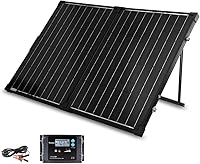
ECO-WORTHY uses two 100W panels at 35.2 x 23.1 x 1.37 in each, weighing 31.6 lb as a kit. Two smaller panels fit roof or rack spots where one large panel cannot, and the kit includes Z brackets, a 30A controller and cables.
Renogy's portable panel weighs 13.89 lb and folds to 23.72 x 22.99 x 1.97 in, with kickstands at 40, 50 and 60 degrees and USB C PD 45W plus dual USB A ports. Renogy's suitcase weighs 28.46 lb and includes a Voyager 20A PWM controller, alligator clip cable with 15A fuse and adjustable kickstand.
Our best 200 watt portable solar panel roundup compares more foldable options by weight and output.
What specs tell you real daily output from a 200W kit?
Panel watts are a peak rating under lab conditions, not a promise for your yard or campsite. Efficiency, cell type, size and sun hours shape the energy you get each day.
Renogy states 25 percent efficiency with 16BB N type cells for both 200W portable options, with strong power in limited or cloudy conditions. ECO-WORTHY states up to 21.5 percent higher efficiency for its monocrystalline panels, with IP65 junction boxes and wind and snow load ratings for fixed use.
Daily energy compares better. ECO-WORTHY states 800Wh per day under 4 hours of full sunshine, while Renogy's suitcase states up to 1000Wh per day with 5 hours of sunlight.
Those sun hours differ, so do not rank one higher without matching conditions. Voltage and current also help match parts, at 27.4 volts and 11A for ECO-WORTHY, 21.6 volts and 11.3A for Renogy's portable panel, and 21.47 volts and 11.89A for the suitcase.
How do you size cables, fuses and connectors for safe use?
Cables and fuses protect the system and cut losses. Use thick enough cables for the current and distance, and fuse the battery line close to the battery.
Current rises as voltage falls. A 200W array at 12V can push about 16A in ideal conditions, so longer runs need thicker wire to limit voltage drop.
ECO-WORTHY includes 16.4ft 10 AWG solar cables and tray cable.
MC4 connectors are standard on many panels. Renogy's portable panel and suitcase use MC4 output only, with a 4 in 1 adapter sold separately.
Renogy's suitcase includes an alligator clip cable with a 15A fuse, and battery fuses should sit near the positive terminal with polarity kept clear at every join. IP65 rated junction boxes support outdoor use, though they do not replace good routing, strain relief and dry storage for connectors.
Which 200W options fit an inverter and battery system best?
Each option below solves a different part of the buying problem. Match the panel style to your placement first, then add the inverter and battery that fit your loads.
Fixed kit option
ECO-WORTHY suits buyers who want a fixed or semi permanent kit. Two 100W panels can spread across a roof, rack or shed wall.
The kit connects in series for 24V or parallel for 12V. Pre drilled backs and plug and play cables speed install.
The aluminum frame and junction box suit outdoor exposure.
The trade off is weight and install work. At 31.6 lb per kit and 35.2 x 23.1 in per panel, it is not a backpack panel.
You will want mounting brackets, sealant for roof holes and a plan for cable entry. Fixed panels also cannot chase the sun when trees shade one spot.
Our best 200 watt solar panel kit roundup lists more fixed and portable kits side by side.
Lightweight portable option
This Renogy panel suits campers and backup buyers who move often. It folds to backpack size and weighs under 14 lb.
Direct USB C PD 45W and dual USB A ports charge phones, tablets and laptops without a power station. MC4 output links to many power stations that meet its voltage and current needs.
The trade off is no included charge controller for direct battery charging. You will need a controller, a power station with built in solar input or a suitable adapter.
It also lacks the suitcase kit's alligator clip cable and pre installed controller. For a pure power station setup, that gap may not matter.
Suitcase kit option
This Renogy suitcase suits buyers who want a ready to use portable kit. The 20A controller is pre installed, so you can link to a 12V battery system with the included clip cable.
MC4 output also fits many power stations with matching inputs. The adjustable aluminum kickstand helps you aim the panel through the day.
The trade off is size and weight. At 28.46 lb, it is heavier than the 13.89 lb Renogy portable panel.
It uses MC4 output only, so a 4 in 1 adapter is sold separately for some stations. Choose it for complete portable battery charging, or choose the lighter panel for travel and direct device charging.
Rule: pick the panel style for your placement, then match controller, battery and inverter voltage to that choice.
What mistakes waste money on a 200W kit with an inverter?
The most common mistake is buying the inverter before listing your loads. A costly inverter that cannot start your fridge, or a kit with no room for a battery, wastes more money than a slightly larger panel.
Another mistake is ignoring solar input limits on power stations. A station may cap solar watts, voltage or current below what a 200W panel can send in bright sun, so check the manual and input label before pairing parts.
Buyers also skip the controller for direct battery charging, which risks overcharge and short battery life. Pre installed controllers, as on Renogy's suitcase, cut wiring errors for new owners.
MC4 only panels need an adapter for some stations, and Renogy sells its 4 in 1 adapter separately for both portable options. Daily use of a kettle, microwave or space heater can also drain a small bank faster than a 200W panel replaces it.
Our what is emergency lighting inverter guide explains how inverters handle essential circuits during outages.
How do you set up and care for a 200W solar kit with inverter?
Clean setup starts with placement, angle and safe wiring. Set the panel in full sun, aim it toward the equator, and connect power only after you confirm voltage, polarity and fuse placement.
Place fixed panels where shade stays away through most of the day, facing toward the equator for best yearly output in most US locations. Portable panels can move with the sun, which is a key benefit on camping trips.
For portable use, open the panel fully and set kickstands on firm ground. Renogy's portable panel offers 40, 50 and 60 degree angles, and the suitcase has an adjustable aluminum kickstand.
A panel that tips in wind can crack glass or pull cables loose.
Wire in a safe order. Connect the battery first when the system calls for it, then link the panel, then turn on the inverter last.
Wipe glass with a soft cloth and water when dust builds, and check mounts, brackets and cable clips after storms. Inspect MC4 seals and alligator clips for heat damage or corrosion.
Our best 200 watt solar panel with battery roundup helps if you want panel and storage options in one shortlist.
What should you check on the About this guide line before you buy?
The About this guide line at the end of every post names the topic and reminds you this page is research based. Use it as a prompt to check specs once more before you order, especially voltage, current and connector type.
We compared maker stated specs for weight, size, efficiency, controller rating and included parts. We did not test these panels in the field.
Owner reports and maker claims help, but your sun hours, shade and load list decide real output.
Before you buy, write down five facts. Your battery voltage.
Your inverter continuous and surge watts. Your controller type and amp rating.
Your power station solar input limits if you use one. Your connector type and adapter needs.
If any fact is missing, pause and find it in the manual or on the maker's site pages.
Our best 200 watt portable solar panel kit roundup is the best next read if you lean toward foldable camping power.
Which 200W solar kit with inverter should you choose first?
Pick ECO-WORTHY if you want fixed panels for an RV, camper or cabin and plan to charge a 12V or 24V battery bank. Pick Renogy's 13.89 lb portable panel if you want light travel power for a power station and direct device charging.
Pick Renogy's suitcase if you want a foldable kit with a pre installed 20A controller and alligator clip cable for 12V battery use.
Match the inverter to your largest load plus surge, then size the battery for one full night of the loads you care about most. A 200 watt solar panel kit with inverter can cover lights, phones, laptops and small fans with care.
It will struggle with daily high watt cooking unless you add panel watts and battery capacity.
Start with your load list and battery voltage. That list will tell you the right inverter size faster than any panel spec.
Then choose the panel style that fits your roof, campsite or storage space.
Frequently asked questions
Can a 200W panel run an inverter directly without a battery?
A 200W panel can feed some inverters in bright sun, but output drops with clouds and at night. A battery smooths that supply, stores daytime energy and lets the inverter start loads when the sun is away.
Most home and RV setups use a battery for steady power.
What inverter size fits a 200 watt solar panel kit with inverter?
Size the inverter by your loads, not by the panel alone. Add the watts for devices you run at once, then leave headroom for startup surges.
A 200W panel refills a battery over hours, while the inverter may deliver much higher watts for short periods from that stored energy.
Do I need a charge controller with a 200W solar kit?
Yes, if you charge a battery from the panel. The controller limits voltage and current so the battery does not overcharge.
Some power stations have a built-in controller, so check whether your station or inverter already provides one before you add a separate unit.
What battery size pairs well with 200 watts of solar?
A 100Ah 12V battery stores about 1,200Wh in theory, though usable energy is lower. That size can cover lights, phones and small appliances for an evening in many setups.
Larger loads or longer nights call for more stored capacity or a bigger panel array.
Can a portable 200W panel charge a power station and a battery at once?
Most setups charge one target at a time for clean control and clear readings. Splitting output can lower efficiency and confuse charge settings.
Pick the device that needs power first, then switch when it is full or when the sun is strongest.