Which Type of Solar Panel Is Best for Your Needs?
The best type of solar panel is the one that matches your space, weight limit and power station. Pick a high-efficiency monocrystalline portable panel for most camping and RV use, and choose foldable construction when you need to carry it easily.
On this page (12 sections)
- What type of solar panel is best for most portable users?
- How does cell efficiency change the answer?
- What is the best solar panel type for camping?
- What is the best type of solar panel for RV and off-grid use?
- When should you choose a flexible solar panel type?
- When is a rigid panel still the better type?
- What is the best solar panel type for low light and cloudy days?
- How do bifacial panels fit into the choice?
- How do waterproof ratings and materials affect durability?
- How should you choose among the three examples here?
- How do you set up and care for any panel type?
- Final choice: what type of solar panel is best for you?
The best type of solar panel is the high-efficiency monocrystalline type that fits your carrying limit. For portable power, that often means a foldable monocrystalline panel with a kickstand and the right cable for your power station.
This guide covers what type of solar panel is best by use, not by brand hype. We compared specs, folded size, weight, efficiency, connectors and included parts for three portable examples.
You can use the same checks on any panel.
Start with your load. A phone and camera need less power than a power station running a fridge, laptop and lights.
Match the panel wattage to the battery or station you plan to charge.
What type of solar panel is best for most portable users?
A foldable high-efficiency monocrystalline panel is the best starting type for most portable users. It balances output, weight and storage better than a large rigid panel.
Monocrystalline cells use a single crystal structure. That design usually supports higher conversion efficiency than older polycrystalline designs.
Higher efficiency means more power from the same sunlight and less panel area for the same wattage.
Foldable construction adds portability without changing the cell type. You can carry the panel in a car, store it in a closet and set it up in minutes.
An adjustable kickstand lets you tilt it toward the sun during the day.
If you want a plain-language overview first, read our guide on what is a portable solar panel. It explains how portable panels differ from roof panels.
Rule: choose monocrystalline foldable for general camping, RV and backup use. Choose another type only when a specific surface, weight limit or light condition points that way.
How does cell efficiency change the answer?
Efficiency tells you how much sunlight a panel can convert into electricity. A 25% efficient panel converts more of the same light than a 20% efficient panel of equal size.
That difference matters most in limited space. A smaller panel can still deliver useful power when it has higher efficiency.
It also helps on cloudy days, though output will still drop when sunlight is weak.
The Renogy 100W Portable Solar Panel uses N-Type cells with up to 25% conversion efficiency. Renogy says it can produce up to 500Wh per day with 5 hours of sunlight.
Your result will vary with sun angle, shade, temperature and your battery or station.
The Renogy 200W Portable Solar Panel for Power also rates its 16BB N-Type cells at 25% efficiency. It doubles the wattage while folding to a compact size.
That higher output suits larger power stations and faster top-ups.
Rule: pick the highest efficiency you can afford within your size and weight limit. Do not chase efficiency if the panel is too heavy to carry or too large to store.
What is the best solar panel type for camping?
Foldable panels with kickstands are best for camping because you can move them as the sun shifts. A campsite rarely gives you a fixed roof angle, so a portable stand matters.
Look for a panel that folds flat and has handles or a magnetic closure. The Renogy 200W model folds to 23.72 x 22.99 x 1.97 in and weighs 13.89 lb.
Renogy describes it as backpack size for SUVs, RVs and campsites.
The ZOUPW 100W Portable Solar Panel for Power folds to 24.13 x 21.06 x 1.77 in and weighs 9.48 lb. Its lighter weight helps when you carry gear over a short walk.
It also has two adjustable kickstands for aiming.
For camping, check the cable length too. A longer cable lets the panel sit in sun while your station stays in shade or under a canopy.
The ZOUPW kit includes a 10ft solar connector cable.
Rule: choose the lightest panel that still meets your daily watt-hour need. A panel you leave in the car cannot charge anything.
What is the best type of solar panel for RV and off-grid use?
For RV and off-grid use, a portable foldable panel works well when you park in partial shade. You can place the panel in open sun while the rig stays under trees.
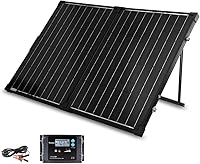
A 12V kit with a charge controller suits direct battery charging. The Renogy 100W kit includes a pre-installed waterproof 20A PWM charge controller and alligator clip cables.
Renogy lists compatibility with 12V portable power stations, Gel, AGM, Flooded and Lithium batteries.
For a larger power station, the Renogy 200W panel uses MC4 output. Renogy lists compatibility with Jackery Explorer 1000 v2, EcoFlow DELTA 3, DELTA 3 Max, RIVER 3 Max and Anker SOLIX S2000.
It notes the 4-in-1 adapter is sold separately, so check your cable needs.
If you pair solar with backup storage, read What Is a Solar UPS? The Essential Guide.
It helps you match panel input to a system that powers loads during an outage.
Rule: match the panel voltage and connector to your battery or station before you buy. A strong panel with the wrong plug adds cost and delay.
When should you choose a flexible solar panel type?
Flexible panels fit surfaces where rigid glass panels cannot bend or where weight is tightly limited. They can suit some boat decks, RV roofs and curved covers.
Flexible does not always mean portable. Some flexible panels are made for permanent mounting and may not fold for storage.
Check the bend limit, mounting method and connector type before choosing this type.
If you are comparing boat use, look at the best marine flexible solar panels. Salt, vibration and deck traffic change the choice in ways a campsite panel does not.
For RV roofs, check whether the panel needs screws, adhesive or a bracket. A flexible panel still needs full sun, so roof shade from vents or a vent cover can reduce output.
Our EcoFlow flexible solar panel comparison explains how flexible and rigid options compare for common portable power setups. Use it to weigh mounting ease against output and storage.
Rule: choose flexible only when the surface truly needs a low-profile, bendable panel. For ground use, a foldable rigid-glass panel is often simpler to aim and store.
When is a rigid panel still the better type?
Rigid panels still make sense for fixed roof or ground mounts with a flat surface. They can be screwed down, cleaned easily and left in place for a season.
A rigid panel is a poor choice if you need to carry it between sites. Weight and breakage risk rise, and storage takes more room.
A suitcase-style foldable panel solves most of those problems.
Rigid construction also helps when you want a large wattage from one fixed array. Portable suitcases usually stop at 100W to 200W for easy handling.
A roof array can go higher when space allows.
For sailboats, the trade-off shifts again. Read best solar panels for sailboats to see how deck space, shade from the boom and salt exposure affect the choice.
Rule: choose rigid for a fixed flat mount, and portable foldable for changing sites. Do not pay for fixed-mount hardware if you plan to move the panel often.
What is the best solar panel type for low light and cloudy days?
High-efficiency monocrystalline panels are the best type for low light among common portable options. They make better use of diffuse light, but they do not create full power from a dark sky.
Angle still matters on cloudy days. A kickstand lets you tilt the panel toward the brightest part of the sky.
The Renogy 100W panel has an adjustable aluminum alloy kickstand for that purpose.
The ZOUPW panel rates its Grade A+ monocrystalline cells at 23.5% efficiency. ZOUPW says the two kickstands can angle the panel at 45 degrees.
That angle can help capture more light than a flat panel on the ground.
If low light is your main concern, read our best low light solar panels guide. It covers what to expect when output drops and how to size storage for dull days.
Rule: choose high-efficiency monocrystalline for cloudy use, then size your battery for reduced output. No portable panel type removes the need for sun.
How do bifacial panels fit into the choice?
Bifacial panels collect light on the front and rear sides. The rear side can pick up reflected light from snow, sand, a white roof or a light-colored ground surface.
That extra rear-side input can raise daily output when the ground reflects light well. It adds less on dark grass, soil or asphalt.
Placement height and tilt also affect how much light reaches the back.
Bifacial portable panels can suit open ground where light bounces back. They are less useful if the panel lies flat on a dark surface or sits close to a wall.
Our best bifacial portable solar panel guide compares models for this rear-side gain. It also covers weight and setup trade-offs.
Rule: choose bifacial when you expect strong reflected light and can raise or tilt the panel. Skip it when the rear side will face a dark surface.
How do waterproof ratings and materials affect durability?
Weather protection matters as much as wattage for outdoor use. Rain, dust, sand and sudden splashes can damage weak junction boxes, cables and connectors.
Check the panel surface and the whole cable path, not just the panel face. The Renogy 100W panel uses low-iron tempered glass and an anti-corrosion aluminum frame.
Renogy rates its junction box as IP65.
The ZOUPW panel uses an ETFE coating and carries an IP67 waterproof rating for the panel body. ZOUPW notes the USB hub and connection cables are not fully waterproof.
Keep those parts dry even when the panel can handle rain.
For a deeper look at ratings and care, read are solar panels waterproof. It explains what IP ratings do and do not cover.
Rule: choose the panel whose seals and cables suit your wettest expected use. Dry the connectors after rain and store cables out of standing water.
How should you choose among the three examples here?
Use wattage, weight and connector fit to narrow this group. The Renogy 100W kit suits 12V battery charging because the 20A controller is included.
It weighs 17.4 lb and folds to a suitcase size.
The Renogy 200W panel suits larger power stations when you need faster charging. It weighs 13.89 lb, folds to 23.72 x 22.99 x 1.97 in and adds USB-C PD 45W plus dual USB-A outputs.
Four kickstands offer 40, 50 and 60 degree angles.
The ZOUPW 100W panel suits lighter loads and direct device charging. It weighs 9.48 lb and includes a 5-in-1 cable with DC8020, XT60, Anderson, DC7909 and DC5521 connectors.
It also has USB-C PD and dual USB-A ports.
Check your station input limit before you assume full panel output. ZOUPW notes a station with a 60W input limit will draw only 60W from a 100W panel.
The same principle applies to the larger Renogy panel.
Rule: choose 100W for light loads and easy carrying, and 200W for larger stations and faster top-ups. Confirm the cable and input limits first.
How do you set up and care for any panel type?
Set the panel where it gets direct sun for the most hours. Turn it through the day so the face stays square to the sun.
Move it before shade from trees, tents or buildings reaches it.
Use the kickstand angles to aim the panel. Low morning and late afternoon sun needs a steeper tilt.
Midday sun needs a shallower tilt. Small checks every hour can lift daily output.
Clean the surface with a soft cloth and water. Remove dust, pollen and bird droppings before they cut light.
Avoid harsh cleaners that can scratch glass or coatings.
Store the panel folded and dry when you are not using it. Wipe connectors dry, coil cables without sharp bends and keep the panel away from heat and heavy loads in the car.
Rule: aim, clean and reposition the panel through the day. Good placement often beats a small wattage upgrade.
Final choice: what type of solar panel is best for you?
The best solar panel type is the one that fits your site, weight limit and station input. Start with a foldable high-efficiency monocrystalline panel for general portable use when you need to move it between sites.
Pick the Renogy 100W kit when you charge 12V batteries and want the controller included. It has a pre-installed waterproof 20A PWM charge controller and alligator clip cables for 12V portable power stations, Gel, AGM, Flooded and Lithium batteries.
That setup suits direct battery charging without sourcing separate parts.
Pick the Renogy 200W panel when you need more wattage for a larger station. It weighs 13.89 lb, folds to 23.72 x 22.99 x 1.97 in and adds USB-C PD 45W plus dual USB-A outputs for phones, tablets, laptops, GPS and cameras.
Its four kickstands offer 40, 50 and 60 degree angles for aiming on RVs, tents or windy campsites.
Pick the ZOUPW 100W panel when light weight and broad cable fit matter most. It weighs 9.48 lb, folds to 24.13 x 21.06 x 1.77 in and includes a 5-in-1 cable with DC8020, XT60, Anderson, DC7909 and DC5521 connectors.
That range suits many power stations and generic lithium batteries without extra adapters.
Our score weighs specs, features and buyer feedback against what you are shopping for. Use the spec checks above to confirm fit for your station before you order.
Check your station input limit before you assume full panel output. A station with a 60W input limit will draw only 60W from a 100W panel.
The same principle applies to the larger Renogy panel, so match voltage and wattage first.
For the Renogy 200W panel, confirm the MC4 output and cable plan. Renogy lists compatibility with Jackery Explorer 1000 v2, EcoFlow DELTA 3, DELTA 3 Max, RIVER 3 Max and Anker SOLIX S2000.
It notes the 4-in-1 adapter is sold separately, so plan for that need before a trip.
For camping, weight and folded size often decide the choice. The ZOUPW panel is the lightest of the three and suits short carries to a tent or fishing spot.
The Renogy 200W panel is heavier in use but gives faster top-ups for a larger station.
For RV and off-grid use, aim and placement matter as much as wattage. Set the panel in open sun while the rig stays in partial shade.
Reposition it as the sun moves and keep trees, tents and roof vents from casting shade on the face.
Care is simple when you build it into the day. Clean the surface with a soft cloth and water to remove dust and pollen.
Store the panel folded and dry, coil the cables without sharp bends and wipe connectors dry after rain.
Choose 100W for light loads and easy carrying, and 200W for larger stations and faster top-ups. Confirm the cable and input limits first, then the panel type will follow from your actual use.
Frequently asked questions
What type of solar panel is best for portable use?
A high-efficiency monocrystalline foldable panel is best for most portable use because it gives strong output for its size and folds for storage. Check the wattage, cell efficiency, folded dimensions and connector match for your power station.
Choose 100W for light loads and 200W when you need faster charging.
Are flexible solar panels better than rigid panels?
Flexible panels can suit curved or weight-limited surfaces, while rigid panels often give strong output and simple mounting. For portable use, a foldable panel may be easier to aim at the sun and store.
Compare surface material, weight, connector type and shade tolerance before you choose.
What is the best solar panel type for cloudy days?
High-efficiency monocrystalline panels are often chosen for cloudy conditions because they convert available light more effectively. No portable panel reaches full output in low light, so angle and placement still matter.
Pair the panel with a suitably sized power station or battery for backup use.
How do I match a portable solar panel to a power station?
Check the power station input voltage and wattage limits, then match the panel output and cable connector. Confirm whether a charge controller is needed and whether adapters are included.
Keep the panel unshaded, aim it at the sun and reposition it as the sun moves.