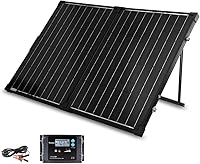
Best 200 Watt Solar Panels: Top 9 Picks (November 2026)
The best 200 watt solar panels include the Renogy Solar Panels 200 Watt N-Type for compact fixed installs, the SOKIOVOLA N-Type 16BB 200W Portable Solar Panel for portable power stations, and the JJN Bifacial 200 Watt Solar Panel for a bifacial fixed setup.
On this page (4 sections)
The Renogy Solar Panels 200 Watt N-Type is the best 200 watt solar panel for a compact fixed installation, while the SOKIOVOLA is a strong portable choice. Pick a rigid panel for a planned mount, a foldable one for travel, or a bifacial design when reflected light can reach its rear side.
A 200W rating doesn't mean the panel will deliver 200 watts in every condition. Sun angle, clouds, temperature, shade, and the power station or charge controller you connect all affect the result.
If you're new to portable solar, start with what a portable solar panel is and how to choose one. We compared the listed features and dimensions to match each panel to a practical setup.
Our score weighs specs, features, and buyer feedback against what you're shopping for.
Our picks at a glance
-
1
 Best for compact fixed installs
Renogy Solar Panels 200 Watt N-Type
9.7/10 our score
See it on Amazon -
2
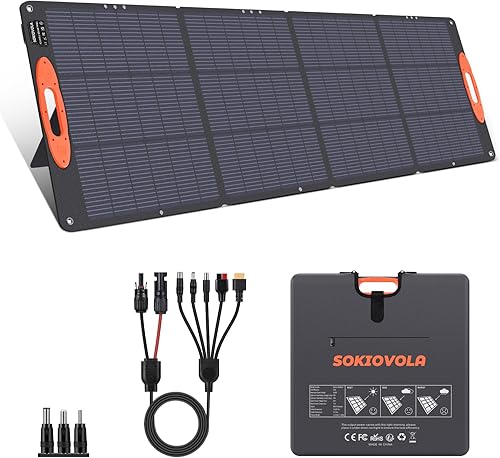 Best for portable power stations
SOKIOVOLA N-Type 16BB 200W Portable Solar Panel
9.4/10 our score
See it on Amazon -
3

- 4
 Check it
GRECELL 200W Portable Solar Panel for Power
Best for adjustable ground setup - 5
 Check it
Rvpozwer 200 Watt Solar Panel 18BB
Best for a 12V fixed system - 6
 Check it
Renogy ShadowFlux Solar Panel 200 Watt
Best for locations with partial shade - 7
 Check it
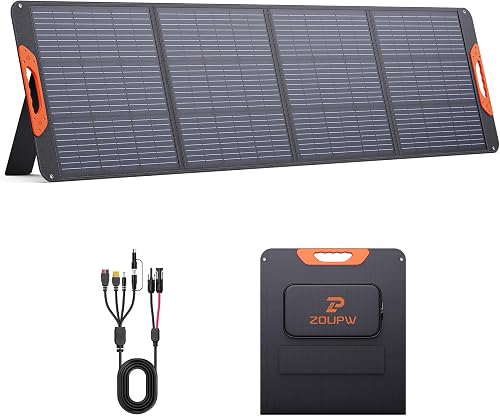
ZOUPW 200W Portable Solar Panel for Power
Best for direct device charging - 8
 Best for a high-efficiency rigid panelCheck it
- 9
 Best for reflected-light potentialCheck it
Which 200 watt solar panels suit each setup?
The right panel depends on where it will sit and what it needs to charge. These picks include fixed framed panels, foldable models, and bifacial options.
Best 200 watt solar panels for fixed installation
Renogy Solar Panels 200 Watt N-Type: Best for compact fixed installs
- 200W N-Type panel
- 25% stated cell efficiency
- 24V panel for 12V and 24V battery systems
- 49.7 x 30.1 x 1.2 in
A compact framed panel for buyers planning a fixed setup on a Class B van, RV, boat, or other off-grid location. Renogy says its N-Type cells have 25% efficiency.
Pros
- Smaller and lighter than Renogy's previous models
- Compatible with 12V and 24V battery systems
- Renogy provides a 10-year output and workmanship commitment
Cons
- Rigid panel needs a planned mounting location
- Controller must meet the panel's voltage requirements
Renogy's N-Type panel fits buyers who need a fixed panel but have limited roof space. The brand says this model is 7.5% smaller and 11.7% lighter than its previous models, while retaining a 200W rating.
It measures 49.7 x 30.1 x 1.2 in and weighs 23.4 lb. Renogy describes it as a 24V panel that can work with 12V and 24V battery systems, including lithium, AGM, and deep-cycle batteries.
Check controller voltage before wiring: Renogy recommends at least 40V of maximum PV input voltage for one panel in a single or parallel connection. The panel's rigid frame and glass surface make this a planned-mount choice rather than one you fold away after use.
Renogy states a 10-year output and materials and workmanship commitment, plus a 25-year guarantee of 80% output. Choose it when roof space and a fixed installation matter most.
JJN Bifacial 200 Watt Solar Panel: Best for a bifacial fixed setup
- Rigid bifacial 200W panel
- 25% stated efficiency
- Pre-drilled mounting holes
- IP67 connectors and IP65 junction box
This framed panel can receive light on both sides, so it may suit an installation where reflected light can reach the rear. Its mounting holes support a fixed setup.
Pros
- Bifacial design
- Pre-drilled mounting holes
- JJN provides a 10-year workmanship warranty
Cons
- Rear-side gain depends on the installation
- Rigid format is less suited to portable use
JJN's bifacial panel suits a fixed mount where light can reach both sides. Its transparent backsheet is designed to let the rear side generate power from reflected light, though the actual gain depends on the surface and installation.
The rigid panel weighs 23.2 lb and has pre-drilled holes for mounting. JJN states 25% efficiency and gives wind and snow load ratings of 2,400 Pa and 5,400 Pa, respectively.
The connectors carry an IP67 rating and the junction box an IP65 rating. These ratings describe specific components, so protect connections as directed during installation and don't assume the whole setup can be submerged.
JJN provides a 10-year workmanship warranty and says the panel will retain over 88.9% output at 30 years. Choose it if you can mount it with space behind the panel for reflected light to reach the rear.
Rvpozwer 200 Watt Solar Panel 18BB: Best for a 12V fixed system
- Rigid 200W N-Type panel
- 18BB cell design
- Pre-drilled mounting holes
- IP68 rating stated
A rigid panel described for 12V systems, with a framed design and mounting holes for RVs, boats, rooftops, and off-grid setups. Plan around its roughly 52.8 x 26.4 in dimensions.
Pros
- 18BB N-Type cell design
- Mounting holes for bracket installation
- Rvpozwer offers a 10-year warranty
Cons
- Needs a fixed mounting space
- The maker limits panel connections to 3 in series or parallel
Rvpozwer's 18BB panel is described for 12V systems and offers a rigid format for RV roofs, boats, and off-grid setups. Its dimensions are about 52.8 x 26.4 x 1.2 in, so measure your mounting area before choosing it.
The panel weighs 19.2 lb and has pre-drilled holes for brackets. Rvpozwer states an IP68 rating, 25% efficiency, and resistance to 2,400 Pa wind and 5,400 Pa snow loads.
The maker cautions against connecting more than three panels in series or parallel. Plan any expansion around the limits of the panel, wiring, charge controller, and battery system, and follow the manufacturer's instructions.
Rvpozwer offers a 10-year warranty. This is a practical fit when you want a fixed 12V panel with mounting holes and an 18BB cell design.
Renogy ShadowFlux Solar Panel 200 Watt: Best for locations with partial shade
- 200W N-Type panel
- ShadowFlux anti-shading technology
- 25% stated efficiency
- IP67 or higher rating
Renogy's ShadowFlux design is intended to reduce output losses from common partial shade. Its rigid size suits a planned RV, marine, or rooftop installation.
Pros
- Designed for partial-shade conditions
- N-Type 16BB cells
- Compatible with 12V and 24V battery systems
Cons
- Still works best with more than half the panel in direct sun
- Renogy recommends an MPPT controller
Renogy's ShadowFlux model is designed for sites where partial shade from trees, debris, or nearby structures may cross the panel. The brand says its technology reduces power loss in common shading patterns, but direct, unshaded sunlight remains the better condition.
This rigid panel measures 49.69 x 30.08 x 1.18 in and weighs 23.8 lb. It has N-Type 16BB cells and a stated 25% efficiency, with a maximum voltage of 36.5V.
Renogy recommends an MPPT charge controller, with a maximum input voltage of at least 50V and charging current above 10A. The panel is compatible with 12V and 24V battery systems, but the controller still needs to match your wiring and battery setup.
Choose ShadowFlux if partial shade is a concern and you can use the recommended controller. It isn't a reason to ignore placement: Renogy advises keeping over half the panel in direct sun for best results.
ECOBOSS 200 Watt Solar Panels: Best for a high-efficiency rigid panel
- Rigid 200W N-Type panel
- Up to 25.6% stated efficiency
- 16BB cell design
- IP68 rating stated
ECOBOSS states up to 25.6% conversion efficiency for this framed panel. Pre-drilled holes and MC4 connectors support fixed installations in RVs, boats, and off-grid systems.
Pros
- Highest stated efficiency in this group
- Pre-drilled holes and MC4 connectors
- Supports series or parallel connections for larger systems
Cons
- Rigid frame requires a suitable mounting area
- Only many reviews are reported in the provided source, so feedback is limited
ECOBOSS offers the highest stated cell efficiency among these picks, at up to 25.6%. The framed panel measures 30.31 x 52.76 x 1.18 in and weighs 22 lb, so check that your installation area can accommodate its shape.
It uses N-Type monocrystalline cells with 16 busbars. ECOBOSS says bypass diodes reduce power loss from partial shade, and the panel has pre-drilled mounting holes and MC4 connectors.
The maker states an IP68 rating and resistance to 2,400 Pa wind and 5,400 Pa snow loads. It describes the panel as suitable for charging 12V batteries and says multiple panels can be connected in series or parallel for 24V or 48V systems.
Choose ECOBOSS when a rigid panel's stated efficiency and standard MC4 connections match your setup. Its reported buyer feedback is limited, so give extra weight to the features and installation requirements you can confirm.
HQST 200W Solar Panel: Best for reflected-light potential
- Rigid bifacial 200W panel
- Up to 25.4% stated efficiency
- 16BB N-Type cells
- IP68 rating stated
A framed bifacial panel that can capture reflected light from behind when the mounting surface and spacing allow it. HQST says the amount of extra energy depends on reflectivity, height, and tilt.
Pros
- Bifacial design
- Compact dimensions for a framed panel
- HQST states a 30-year service life
Cons
- Bifacial gain depends on installation conditions
- Rigid panel is not a foldable travel option
HQST's bifacial panel is another fixed-mount choice for a location where reflected light can reach the rear. HQST says it can produce up to 30% more energy in suitable conditions, with actual gain depending on surface reflectivity, panel height, and tilt.
The panel measures 30.1 x 47.2 x 1.2 in and weighs 21.58 lb. It uses N-Type 16BB cells, with stated efficiency up to 25.4%, and has an IP68 rating.
HQST describes it as 13% smaller and 13.3% lighter than standard PERC cell panels. Its fixed frame needs a suitable mount, and you should leave room behind the panel if you want reflected light to reach the back.
Choose HQST when a compact rigid panel and bifacial design fit your roof or off-grid setup. Its rear-side benefit depends on installation conditions rather than the wattage printed on the panel.
Best 200 watt solar panels for portable power stations
SOKIOVOLA N-Type 16BB 200W Portable Solar Panel: Best for portable power stations
- Foldable 200W panel
- 25% stated efficiency
- 21 x 23 in folded size
- 5-in-1 adapter cable
A folding panel with a multi-connector cable for portable power stations. Check your station's solar input limit and connector before choosing it.
Pros
- Folds for storage and transport
- Includes connectors for several power station input types
- IP68 rating stated for the panel
Cons
- May feel heavy for long hikes
- Power station input limits can restrict charging
SOKIOVOLA is a foldable panel with a cable that adapts to several common power station inputs. It folds to 21 x 23 in and weighs 16.3 lb, so it's easier to pack than a rigid panel, though the weight may be noticeable on a long walk.
The panel has a magnetic handle and four holes for attaching it to an RV. SOKIOVOLA states up to 25% conversion efficiency and an IP68 rating for the panel.
Its included 5-in-1 cable has XT60, DC5521, DC7909, DC8020, and Anderson connectors. Before connecting it, confirm your power station accepts the panel's voltage and won't limit input below what you expect.
Choose it for campsite or RV charging when you can set the panel toward the sun.
For more options in this format, see our best portable 200W solar panels. If you need a preconfigured set of components, compare the best 200 watt solar panel kits.
GRECELL 200W Portable Solar Panel for Power: Best for adjustable ground setup
- Foldable 200W panel
- Four adjustable kickstands
- 23.5% stated conversion efficiency
- Four-in-one cable
Four built-in kickstands let you set the panel on the ground and adjust its angle. The included cable connects to several types of portable power station.
Pros
- Four adjustable kickstands
- Folds to about one-quarter of its full size
- Grommets allow other mounting setups
Cons
- Not designed to be submerged or left under rain
- Charge controller and battery clips for 12V batteries are not included
GRECELL's four adjustable kickstands make it easy to prop the panel on the ground and change its angle. The foldable panel weighs 17.94 lb and folds to 25.82 x 21.1 x 2.95 in.
It includes a four-in-one cable for several power station connections and has grommets for other mounting setups, such as hanging from an RV. GRECELL states 23.5% conversion efficiency and an IP65 rating for splash protection.
The maker says not to place the panel under rain or soak it in water. For charging a 12V battery, GRECELL says a charge controller and alligator clip cable are needed, and those are not included.
Choose it for a portable setup where kickstands and quick angle adjustments are useful.
ZOUPW 200W Portable Solar Panel for Power: Best for direct device charging
- Foldable 200W panel
- Built-in USB-A and USB-C ports
- Four adjustable kickstands
- 5-in-1 cable
The built-in USB-A and USB-C ports allow direct charging of compatible devices, while its 5-in-1 cable connects to many portable power stations. Keep the junction box and connected devices dry.
Pros
- USB-A and USB-C charging ports
- Includes a 5-in-1 cable
- Four kickstands help angle the panel
Cons
- Junction box is water-resistant, not submersible
- Output drops in clouds or shade
ZOUPW combines a foldable panel and four kickstands with USB-A and USB-C ports in its junction box. The maker says the USB-C port supports up to 60W, while USB-A supports QC3.0, so check your device's charging needs.
It weighs 19 lb and folds to 25 x 21.06 x 1.97 in. The included 5-in-1 cable has XT60, Anderson, DC7909, DC8020, and DC5521 connectors for portable power stations.
ZOUPW states an IP67 rating for the panel body, but says the junction box is water-resistant and not submersible. Keep the junction box and connected devices dry, even when the panel is used outdoors.
Choose it if you want both power station connections and direct USB charging from one foldable panel.
A foldable panel still needs good placement to produce useful power. Our guide on how to use foldable solar panels covers aiming, positioning, and keeping shade off the cells.
How do 200W solar panels compare?
Rigid panels suit permanent mounts, while portable models trade a fixed frame for folding legs or a carrying format. Bifacial designs add a possible rear-side benefit when the installation lets reflected light reach the back.
| Product | Best for | Rated power | Dimensions | Weight | Our score |
|---|---|---|---|---|---|
| Renogy Solar Panels 200 Watt N-Type | compact fixed installs | 200W | 49.7 x 30.1 x 1.2 in | 23.4 lb | 9.7 |
| SOKIOVOLA N-Type 16BB 200W Portable Solar Panel | portable power stations | 200W | 16.3 lb | 9.4 | |
| JJN Bifacial 200 Watt Solar Panel | a bifacial fixed setup | 200W | 23.2 lb | 9.3 | |
| GRECELL 200W Portable Solar Panel for Power | adjustable ground setup | 200W | 17.94 lb | 9.3 | |
| Rvpozwer 200 Watt Solar Panel 18BB | a 12V fixed system | 200W | 19.2 lb | 9.2 | |
| Renogy ShadowFlux Solar Panel 200 Watt | locations with partial shade | 200W | 49.69 x 30.08 x 1.18 in | 23.8 lb | 9.1 |
| ZOUPW 200W Portable Solar Panel for Power | direct device charging | 200W | 19 lb | 9.1 | |
| ECOBOSS 200 Watt Solar Panels | a high-efficiency rigid panel | 200W | 30.31 x 52.76 x 1.18 in | 22 lb | 9.0 |
| HQST 200W Solar Panel | reflected-light potential | 200W | 30.1 x 47.2 x 1.2 in | 21.58 lb | 8.8 |
A 200W rating is a standardized maximum, not a promise of 200 watts in changing weather. Direct sun, panel angle, heat, shadows, cleanliness, and a connected power station's input limit can all reduce the power reaching your battery.
What should you check before choosing a 200W panel?
Start with the installation style, then match the panel's voltage and connectors to your battery or power station. Those checks can rule out a panel before its efficiency figure becomes useful.
Will the panel stay mounted or move between uses?
A rigid framed panel is suited to a fixed roof, boat, or off-grid mount. A foldable panel is made to travel and set out when you need it, though you still have to carry it, position it, and store it between uses.
If you want a framed 12V option, compare our best 200 watt solar panels 12V. For a portable case-style format, see the best 200 watt suitcase solar panel options.
Does the panel match your battery or power station?
Check the panel's voltage, the controller's input range, and the battery system voltage before wiring a fixed installation. For a portable power station, confirm its connector and maximum solar input; a station can limit how much power it accepts even when the panel is rated at 200W.
A panel's voltage description can also differ from its actual output voltage. Renogy, for example, describes its N-Type panel as a 24V panel suited to 12V and 24V battery systems, while giving a separate maximum voltage specification.
Do its weather details fit your use?
Water resistance ratings refer to equipment under stated conditions and don't mean every connector or attached device can get wet. ZOUPW says its panel body is IP67 rated but its junction box isn't submersible, while GRECELL says not to leave its panel under rain.
Read whether solar panels are waterproof before leaving a setup outdoors. Keep connectors, power stations, and other equipment protected as their makers direct.
What does bifacial mean for your installation?
A bifacial panel can receive light from its front and rear, but the rear side needs access to reflected light. The surface below it, the gap behind it, and the tilt angle affect whether the design provides a useful gain.
If the back sits close to an opaque roof, the panel may not get much reflected light. A standard rigid panel can be a simpler choice when there's no space or reflective surface behind the mount.
Which 200 watt solar panel should you choose?
Choose Renogy's N-Type panel for a compact fixed installation, SOKIOVOLA for a foldable panel with a multi-connector cable, or JJN and HQST when a bifacial mount suits the site. If partial shade is the main concern, compare Renogy ShadowFlux with your planned controller and mounting conditions.
Check dimensions, wiring, and power input limits before choosing any 200 watt solar panel. For a larger portable option, see our EcoFlow 400W portable solar panel review.
Our top 3 picks at a glance
-
1
Best for compact fixed installs
Renogy Solar Panels 200 Watt N-Type
9.7/10 our score
See it on Amazon -
2
Best for portable power stations
SOKIOVOLA N-Type 16BB 200W Portable Solar Panel
9.4/10 our score
See it on Amazon -
3
Frequently asked questions
Can a 200W solar panel produce 200 watts all day?
No. A 200W rating describes output under standard test conditions, not a constant daily output.
Sun angle, clouds, heat, shade, and panel cleanliness all affect the power you get.
Aim the panel toward direct sun and keep it clear of obstructions for better output.
Can I use a 200W solar panel with a portable power station?
Often, if the panel's voltage, connector, and output fit the station's solar input limits. Foldable models here include multi-connector cables, but the station may cap how much power it accepts.
Check the input range and maximum wattage in your station's manual before connecting a panel.
Is a rigid or foldable 200W solar panel better?
A rigid panel suits a permanent mount on an RV, boat, or roof. A foldable panel suits temporary use when you want to pack it away between charging sessions.
Compare the panel's weight, folded size, mounting options, and cable connections with how you'll use it.
Can a 200W solar panel charge a 12V battery?
Yes, some 200W panels are designed for 12V battery systems, but you'll generally need a suitable charge controller between the panel and battery. Match the controller to the panel's voltage and the battery system.
Follow the panel and battery makers' connection instructions.