Best 400W Solar Panels: Top 9 Picks (November 2026)
The best 400 watt solar panels include the Renogy Solar Panels 400 Watt N-Type for compact fixed arrays, the HQST 400W Solar Panel for long-term roof plans, and the ZOUPW 450W Portable Solar Panel N-Type 16BB for high-voltage power stations.
On this page (4 sections)
The best 400 watt solar panels for a fixed off-grid system are the Renogy Solar Panels 400 Watt N-Type, a pair of 200W modules designed for 12V and 24V battery systems. For portable charging, choose by your power station's input limits, since panel wattage alone doesn't confirm compatibility.
This roundup compares rigid panels, multi-panel sets and foldable options. A single 400 watt solar panel can simplify mounting, while smaller modules may fit a roof or rack with obstacles.
If you're new to this category, start with what a portable solar panel is and how it works.
Our picks at a glance
-
1

-
2

-
3
 Best for high-voltage power stations
ZOUPW 450W Portable Solar Panel N-Type 16BB
9.4/10 our score
See it on Amazon
- 4
 Check it
ECO-WORTHY 400W Solar Panels N-Type 4pcs
Best for modular 12V and 24V systems - 5
 Best for reflective ground surfacesCheck it
- 6
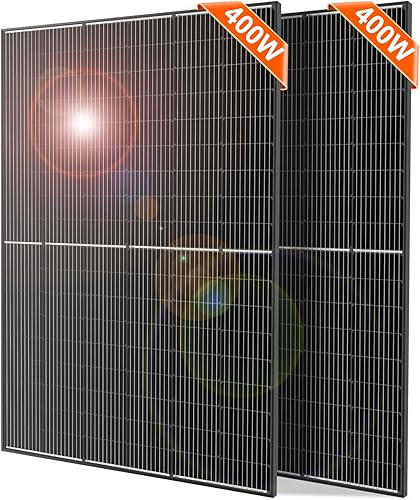 Best for buyers planning an 800W arrayCheck it
- 7
 Check it
TWELSEAVAN 400W Portable Solar Panel for Power
Best for a lighter portable setup - 8
 Check it
Renogy 400W Portable Solar Panel
Best for frequent trips - 9
 Check it
DOKIO 400W 31V Monocrystalline Solar Panel
Best for a single fixed panel
How we chose these 400 watt solar panels
We compared rated output, panel format, voltage information, included connectors and stated use cases. Our score weighs specs, features and buyer feedback against what you're shopping for.
A 400W label describes rated output under standard test conditions. Actual output changes with sunlight, angle, shade, heat, cable setup and the input limit of the controller or power station.
The products here include panels sold as a pair or set, as well as single modules and portable panels. Check the item count and total system rating before buying, especially when the name refers to multiple panels.
| Product | Best for | Rated power | Panel size | System suitability | Our score |
|---|---|---|---|---|---|
| Renogy Solar Panels 400 Watt N-Type | compact fixed arrays | 400W total, 2 x 200W | 49.7 x 30.1 x 1.2 in | 12V and 24V battery systems | 9.7 |
| HQST 400W Solar Panel | long-term roof plans | 400W total, 2 x 200W | 46.3 x 30.1 x 1.2 in each | 9.5 | |
| ZOUPW 450W Portable Solar Panel N-Type 16BB | high-voltage power stations | 450W | 9.4 | ||
| ECO-WORTHY 400W Solar Panels N-Type 4pcs | modular 12V and 24V systems | 400W total, 4 x 100W | 35.63 x 23.03 x 1.18 in each | 12V and 24V battery charging | 9.3 |
| JJN 400W Bifacial Solar Panel | reflective ground surfaces | 400W total, 2 x 200W | 53.7 x 30.3 x 1.18 in | 9.2 | |
| DOKIO 800W Solar Panels | buyers planning an 800W array | 800W total, 2 x 400W | 67.8 x 44.6 x 2.4 in | 8.2 | |
| TWELSEAVAN 400W Portable Solar Panel for Power | a lighter portable setup | 400W | 8.2 | ||
| Renogy 400W Portable Solar Panel | frequent trips | 400W | 8.1 | ||
| DOKIO 400W 31V Monocrystalline Solar Panel | a single fixed panel | 410W maximum listed | 67.8 x 44.6 x 1.2 in | 8.0 |
The best 400W solar panels for fixed and portable systems
The right panel depends on where you will mount it and what equipment it must charge. The fixed models below need suitable mounting and a compatible controller, while portable panels need a matching station input.
Renogy Solar Panels 400 Watt N-Type: Best for compact fixed arrays
- Two 200W N-type panels
- 25% cell efficiency
- 24V system suitability
- 25-year 80% output claim
Two 200W panels make this a flexible choice for a fixed roof or off-grid array. Renogy says the panels have 25% cell efficiency and are suited to 12V and 24V battery systems.
Pros
- Two panels instead of one large module
- 25% cell efficiency
- Renogy states a 25-year 80% output level
Cons
- Requires a charge controller and battery for an off-grid system
- Two panels need suitable mounting space
Renogy's 400W set contains two 200W N-type panels, each measuring 49.7 x 30.1 x 1.2 inches. That split format can help when a roof or rack has more than one clear mounting area.
Renogy gives the panels a 25% cell efficiency figure and says they're compatible with 12V and 24V battery systems, including lithium, AGM and deep-cycle batteries. The system still needs a charge controller to regulate current and a battery to store power.
Renogy also states a 25-year output level of 80%, with degradation of no more than 1% in the first year and 0.4% annually after that. Those are manufacturer claims, not a substitute for checking the conditions and coverage that apply to your installation.
Choose this set for a fixed array where two smaller modules fit better than one large panel. To compare a brand-specific setup, see our Renogy 400 watt solar panel guide.
HQST 400W Solar Panel: Best for long-term roof plans
- Two 200W N-type panels
- Up to 25.4% efficiency
- IP65 protection
- 30-year service life claim
HQST's pair offers two 200W modules with N-type cells and a stated 30-year service life. The company describes them as suitable for vans, trailers, boats, rooftops and off-grid systems.
Pros
- Two smaller modules for a roof layout
- Up to 25.4% stated efficiency
- IP65 waterproof protection
Cons
- Requires separate system components
- Confirm dimensions and wiring before mounting
HQST's set pairs two 200W panels, each measuring 46.3 x 30.1 x 1.2 inches. That footprint is slightly shorter than the Renogy pair listed above, which may matter when measuring a van roof or narrow rack.
The panels use N-type cells and 16 busbars. HQST states up to 25.4% efficiency, IP65 waterproof protection and a 30-year service life with 87.4% output.
HQST describes these panels for vans, trailers, boats, rooftops, tiny houses, sheds and off-grid systems. Its low-light and durability statements come from the manufacturer, so use them as design details rather than a guarantee of output in cloudy weather.
Choose HQST when its stated size and service-life figures match your roof plan. Confirm the included wiring, controller limits and mounting hardware for your system before installation.
ZOUPW 450W Portable Solar Panel N-Type 16BB: Best for high-voltage power stations
- 450W rated output
- 25% efficiency claim
- 45.9V open-circuit voltage
- Foldable with adjustable kickstands
This foldable panel suits large power stations that accept its voltage and connector setup. ZOUPW recommends it for stations with 40–60V input and warns against use with units below 30V input.
Pros
- Higher rated output than 400W
- Includes a 4-in-1 adapter cable
- Four adjustable kickstands
Cons
- Not suitable for low-voltage stations
- Not recommended for fixed installation
ZOUPW's foldable panel is rated at 450W, making it the highest-output portable pick here. It weighs 29.5 lb, has four adjustable kickstands and includes a 4-in-1 adapter cable.
The key fit check is input voltage. ZOUPW gives an open-circuit voltage of 45.9V and recommends the panel for large power stations with 40–60V input, while warning against use with units below 30V input.
ZOUPW says the panel is not recommended for long-term fixed installation or shaded operation. Its portability and connector set suit temporary charging, but its voltage and use guidance make it a poor fit for some smaller stations.
Choose it for a compatible high-voltage station and a portable setup. For a closer look at portable options, compare our best 400 watt portable solar panels.
ECO-WORTHY 400W Solar Panels N-Type 4pcs: Best for modular 12V and 24V systems
- Four 100W panels
- N-type bifacial cells
- 16BB busbar design
- MC4 connectors
Four 100W modules offer more layout choices than one large panel. ECO-WORTHY describes this set as a DIY option for home, garden, RV, boat and agricultural systems.
Pros
- Four separate modules for flexible placement
- Pre-drilled mounting holes
- Waterproof junction box
Cons
- More modules and connections to plan
- The set ships in two boxes
ECO-WORTHY's set includes four 100W panels, each measuring 35.63 x 23.03 x 1.18 inches. Four modules give you more placement options than a single large panel, though they also mean more mounting points and connections to plan.
The panels use N-type bifacial cells with 16 busbars. ECO-WORTHY describes them as suitable for 12V and 24V battery charging and includes 35-inch cables, pre-installed bypass diodes and an IP68-rated junction box.
This set may suit a DIY array spread across a roof, garden structure or boat. Check how the panels will fit together, then size the controller and wiring for the intended array.
Choose ECO-WORTHY when the four-panel layout works for your available space. The set ships across two boxes, so allow for both when planning delivery and installation.
JJN 400W Bifacial Solar Panel: Best for reflective ground surfaces
- Two 200W bifacial modules
- Up to 23% efficiency
- Rear-side light capture
- IP65 junction box
The bifacial design can use light reaching the rear side, which may suit a raised installation above a reflective surface. JJN gives an estimate of up to 30% rear-side gain on white reflective surfaces.
Pros
- Bifacial design
- Two-panel set
- Aluminum frame
Cons
- Rear-side output depends on the surface and installation
- The package contains panels only
JJN's two 200W bifacial panels can capture light reaching both sides. JJN gives an estimate of up to 30% rear-side gain on white reflective surfaces, with lower ranges for grass and sand or gravel.
Each panel measures 53.7 x 30.3 x 1.18 inches. The stated efficiency is up to 23%, and the set has a black aluminum frame, an IP65 junction box and IP67 connectors.
A bifacial panel needs light and space behind it to make use of its rear side. If the panels will sit close to a dark surface, don't assume the maximum rear-side gain will apply.
Our guide to 400 watt bifacial solar panels covers that tradeoff in more detail.
Choose JJN when you can raise the panels over a surface that reflects light. The package contains panels only, so plan for a controller, cables and mounting parts separately.
DOKIO 800W Solar Panels: Best for buyers planning an 800W array
- Two 400W panels
- 31V output
- MC4 adapters
- 9.84 ft leads per panel
This set includes two 400W panels, so it fits buyers who intend to build an 800W array. DOKIO recommends a controller that handles the total current and advises parallel wiring first for 12V systems.
Pros
- Two 400W panels in one set
- Long MC4 leads
- Tempered glass and aluminum frame
Cons
- Large panels need substantial mounting space
- Requires a controller matched to the array
This DOKIO option includes two 400W panels, for 800W total rated power. Each panel is large, measuring 67.8 x 44.6 inches, so measure the roof or ground mount before choosing this set.
DOKIO gives each panel 9.84 ft MC4 leads and says the panels are compatible with 24V banks using PWM or MPPT controllers. It advises using parallel wiring first for 12V systems and says an MPPT controller is recommended for the pair.
The combined system needs a controller and inverter that can handle the array's total current. This isn't a single 400 watt solar panel purchase, so make sure you need 800W before ordering.
Choose the set if you're planning a larger array and have room for both modules. For a single-panel alternative, compare the DOKIO 400W model below.
TWELSEAVAN 400W Portable Solar Panel for Power: Best for a lighter portable setup
- 400W rated output
- 24% efficiency
- 22 lb listed weight
- 46.9V maximum voltage
The foldable panel includes adjustable kickstands and a multi-connector cable for portable power stations. Check the station's voltage limit first because the panel's maximum voltage is 46.9V.
Pros
- Lower listed weight than several portable picks
- Multiple connector options included
- Foldable design
Cons
- Not suitable for stations with a voltage limit below 46.9V
- Keep the control box dry
TWELSEAVAN's folding panel is rated at 400W and weighs about 22 lb. It folds to 26 x 35.5 inches and includes a multi-connector cable with adapters for several common power station connections.
Its maximum voltage is 46.9V. TWELSEAVAN cautions that the panel isn't suitable for small power stations that don't support that voltage, so check the station's maximum input before connecting it.
The four kickstands let you set the panel's angle on the ground. TWELSEAVAN gives an IP65 rating for outdoor use, but says the control box is not waterproof and should stay dry while operating.
Choose it if you want a foldable 400W panel and your station accepts its voltage. If weight is your main concern, compare the folded size and carry weight with the other portable models.
Renogy 400W Portable Solar Panel: Best for frequent trips
- 400W rated output
- Foldable suitcase design
- 30.2 lb
- IP67 waterproofing
Renogy's portable panel folds into a suitcase shape and includes a carry case. It has MC4 output cables, while the 4-in-1 adapter cable is sold separately.
Pros
- Carry case included
- Foldable kickstand design
- 3-year materials and workmanship warranty
Cons
- Adapter cable is separate
- Check station voltage, current and connector requirements
Renogy's portable 400W panel folds into a suitcase shape and weighs 30.2 lb. It includes a carry case, has a folded size of 33.7 x 27.9 x 3.2 inches and uses MC4 output cables.
Renogy says the panel is compatible with power stations that match its voltage, current and connector requirements. Its 4-in-1 adapter cable is sold separately, so check whether your station needs one before planning a trip.
For a battery setup, Renogy says to pair the panel with a compatible solar charge controller. The company gives the panel an IP67 rating and provides a 3-year materials and workmanship warranty.
Choose this panel for repeat trips where the carry case and foldable format suit your routine. Compare it with the best ALLPOWERS solar panel options if you're considering another portable brand.
DOKIO 400W 31V Monocrystalline Solar Panel: Best for a single fixed panel
- One 400W monocrystalline panel
- 31V output
- 9.84 ft MC4 leads
- Pre-drilled mounting holes
This single rigid panel reduces the number of modules in a 400W-class setup. DOKIO says real output varies with sunlight, heat, shade, cable size and controller choice.
Pros
- One panel to mount
- Long MC4 leads
- Pre-drilled holes for common mounting hardware
Cons
- Large footprint
- Use a controller suited to the panel and battery
DOKIO's rigid panel is sold as one module, with a maximum power figure of 410W and a stated output voltage of 31V. It measures 67.8 x 44.6 inches and has 9.84 ft MC4 leads.
The panel's large footprint can reduce the number of modules needed for a 400W-class array, but it needs suitable space and mounting. DOKIO says output varies with sun, heat, shade, cable length and controller choice, and recommends MPPT.
DOKIO advises parallel wiring first for 12V systems, with series wiring only when paired with a controller that supports the higher input voltage. Confirm controller limits before choosing a wiring plan.
Choose it for a single fixed panel when the dimensions and electrical limits fit your system. If you need help with the next component, see our guide to a 400 watt solar panel charge controller.
What should you check before buying a 400W panel?
Start with the space available and the panel format. A single rigid panel needs room for its full size, while sets with two or four modules can fit around obstacles but require more mounts and wiring.
Next, match the panel to the battery, charge controller or power station. Check open-circuit voltage, operating voltage, current and connector type, then compare them with the connected device's input limits.
A panel labeled for a 24V system doesn't necessarily operate at exactly 24V. For example, Renogy describes 24V as the system it suits, while giving a separate maximum voltage figure in its specifications.
Is one 400 watt solar panel better than two 200W panels?
A single 400W module needs one main mounting area and fewer panel-to-panel connections. Two 200W panels can be easier to arrange across a divided roof, but make sure the combined wiring and controller fit the system.
The choice comes down to measurements and wiring. Compare the dimensions of every panel, not just the wattage in its name.
How should you wire panels for a 12V or 24V battery?
Follow the charge controller's allowed input range and the panel maker's wiring guidance. Parallel wiring adds current while keeping voltage similar, while series wiring adds voltage, so the controller must be suitable for the resulting array.
For a battery system, the panels also need a compatible charge controller and battery cables. Our guide to 200 watt solar panels can help if a smaller module fits your space or charging plan better.
When does a portable 400W panel make sense?
A portable panel suits temporary charging when you can set it in direct sun and reposition it as the sun moves. It also avoids permanent roof mounting, though you'll need to carry, unfold and connect it.
A portable panel isn't automatically compatible with every power station. Confirm its voltage, current and connector against the station's solar input before use.
Which 400 watt solar panel should you choose?
Choose Renogy's two-panel N-type set for a fixed 400W-class array with a 12V or 24V battery system. Choose HQST if its dimensions and stated service-life details suit your roof, or ECO-WORTHY if four smaller modules fit your layout.
For a single rigid module, DOKIO's 400W-class panel has longer MC4 leads and a broad footprint. For portable charging, pick ZOUPW for a compatible high-voltage station, TWELSEAVAN for a lighter foldable option, or Renogy for a suitcase-style panel with a carry case.
If you want rear-side light capture, JJN's bifacial set is the focused choice. In every case, match the panel's electrical limits to your controller or power station before connecting it.
Our top 3 picks at a glance
-
1
-
2
-
3
Best for high-voltage power stations
ZOUPW 450W Portable Solar Panel N-Type 16BB
9.4/10 our score
See it on Amazon
Frequently asked questions
Can one 400 watt solar panel charge a 12V battery?
Yes, when the panel is paired with a compatible charge controller and the system is wired within the controller's voltage and current limits. A panel's system label does not always equal its operating voltage, so check its electrical specifications and your battery setup before connecting it.
Use the controller maker's wiring guidance for series or parallel connections.
How much power does a 400W solar panel produce?
A 400W rating is measured under standard test conditions, so it is not a promise of 400W at every hour. Sun angle, shade, temperature, dust, cable length and the connected controller or power station can reduce the output you see.
Check the device's maximum solar input as well as the panel rating.
Should I choose one 400W panel or several smaller panels?
Choose one panel when you have room for its full dimensions and want fewer modules to mount. Several smaller panels can fit around roof obstacles or give you more placement options, but they require suitable wiring and more mounting points.
Compare the actual panel dimensions with your available space.
Can I connect a portable 400W panel to any power station?
No. The station must support the panel's voltage, current and connector.
Some high-output portable panels have voltage levels that exceed the limits of smaller stations, even when their cables fit.
Check both devices' input limits before connecting them.
Do bifacial 400W panels always produce more power?
No. A bifacial panel can collect light from its rear side, but the extra energy depends on how much light reaches that side and what surface reflects it.
A panel mounted close to a dark roof may gain less than one raised over a bright surface.
Treat rear-side gain as installation-dependent.