6 Best Suitcase Solar Panels for RVs (November 2026)
The best suitcase solar panels for rv include the Renogy 100W Portable Solar Panel for simple 12V RV charging, the Renogy 200W 12V Portable Solar Panels Suitcase for higher daily RV power, and the DOKIO 200W Portable Foldable Solar Panel Kit for lightweight 200W travel.
On this page (9 sections)
- How we compared suitcase solar panels for RV battery charging
- The best suitcase solar panels for RVs, ranked
- Compare the top suitcase solar panel kits side by side
- How many watts do you need for suitcase solar panels for RV use?
- Which suitcase solar panel is easiest to carry and store?
- What should you check in a charge controller?
- Which connectors work best with RV batteries and power stations?
- How do you set up and care for a folding RV solar suitcase?
- Verdict: best suitcase solar panels for RV charging
The best suitcase solar panels for RV use are the Renogy 100W Portable Solar Panel for simple 12V charging and the Renogy 200W 12V Portable Solar Panels Suitcase when you need more daily power.
Pick a 100W kit for a single house battery, and a 200W or 300W suitcase when you run lights, fans and a fridge load for longer hours.
A suitcase panel works differently from a roof-mounted panel.
You set it on the ground, aim it at the sun, and pack it away when you drive.
That freedom helps at campsites with shade over your roof.
It also means you carry the weight, store the folded size, and move it during the day.
If you are new to portable solar, start with what is a portable solar panel.
That guide explains wattage, controllers and battery types in plain terms.
Then compare the suitcase picks below against your battery size.
Our score weighs specs, features and buyer feedback against what you are shopping for.
We compared wattage, weight, folded size, controller type, connectors and included parts.
We did not test these panels.
Our picks at a glance
-
1

-
2
 Best for higher daily RV power
Renogy 200W 12V Portable Solar Panels Suitcase
9.6/10 our score
See it on Amazon -
3
 Best for lightweight 200W travel
DOKIO 200W Portable Foldable Solar Panel Kit
9.4/10 our score
See it on Amazon
- 4
 Check it
Go Power GP-PSK-130 130W Portable RV Solar
Best for connector variety - 5
 Check it
DOKIO 100W 18V Portable Foldable Solar Panel
Best for a full accessory kit - 6
 Check it
Ecosonique Technology 300W Portable Solar Panel Suitcase 40V
Best for power station charging
How we compared suitcase solar panels for RV battery charging
We checked each panel for the parts an RV owner actually uses at a campsite.
Wattage matters, but weight and connectors decide whether you will set the panel up every day.
We also checked what is included in the box.
A pre-installed controller saves extra parts.
A separate controller can be easier to shade or replace.
A long cable lets you keep batteries in the shade while the panel sits in sun.
If you want a broader view of non-folding options, see our best portable solar panels for rv guide.
Suitcases win on storage and aiming.
Fixed panels can win on set-and-forget use.
Weight per watt and folded thickness
Weight per watt is a useful check for RV storage, because a panel you leave in the bay helps no one.
The DOKIO 200W kit weighs 9.7 pounds for 220 watts in the specs, so it carries far less per watt than the 28.5 pound Renogy 200W suitcase.
The Ecosonique 300W suitcase weighs 15.4 pounds for 300 watts, which is also light for its output class.
Folded thickness matters too, since many RV bays are wide but shallow.
The DOKIO 200W folds to 1.1 inches thick and the DOKIO 100W to 1.3 inches, while the Renogy 100W folds to 2.8 inches thick.
That extra thickness can push a suitcase against other gear, even when the footprint looks similar on paper.
We also weighed cable length and controller placement, because heat and shade affect daily use more than a small wattage gap.
The best suitcase solar panels for RVs, ranked
The Renogy 100W leads for beginners, the Renogy 200W leads for higher output, and the DOKIO 200W leads for light travel weight.
The rest split the field by connectors, accessories and power station use.
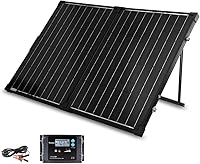
Renogy 100W Portable Solar Panel: Best for simple 12V RV charging
- 100 watts maximum power
- 25% N-Type efficiency
- 20A PWM charge controller pre-installed
- Folds to 24.8 x 2 x 2.8 inches
- 17.4 pounds
A complete 100W folding kit with a pre-installed controller and alligator clips for 12V batteries and power stations.
Pros
- Pre-installed 20A controller
- Adjustable kickstand
- Low-iron tempered glass
Cons
- 100W limits daily output on cloudy days
- Larger folded size than the lightest 100W picks
This Renogy 100W suitcase suits RV owners who want a ready to use kit for one 12V battery and light daily loads.
Renogy says the N-Type cells reach up to 25% conversion efficiency, which helps output in low light, but real charging still depends on sun hours and panel angle on any given day.
The kit includes a pre-installed 20A PWM charge controller and alligator clip cables, so you can connect it without sourcing separate parts.
That setup works with gel, AGM, flooded and lithium 12V batteries, plus some 12V power stations listed by Renogy for this type of kit.
You unfold the panel, prop the adjustable kickstand, and connect the clips to the battery terminals.
At 17.4 pounds and folded to 24.8 x 2 x 2.8 inches, it is not the lightest 100W pick here, and it will not match a 200W kit on cloudy days.
The trade-off is a complete package with low-iron tempered glass, an anti-corrosion aluminum frame and an IP65-rated junction box for rain and dust.
Choose it for simple, complete 12V charging. Skip it if you need 200W or more each day.
Renogy 200W 12V Portable Solar Panels Suitcase: Best for higher daily RV power
- 200 watts maximum power
- 25% N-Type efficiency
- 20A PWM charge controller pre-installed
- Adjustable kickstand
- 28.5 pounds
Double the wattage of the 100W Renogy kit in a folding suitcase with the same controller and kickstand setup.
Pros
- Up to 1000Wh per day with 5 hours of sunlight, Renogy says
- Works with listed power stations and 12V systems
- Tempered glass and aluminum frame
Cons
- 28.5 pounds is heavy for frequent carrying
- MC4 output may need a separate adapter for some stations
This Renogy 200W suitcase suits RV owners who found 100W too slow for daily loads such as lights, fans and longer fridge use.
It uses the same N-Type cell type and 25% efficiency claim as the smaller Renogy kit, and Renogy says it can reach up to 1000Wh per day with 5 hours of sunlight in ideal conditions.
The panel folds to a suitcase shape and weighs 28.5 pounds, so it needs a storage spot where you can lift it from a low bay without twisting.
That weight is the main cost of double wattage compared with the Renogy 100W kit at 17.4 pounds.
The adjustable aluminum alloy kickstand helps you aim the panels on uneven campsite ground without propping them on a chair or rock.
It includes a pre-installed 20A PWM controller and alligator clip cable for 12V battery systems, which keeps setup simple for house batteries.
For power stations, Renogy lists models from Jackery, EcoFlow, Anker, Bluetti and others, but you must match voltage, current and connectors first.
It has MC4 output only, and a 4-in-1 adapter is sold separately for some stations.
Choose it for more RV power. Skip it if you carry gear by hand over long walks.
DOKIO 200W Portable Foldable Solar Panel Kit: Best for lightweight 200W travel
- 200 watts in title, 220 watts maximum power in specs
- 9.7 pounds
- Folds to 20 x 27 x 1.1 inches
- 9.84 ft cable
- Standalone PWM controller and dual USB
The lightest 200W option here, with a long cable and a separate controller for flexible placement.
Pros
- Only 9.7 pounds
- 9.84 ft cable for sun tracking
- Dual USB ports
Cons
- No kickstand in the data
- Check your power station input limit before buying
This DOKIO 200W kit suits RV and van travelers who care most about carry weight and slim storage in a small compartment.
It weighs only 9.7 pounds and folds to 20 x 27 x 1.1 inches, which makes it far easier to store than the Renogy 200W suitcase at 28.5 pounds.
The specs list 220 watts maximum power, while the title says 200W, so use 200W as the planning number and confirm details before you order for a power station.
A 9.84 ft cable lets you place the panel in sun while the controller or power station stays shaded, which is useful on hot afternoons when setup shade is limited.
It comes with a standalone PWM controller that protects against reverse polarity, overcharge, overload and short circuit, and dual USB ports for phones and small gadgets.
DOKIO warns that some power stations cap input at 100 to 150W, and that cap is normal design, not a panel fault.
Unlike the Renogy kits, no kickstand is listed, so you need a flat surface or extra support to hold angle.
Choose it for light 200W travel. Skip it if you want an adjustable kickstand included.
Go Power GP-PSK-130 130W Portable RV Solar: Best for connector variety
- 130 watts maximum power
- 10 amp controller
- Adjustable angle legs
- Anderson, SAE, XLR, ring terminals and battery clamps
- Heavy-duty nylon case
A 130W folding kit aimed at RV, camping and marine use with many connector options in the box.
Pros
- Multiple connector types included
- Adjustable legs
- Nylon case for storage
Cons
- 28.7 pounds for 130W
- 10 amp controller is smaller than the 20A Renogy controllers
This Go Power 130W kit suits RV, camping and marine users who want many ways to connect without buying adapters later.
It folds for storage and uses adjustable angle legs to aim the panels at the sun, which helps when you park on uneven ground or want to angle toward a gap in tree shade.
The kit includes Anderson-style connectors, an SAE plug, an XLR plug, ring terminals and battery clamps, so it can reach older RV wiring or boat batteries that other kits do not fit directly.
Go Power says it supports AGM or lithium batteries for off-grid use, which covers the battery types most RV owners use for house power.
At 130 watts and 28.7 pounds, it gives less wattage per pound than the DOKIO 200W kit at 9.7 pounds, so weight is a clear trade-off here.
The listed controller is 10 amp, smaller than the 20A Renogy controllers, so check your battery size before pairing it with a larger bank.
The heavy-duty nylon case helps protect the panels in transit and keeps the many connector parts together in storage.
Choose it for connector variety and a case. Skip it if light weight matters more than connection options.
DOKIO 100W 18V Portable Foldable Solar Panel: Best for a full accessory kit
- 100 watts maximum power
- 10.1 pounds
- 10A waterproof controller
- 9.8 ft cable and 30 degree adjustable bracket
- 5V 2A USB port
A 100W suitcase with a detachable LCD controller, extension cable and several DC adapter plugs.
Pros
- 10.1 pounds
- Detachable LCD controller
- Extra DC plugs included
Cons
- 100W output for lighter loads
- Adjust the bracket gently, DOKIO says
This DOKIO 100W suitcase suits RV owners who want a full set of cables and adapters for batteries, power stations and small electronics.
It weighs 10.1 pounds and unfolds to 38.8 x 23.8 x 0.7 inches, with a folded thickness of only 1.3 inches, so it slides into storage more easily than thicker kits here.
It includes a detachable LCD charge controller, a 3-meter cable, a 1-meter extension cable and five DC adapter plugs, which is the longest accessory list in this group.
That list helps if you charge a battery, a power station or a phone, since the kit also has a 5V 2A USB port for small devices.
DOKIO says the panel uses N-type cells and a 30 degree adjustable bracket, with a corrosion-resistant aluminum frame and reinforced corner guards for travel use.
The specs list a 10A waterproof controller and an 18 volt maximum voltage, so match those limits to your battery before you connect it.
DOKIO also warns you to adjust the bracket gently and clean dust with a soft damp cloth to keep light transmittance up.
Choose it for accessories and light weight. Skip it if you need more than 100W for daily RV loads.
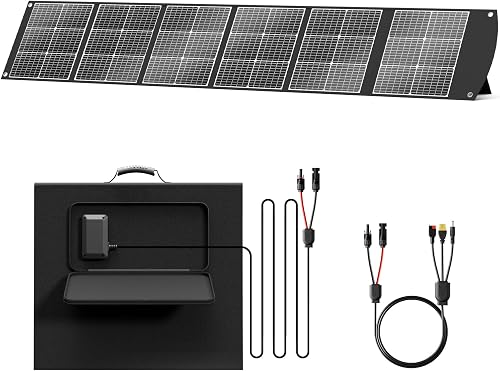
Ecosonique Technology 300W Portable Solar Panel Suitcase 40V: Best for power station charging
- 300 watts maximum power
- 23.5% efficiency
- 15.4 pounds
- 3m 3-in-1 MC4 to Anderson, XT60 and DC8020 cable
- Adjustable kickstands and IP65 waterproof surface
The highest wattage here at 300W and 40V, built for power stations rather than a basic 12V battery clamp setup.
Pros
- 300W from 15.4 pounds
- 3-in-1 cable included
- Kickstands and grommet hooks
Cons
- 40V output needs a compatible power station or controller setup
- No charge controller listed in the box
This Ecosonique 300W suitcase suits RV owners charging a portable power station, not a simple battery clamp setup for a single 12V battery.
It delivers 300 watts at 40 volts from monocrystalline cells with 23.5% efficiency, which is the highest wattage and voltage in this roundup.
At 15.4 pounds, it packs more wattage per pound than most picks here, and Ecosonique says it is 18% lighter than a standard structure for this output class.
It includes a 3m 3-in-1 cable that adapts MC4 to Anderson, XT60 or DC8020, which helps connect to many power stations without extra adapters.
Ecosonique lists EcoFlow, Bluetti, Anker and most other solar generators as compatible, but you still need to check your station input limits for voltage and current.
The panel has adjustable kickstands, grommet hooks and an IP65 waterproof surface, and Ecosonique says it sets up in about 60 seconds.
No charge controller is listed in the box, so plan for that if you use it with a 12V battery bank instead of a station.
Choose it for high-watt power station charging. Skip it for basic 12V battery use unless you add a suitable controller.
Compare the top suitcase solar panel kits side by side
Use this table to compare wattage, weight and controller type at a glance.
Weight and connectors often matter more than a small wattage gap.
| Product | Best for | Maximum power | Weight | Controller | Our score |
|---|---|---|---|---|---|
| Renogy 100W Portable Solar Panel | simple 12V RV charging | 100 watts | 17.4 pounds | 20A PWM | 9.7 |
| Renogy 200W 12V Portable Solar Panels Suitcase | higher daily RV power | 200 watts | 28.5 pounds | 20A PWM | 9.6 |
| DOKIO 200W Portable Foldable Solar Panel Kit | lightweight 200W travel | 220 watts | 9.7 pounds | 9.4 | |
| Go Power GP-PSK-130 130W Portable RV Solar | connector variety | 130 watts | 28.7 pounds | 10 amp | 9.1 |
| DOKIO 100W 18V Portable Foldable Solar Panel | a full accessory kit | 100 watts | 10.1 pounds | 10A waterproof | 8.9 |
| Ecosonique Technology 300W Portable Solar Panel Suitcase 40V | power station charging | 300 watts | 15.4 pounds | 8.7 |
For kits built around a full RV solar setup, see the best portable solar panel kit for rv.
For higher wattage stations, the best 200 watt solar panel kit for rv compares more 200W options.
For a smaller single-battery setup, the best 100 watt solar panel for rv focuses on 100W picks.
How many watts do you need for suitcase solar panels for RV use?
The right wattage depends on your battery bank and daily loads.
A 100W panel suits light use with one 12V battery.
A 130W panel adds a small margin for fans or lights.
A 200W panel suits two batteries or a power station with daily charging.
100W suitcases for single batteries
Choose 100W if you charge one house battery and use modest loads.
The Renogy 100W and DOKIO 100W both fit this group.
Expect slower recovery after a deep discharge, especially on cloudy days.
200W suitcases for daily RV loads
Choose 200W if you run a fridge, lights and fans for many hours.
The Renogy 200W and DOKIO 200W fit this group.
Check your battery capacity and controller limits before you buy.
300W suitcases for power stations
Choose 300W if you mainly charge a portable power station.
The Ecosonique 300W outputs 40V, so match it to your station input.
Do not assume it works like a 12V battery kit.
Which suitcase solar panel is easiest to carry and store?
Weight decides whether you will use the panel daily.
The DOKIO 200W at 9.7 pounds is the easiest 200W pick to carry.
The DOKIO 100W at 10.1 pounds is also light for its class.
Folded size matters in a small RV compartment.
The DOKIO 200W folds to 20 x 27 x 1.1 inches.
The Renogy 100W folds to 24.8 x 2 x 2.8 inches.
The Renogy 200W weighs 28.5 pounds, so store it where you can lift it without twisting.
A kickstand or legs helps on uneven ground.
Renogy kits include an adjustable kickstand.
Go Power includes adjustable legs.
The DOKIO 200W does not list a kickstand, so you may need a flat surface or extra support.
What should you check in a charge controller?
A controller protects your 12V battery from overcharge.
Renogy includes a 20A PWM controller on both Renogy kits here.
DOKIO includes a standalone PWM controller on the 200W kit and a 10A waterproof controller on the 100W kit.
A pre-installed controller saves wiring steps.
A separate controller lets you keep the electronics in shade.
A detachable LCD controller, like the DOKIO 100W, can help you check charging status.
Check battery type settings before first use.
Renogy lists gel, AGM, flooded and lithium compatibility for the 100W kit.
Go Power lists AGM or lithium support for the 130W kit.
Set the controller for your battery type, not for a generic 12V guess.
Which connectors work best with RV batteries and power stations?
Alligator clips are simplest for direct battery charging.
Renogy includes alligator clip cables on both Renogy kits.
That works well for a first RV setup with a house battery.
MC4 cables connect to many power stations, but not all.
The Renogy 200W has MC4 output only.
Renogy says a 4-in-1 adapter cable is sold separately for some stations.
The Ecosonique 300W includes a 3-in-1 cable with Anderson, XT60 and DC8020 ends.
Go Power includes the widest connector range here.
Anderson, SAE, XLR, ring terminals and battery clamps cover older RV and marine setups.
Extra connectors help only if you actually use those plug types.
How do you set up and care for a folding RV solar suitcase?
Start in direct sun with no shade on any panel cell.
Unfold the suitcase, set the kickstand or legs, and aim the face toward the sun.
Connect the controller to the battery first, then connect the panel, and follow the kit instructions for your model.
Use the cable length to your advantage.
A 9.84 ft cable on the DOKIO 200W lets you keep the controller shaded.
A 3m cable on the Ecosonique 300W helps keep a power station in shade while the panel stays in sun.
Clean the glass with a soft damp cloth when dust builds up.
DOKIO warns against pulling or squeezing cables.
Store the panel folded and dry, and check cable ends for damage before each trip.
Verdict: best suitcase solar panels for RV charging
Pick the Renogy 100W Portable Solar Panel if you want the simplest complete kit for one 12V RV battery.
Pick the Renogy 200W 12V Portable Solar Panels Suitcase if you need more daily power and accept the extra weight.
Pick the DOKIO 200W Portable Foldable Solar Panel Kit if light travel matters most.
For power station charging at higher wattage, compare the Ecosonique Technology 300W Portable Solar Panel Suitcase 40V against your station input limits.
For connector variety, the Go Power GP-PSK-130 130W Portable RV Solar covers more plug types.
For accessories, the DOKIO 100W 18V Portable Foldable Solar Panel includes extra cables and DC plugs.
If you are still deciding between suitcase and fixed panels, read what is a portable solar panel first.
Then return to this list and match wattage to your battery bank.
The best suitcase solar panel for RV use is the one you will set up in the sun, aim well, and pack away without strain.
Our top 3 picks at a glance
-
1
-
2
Best for higher daily RV power
Renogy 200W 12V Portable Solar Panels Suitcase
9.6/10 our score
See it on Amazon -
3
Best for lightweight 200W travel
DOKIO 200W Portable Foldable Solar Panel Kit
9.4/10 our score
See it on Amazon
Frequently asked questions
How many watts do you need for RV battery charging?
A 100W suitcase suits a single 12V house battery with light loads. A 200W suitcase fits two batteries or longer daily use.
Match wattage to battery size, daily sun hours and your usual loads, not to the largest panel you can carry.
Can a suitcase solar panel charge a power station?
Yes, if voltage, current and connector types match your station limits. Some Renogy models list specific compatible stations.
Others use MC4, XT60 or DC cables.
Check your station input range before you connect any panel.
Do suitcase solar panels need a charge controller?
Most RV battery setups do. A controller limits voltage and current to protect 12V batteries from overcharge.
Renogy and DOKIO kits here include PWM controllers.
The 300W Ecosonique suitcase does not list a controller in the box.
How should you angle a folding solar suitcase?
Face the panels directly toward the sun and tilt them with the kickstand or legs. Adjust the angle as the sun moves.
A clear view matters more than a perfect angle, so move the suitcase if shade covers part of it.