Anker SOLIX F3000 Review: Worth It? (November 2026)
The Anker SOLIX F3000 is a high-capacity backup power station for home outages, RVs and emergency use, with 3,072Wh, 3,600W output and expansion up to 24kWh. Choose the bundle if you also want a 400W bifacial solar panel.
On this page (12 sections)
- Is the Anker SOLIX F3000 worth considering?
- What does the F3000 offer for backup power?
- How much runtime can you expect?
- What charging options does the F3000 support?
- Is the 400W panel bundle the better choice?
- What is included with the standalone F3000?
- How should you plan F3000 expansion?
- What about the Anker SOLIX double power hub?
- Can the F3000 replace a UPS?
- Standalone F3000 or 400W panel bundle?
- How to use and care for a large power station
- Final verdict on the Anker SOLIX F3000
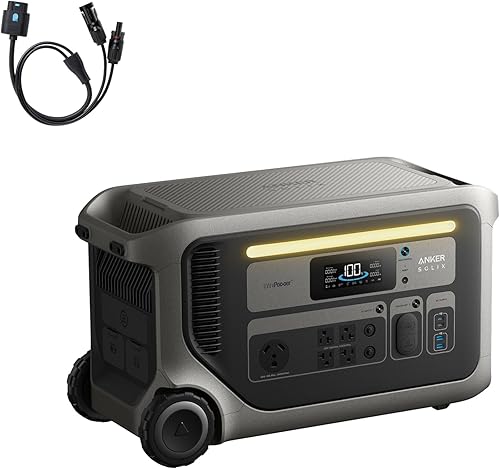
The Anker SOLIX F3000 is a large portable power station for home backup, RVs, camping and emergencies. It combines a 3,072Wh LiFePO4 battery with 3,600W output, solar charging up to 2,400W and expansion up to 24kWh.
That mix suits households who want a planned reserve rather than a small unit for occasional phone charging. The starting capacity is aimed at essential loads during outages and at longer stays where portable power is part of daily use.
The 3,600W output gives more headroom for higher demand appliances than compact stations. Actual runtime still depends on what you connect, how often devices run and how much energy you use per hour.
For home backup, it fits a plan built around refrigeration, lighting, communication equipment and selected small appliances. For RV and camping use, it is better placed in a fixed spot than carried often, at 91.5 lb.
The main choice is simple. Buy the standalone F3000 if you already have a charging plan, or choose the bundle if you want a 400W PS400 bifacial panel included.
The standalone route lets you choose your own solar setup later. The bundle gives a defined solar starting point, but the panel ships separately and adds its own setup work.
Either way, list your essential loads first. Then decide whether the starting capacity meets your outage plan or whether expansion and extra charging sources should be part of it from the start.
Is the Anker SOLIX F3000 worth considering?
The Anker SOLIX F3000 is worth considering when you need more stored energy than a small camping power bank can provide. Its size and 91.5 lb weight make it better for planned placement than frequent hand carrying.
Its 3,072Wh capacity gives you a larger reserve for outages, RV equipment and several smaller devices. The stated 3,600W output also gives it more room for higher-demand appliances than compact power stations.
For a broader comparison, our guide to the best portable power station explains how capacity, output and charging options affect the buying decision.
This is a review based on the stated product specifications and features.
What does the F3000 offer for backup power?
The F3000 offers 3,072Wh of starting capacity and 3,600W of output, making it a fit for planned emergency power rather than only phone charging. It is designed around power outages, camping, RVs and other situations where stored electricity matters.
The F3000 can provide 120V output, and two power stations can be paired at 240V for demanding appliances. That gives buyers a path from basic essential loads to larger backup needs, but larger loads also use stored energy faster.
The stated pass-through charging feature lets the unit recharge with a 120V generator while appliances run. That can reduce interruptions during an outage when you have a generator available as part of the charging plan.
The F3000 also has ultra-low idle power consumption. Anker gives a reference of 125 hours of AC idle standby and up to 42 hours for a 190W refrigerator under stated conditions.
Those figures are not a promise for every setup. A refrigerator cycles on and off, while other devices may draw power continuously, so make a list of the loads you would actually connect.
How much runtime can you expect?
Runtime depends mainly on the device wattage, duty cycle and conversion losses. A useful planning estimate is:
Runtime in hours = usable watt-hours ÷ average watts
A 100W load would use less energy per hour than a 1,000W load. The F3000's 3,072Wh starting capacity therefore suits long-running light loads better than repeated high-power appliance use.
The stated 42-hour refrigerator figure gives you a practical reference for a 190W appliance. Your refrigerator may use more or less energy because compressors cycle, room conditions vary and other equipment may share the station.
For an outage plan, list essential loads such as refrigeration, lighting, communication devices and selected small appliances. Add their average wattage, then decide whether the F3000's starting capacity is enough or whether expansion is justified.
What charging options does the F3000 support?
The F3000 supports AC charging, generator charging and solar charging, with portable and rigid solar panel compatibility. Its solar input can reach 2,400W through the 165V or 60V ports.
The standalone product includes an AC charging cable and a high-voltage solar charging cable. It does not include a solar panel, so you need to plan that part separately if solar charging is central to your setup.
The F3000 can also combine fuel-generator and solar input for stated charging up to 6,000W. That option is aimed at fast recovery during emergencies, when waiting for a slow recharge may not fit your needs.
The best Anker portable power station comparison can help if you are deciding whether the F3000's capacity and charging range match your broader Anker choices.
Is the 400W panel bundle the better choice?
The bundle is the better starting point if you want a defined solar charging setup with the F3000. It includes the F3000 and a 400W PS400 bifacial portable solar panel, but the two packages ship separately.
The PS400 panel is rated at 400W and uses a dual-sided design that can generate power from its front and rear surfaces. Anker says it can provide up to 10% more output than a single-sided panel depending on sunlight conditions.
The panel folds to 22.3 x 38.7 x 3.2 in and weighs 21.9 lb. It is IP68-rated, with a reinforced aluminum frame and impact-resistant design described for rain, mud and dust under controlled conditions.
The bundle includes two 8.2 ft solar charging cables and a 1.6 ft XT60i solar charging cable. It also includes a quick start guide and safety card for the panel.
The separate shipments matter for delivery planning. Scan the package QR code to track remaining items, and do not assume the power station and panel will arrive together.
What is included with the standalone F3000?
The standalone package includes the Anker SOLIX F3000 Portable Power Station, an AC charging cable, a high-voltage solar charging cable, a user manual, a warning notice and a warranty card.
The station measures 25.6 x 11.8 x 14.8 in and weighs 91.5 lb. That footprint is manageable for a planned storage location, but the weight makes a permanent or semi-permanent setup more practical than frequent carrying.
Measure the route to your storage spot before ordering. Check door widths, steps, vehicle access and the surface where the station will sit.
How should you plan F3000 expansion?
The F3000 starts at 3,072Wh and can expand to 24kWh with additional batteries. Expansion is most useful when you want longer outage coverage or need to support more essential loads over several days.
Start with the devices you consider essential. If the station will mainly support a refrigerator, lights and communication equipment, the starting capacity may be enough for your plan.
If you want a longer reserve, expansion can reduce the need to recharge as often. It also adds more equipment to store, manage and budget for, so do not treat maximum capacity as necessary for every household.
A practical plan has two parts: the loads you need to run and the ways you can recharge. Solar, AC power and generator charging serve different conditions, so consider which sources remain available during the outage you are preparing for.
What about the Anker SOLIX double power hub?
The Anker SOLIX double power hub should be treated as a system accessory that needs exact compatibility confirmation before you buy it. The F3000 information here confirms 120V and 240V output options, but it does not guarantee every hub requirement, included cable or installation detail.
If you are considering an Anker SOLIX hub or double power hub, match the accessory to your exact F3000 model and intended electrical setup. Confirm the required equipment, connection method and whether professional installation is needed.
Do not assume that a hub automatically makes every home circuit safe to power. Follow Anker's instructions and local electrical rules, and use a qualified electrician for fixed wiring or transfer equipment.
The What Is a Portable UPS? The Complete Guide explains how portable backup power differs from a conventional stationary UPS.
Can the F3000 replace a UPS?
The F3000 includes UPS-related positioning in its product highlights, but it should not automatically be treated as a replacement for every office or medical UPS. The right choice depends on transfer behavior, connected equipment and the level of power protection you need.
Use a dedicated UPS when your equipment requires a specific transfer time, voltage behavior or protection design. For home outage backup, the F3000 is more relevant when capacity, solar charging and portability matter.
Our explanation of What Is a Double Conversion UPS? Made Simple covers a different UPS design focused on continuous power conversion and conditioning.
For computers, networking equipment or other sensitive electronics, check the equipment instructions before connecting it. Also consider whether the F3000's available outlets and output arrangement suit the devices you plan to protect.
Standalone F3000 or 400W panel bundle?
Choose the standalone F3000 if you already have solar equipment, plan to use AC or generator charging, or want to decide on panels later. It gives you the same stated 3,072Wh capacity and 3,600W output without making the panel part of the initial purchase.
Choose the bundle if solar charging is part of your emergency plan and the PS400's folded size, weight and IP68 rating fit your storage needs. The panel adds a ready starting point, but it also adds setup space and a second package to track.
The bundle's panel is portable, but the F3000 itself weighs 91.5 lb. Think of the pair as transportable equipment for planned use, not a lightweight kit you will casually move every day.
Our Anker SOLIX S2000 review and Anker SOLIX F3800 review provide useful comparisons within the same product family.
How to use and care for a large power station
Set up the F3000 on a stable, suitable surface with its cables arranged so they cannot be pulled or pinched. Keep the station and charging equipment dry, and follow the supplied manual for operating and storage instructions.
Place solar panels where they receive strong sunlight without shade from trees, buildings or vehicles. A bifacial panel can receive light on both surfaces, so avoid placing it where the rear surface is blocked.
Track which devices you connect during an outage. Removing nonessential loads preserves stored energy for refrigeration, communication and other priorities.
Recharge the station before a storm or planned outage if your power plan allows. Store the cables with the station, and keep the manual and warning notice available for anyone who may need to operate it.
Final verdict on the Anker SOLIX F3000
The Anker SOLIX F3000 review verdict is favorable for buyers who need high-capacity backup power with solar and expansion options. Its 3,072Wh battery, 3,600W output, 2,400W solar charging and expansion up to 24kWh give it a broad role in outage, RV and emergency planning.
It suits buyers who prefer a planned placement over frequent carrying. At 91.5 lb, the station is transportable for set routes, but it asks for help with steps, vehicle loading and storage.
For home use, the strongest case is essential loads you have listed in advance. Refrigeration, lighting and communication equipment are easier to support when nonessential loads are left unplugged during an outage.
Solar charging adds value when sunlight is available and panels can be placed without shade. AC charging and generator options give other paths when solar conditions are poor or time is short.
Expansion is useful for longer outages, but it is not needed for every setup. Extra batteries add storage and management, so match them to the loads and duration you actually expect.
Pick the standalone F3000 if you want to build your charging system in stages. Pick the 400W panel bundle if a PS400 bifacial panel is useful from the start, and confirm any double power hub or other accessory against your exact setup before connecting it.
Frequently asked questions
Is the Anker SOLIX F3000 good for backup power?
The Anker SOLIX F3000 is suited to backup power because it has a 3,072Wh battery, 3,600W output and expansion up to 24kWh. It can support home essentials, RV equipment and emergency loads, but your actual runtime depends on the wattage of the devices you connect and how often they run.
How long can the Anker SOLIX F3000 run a refrigerator?
The F3000 is rated to run a 190W refrigerator for 42 hours under the stated conditions. Actual runtime can change with cycling, temperature, startup demand and other connected loads, so use that figure as a reference rather than a guarantee for every refrigerator.
Does the Anker SOLIX F3000 include solar panels?
The standalone Anker SOLIX F3000 includes the power station, AC charging cable, high-voltage solar charging cable, manual, warning notice and warranty card, but no panel. The bundle adds a PS400 400W bifacial portable solar panel and its listed charging cables.
Can the Anker SOLIX F3000 expand its battery capacity?
The F3000 starts at 3,072Wh and can expand to 24kWh with additional batteries. Expansion makes more sense for long outages or larger backup plans than for short trips, so decide whether you need extra stored energy before adding accessories.