9 Best Chargers for Anker Prime Power Banks (November 2026)
The best Anker Prime power bank chargers include the Anker Power Bank for compact 30W travel charging, the Anker Zolo Power Bank for longer days away from a wall charger, and the Anker 621 MagGo Power Bank for snap-on iPhone top-ups.
On this page (8 sections)
- Best Anker Prime power bank chargers and charging bases for every setup
- How do Anker Prime power bank chargers compare on speed?
- What wattage wall charger do I need for an Anker Prime power bank?
- What cable and charging base should I use with a Prime model?
- How do I choose between a Prime model and a smaller Anker model?
- Is a magnetic power bank a good charging base for iPhones?
- What are the trade-offs of high wattage Prime chargers?
- Verdict: which Anker Prime power bank charger should you buy?
The best Anker Prime power bank charger setup is a 100W wall charger for the 20,100mAh model and dual chargers totalling 170W for the 27,650mAh model. That match is the best Anker Prime power bank charger choice because each Prime model has a different recharging limit.
A charging base or wall charger below that limit will refill the bank more slowly.
Choosing the right charger starts with the input number, not the output number. The output number tells you how fast the bank charges your phone or laptop.
The input number tells you how fast the charger refills the bank itself.
Our score weighs specs, features and buyer feedback against what you are shopping for. We compared capacity, output, input, cable needs and size across these nine models.
If you are new to portable power, start with our power bank battery guide. It explains capacity, wattage and why usable capacity is lower than the headline number.
Our picks at a glance
-
1

-
2

-
3

Best Anker Prime power bank chargers and charging bases for every setup
The two Prime models at the end of this list are the core of this guide. The other seven models show what a good charger and charging base must support, from 30W phone charging to 140W laptop charging.
Smaller models help you judge daily use. A 10,000mAh bank suits a phone day out.
A 20,000mAh or larger bank suits travel, tablets and laptops.
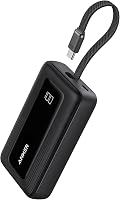
Anker Power Bank: Best for compact 30W travel charging
- 10,000mAh capacity
- 30W output and 20W input
- Built-in 5.4-inch USB-C cable
- 4.32 x 2.58 x 0.98 inches
A compact 10,000mAh model with a built-in USB-C cable for travel. It suits a phone first setup when you want fast 30W charging without a separate cable.
Pros
- Built-in USB-C cable
- Compact travel size
- 30W bi-directional charging
Cons
- 10,000mAh limits multi-device use
- 20W input is slower than Prime models
This 10,000mAh model suits travel when you want one cable and no extra bulk. Its built-in USB-C cable measures 5.4 inches and is tested to endure over 10,000 bends.
30W output and 20W input mean it charges a phone fast and refills at a moderate pace. Anker says it can boost an iPhone 16 Pro Max to 50% in 27 minutes.
At 4.32 x 2.58 x 0.98 inches, it fits a travel bag easily. It delivers up to 2 full charges for an iPhone 15 and 10 charges for AirPods Pro 2.
The trade-off is capacity. A 10,000mAh bank will not keep a laptop and two phones running for a whole trip.
Choose it as a daily charger and charging base idea for phones. Move up to a Prime model when you need laptop output or faster recharging.
It also fits a simple charging base routine at home. You can refill it overnight with a 20W wall charger and carry it out in the morning.
Anker Zolo Power Bank: Best for longer days away from a wall charger
- 20,000mAh capacity
- 30W output and 20W input
- Built-in 5.98-inch USB-C cable
- ActiveShield 2.0 temperature monitoring
A 20,000mAh model with a built-in cable for extended travel. It gives more phone charges than the 10,000mAh picks while keeping 30W output.
Pros
- 20,000mAh capacity
- Built-in USB-C cable
- Low-current mode for small devices
Cons
- Heavier than 10,000mAh models
- 20W input needs about 5.1 hours to recharge
This 20,000mAh model suits longer days when a 10,000mAh bank would run out. It can charge an iPhone 15 up to 4 times, according to Anker.
Its built-in USB-C cable measures 5.98 inches. That length helps when you charge a phone in your hand while the bank sits in a bag.
30W output and 20W input keep charging fast in both directions. Anker says an iPhone 15 can go from 0 to 57% in 30 minutes.
ActiveShield 2.0 monitors temperatures and adjusts output. That helps with reliable performance during long use.
The trade-off is weight and recharging time. At 12.45 oz, it is heavier than the 10,000mAh picks.
With a 20W charger, it takes about 5.1 hours to recharge fully.
It works well with a 20W or higher wall charger. For a Prime charging base, you would step up to a model with a higher input limit.
The low current mode also helps with small devices. Double tap the power button to enter that mode for earphones and similar gear.
Anker 621 MagGo Power Bank: Best for snap-on iPhone top-ups
- 5,000mAh capacity
- 7.5W max wireless charging
- Magnetic attachment
- 4.13 x 2.62 x 0.45 inches
A slim magnetic power bank that snaps to the back of an iPhone. It suits short top-ups when you want cable-free wireless charging at 7.5W max.
Pros
- Pocket size
- Magnetic attachment
- Light at 4.41 oz
Cons
- Only 5,000mAh capacity
- 7.5W wireless charging is slower than wired
This 5,000mAh magnetic model suits short top-ups for an iPhone. It attaches magnetically to the back of an iPhone 15 or 14.
At 4.13 x 2.62 x 0.45 inches and 4.41 oz, it is the smallest option here. It fits a pocket or purse without adding much bulk.
Wireless charging tops out at 7.5W max. That is fine for a top-up, but it is slower than wired charging through USB-C.
MiniCell technology helps keep size down. The trade-off is capacity.
A 5,000mAh bank gives far fewer charges than a 10,000mAh or 20,000mAh model.
Choose it when snap-on ease matters more than total charge count. For faster charging, pair it with a wired wall charger for your phone instead.
Our best Anker power bank guide compares more magnetic and wired Anker options for phone first buyers.
It is best judged as a phone accessory rather than a charger for a bank. You will still refill the bank itself with a wired wall charger.
Anker 737 Power Bank: Best for laptop charging on the go

- 24,000mAh capacity
- 140W output with Power Delivery 3.1
- Smart digital display
- 140W USB-C to USB-C cable included
A 24,000mAh power bank with 140W output for laptops and phones. Its smart display shows output and input power in real time.
Pros
- 140W output
- Smart display
- Airplane-safe carry-on size
Cons
- Needs a 5A cable and 140W charger for full speed
- Larger and heavier than phone-only models
This 24,000mAh model suits laptop users who need more than phone charging. It offers 140W output with Power Delivery 3.1.
Its smart display shows output and input power in real time. That helps you see whether your charger and cable are delivering full speed.
Anker says it can charge an iPhone 16 Pro 4.13 times. It can also charge a 2024 13-inch iPad Pro 1.33 times.
For full speed, use a 5A cable and a 140W charger. A lower wattage cable will limit output to that cable's rating.
The trade-off is size and weight. At about 22 oz, it is a travel tool, not a pocket accessory.
As a charging base idea, it shows why cable rating matters. The same rule applies to Prime models that claim 140W output.
Its three ports suit mixed setups. You can power a laptop, a phone and a smaller device without a separate hub.
Anker MagGo Power Bank: Best for Qi2 magnetic charging with a USB-C port

- 10,000mAh capacity
- 15W max Qi wireless charging
- 30W max USB-C port
- Slim 0.58 inch profile
A slim 10,000mAh magnetic model with 15W wireless charging and a 30W USB-C port. It suits iPhone users who want both snap-on and wired charging.
Pros
- 15W max magnetic wireless charging
- 30W USB-C port
- Slim portable profile
Cons
- Designed for iPhone fit and alignment
- Wireless charging is slower than wired
This 10,000mAh magnetic model suits iPhone users who want wireless and wired options in one bank. It offers 15W max Qi wireless charging and a 30W max USB-C port.
At 0.58 x 2.78 x 4.09 inches, it is slim. It can provide up to 1.8 charges for an iPhone 15 Pro.
A matte finish and metal frame give it a premium feel. Aerogel thermal insulation helps with cool operation.
Device fit matters here. Anker designed it for the iPhone 12 to 16 series.
It does not recommend it with Android phones because fit or alignment may affect speed.
The trade-off is wireless speed. Wired charging through USB-C at 30W max will be faster than 15W wireless charging.
Choose it when magnetic ease is your main need. For the fastest wall charger refill, use a wired USB-C charger rather than wireless charging.
The included 23.62 inch cable keeps wired use simple. That helps when you want a backup after the magnetic charge runs down.
Anker Power Bank: Best for slim everyday carry

- 10,000mAh capacity
- Slim 5.99 x 2.81 x 0.61 inches
- Two-way USB-C charging
- 8.6 oz weight
A slim 10,000mAh portable charger for on-the-go use. Its thin profile suits a bag or pocket when you want two-way USB-C charging.
Pros
- Slim and light
- Two-way USB-C charging
- Scratch resistance focus
Cons
- Long slim shape may not suit every pocket
- No magnetic wireless charging
This 10,000mAh model suits buyers who want a slim bank for daily carry. At 5.99 x 2.81 x 0.61 inches and 8.6 oz, it is thin and light.
Two-way USB-C charging makes charging and recharging simple. The USB-C port handles both input and output.
Anker says it provides 2 charges for iPhone 15 and 1.93 charges for Galaxy S23. That suits a full day out or a short trip.
Its durability is certified by a 3.2 ft drop test. Scratch resistance is also part of its design focus.
The trade-off is shape. A long slim bank may stick out of a small pocket.
It also has no magnetic wireless charging.
Choose it for simple wired charging with a standard wall charger. It is a good baseline for judging whether you need Prime level wattage.
If slim shape is your priority, our best power bank slim guide lists more thin options to compare.
Its two ports give basic flexibility for a phone and a second device. That matters when you carry earbuds or a tablet as well.
Anker Prime Power Bank: Best for a 220W Prime charging base setup

- 20,100mAh capacity
- 220W total output
- 140W max fast charging
- 100W max recharging input
A 20,100mAh Prime model with 220W total output from two USB-C ports and one USB-A port. It recharges to 50% in 25 minutes with 100W max input.
Pros
- 220W total output
- 100W max recharging
- Digital display
Cons
- Needs a 5A cable for 140W output
- Heavier than phone-only models
This 20,100mAh Prime model is the first true answer to the search for an Anker Prime power bank charger. It delivers 220W total output from two USB-C ports and one USB-A port.
For recharging, it accepts 100W max input. Anker says it recharges to 50% in 25 minutes with that input.
Output reaches 140W max for fast laptop charging with a 5A cable. Anker says it can charge a 16-inch MacBook Pro (M4 Pro) to 50% in 28 minutes.
At 20,100mAh (72.36Wh), it is TSA-approved for carry-on travel. Anker says it supports up to 4.2 days of video streaming on an iPhone 17 Pro Max.
The trade-off is weight at 510 g. That is the cost of high output and high input in one bank.
Pair it with a 100W wall charger and a 5A cable for full recharging speed. A lower wattage charger will still work, but recharging will take longer.
Its digital display helps you watch input and output while you set up a charging base. That makes it easier to confirm the charger is delivering full speed.
Anker Nano Power Bank: Best for a built-in cable and recycled casing

- 10,000mAh capacity
- 30W bi-directional charging
- Built-in USB-C cable
- Casing made of 80% recycled plastic
A compact 10,000mAh model with a built-in USB-C cable. Its casing uses 80% recycled plastic from consumer waste.
Pros
- Built-in USB-C cable
- 30W charging in both directions
- Compact size
Cons
- Built-in cable cannot charge Lightning devices directly
- 10,000mAh limits longer trips
This 10,000mAh Nano model suits buyers who want a built-in cable in a small body. At 4.09 x 2.06 x 0.94 inches, it is compact enough for a small bag.
Its built-in USB-C cable can charge phones, tablets and laptops. It can also recharge the power bank itself.
30W bi-directional charging boosts the bank to 50% in 45 minutes. Anker says it can charge an iPhone 14 to 50% in 30 minutes.
The casing is made of 80% recycled plastic from consumer waste. That helps reduce carbon emissions in manufacturing.
The trade-off is device fit. The built-in USB-C cable cannot charge Lightning devices directly.
You will need a separate Lightning cable for older iPhones.
Choose it for USB-C phones and tablets. For Lightning devices or magnetic charging, another model in this list will fit better.
Its compact size also helps as a home charging base refill option. You can top it up quickly with a 30W wall charger before a short trip.
Anker Prime Power Bank: Best for fastest Prime recharging

- 27,650mAh capacity
- 250W multi-device output
- 170W total input with dual chargers
- Full recharge in 37 minutes
A 27,650mAh Prime model with 250W output and 170W total input using dual chargers. It charges a 16-inch MacBook Pro to 50% in 28 minutes.
Pros
- 250W multi-device output
- 37-minute full recharge
- App control for charging status
Cons
- Needs dual chargers for fastest recharging
- Largest capacity here means more weight
This 27,650mAh Prime model is the fastest recharging option here. It offers 250W multi-device output and keeps a laptop at 140W while powering a tablet and phone.
For recharging, it accepts 170W total input using dual chargers. Anker says it fully recharges in 37 minutes with that setup.
Capacity is 27,650mAh (99.54Wh). Anker says it can charge a 13-inch MacBook Air (M2) 1.28 times or an iPhone 14 up to 4.67 times.
App control helps you monitor charging status. It connects via Bluetooth within 33 ft (10 m).
The trade-off is the need for dual chargers for fastest recharging. A single charger will refill it more slowly.
Choose it when you want one bank for a laptop, tablet and phone. For a single charger charging base, the 20,100mAh Prime model is simpler.
It is also TSA friendly at under 100Wh for carry on use. That makes it practical for flights where you need laptop power at the gate or on board.
How do Anker Prime power bank chargers compare on speed?
The 27,650mAh Prime model recharges fastest with 170W total input, while the 20,100mAh Prime model recharges with 100W max input. Smaller models in this list use 20W input, so their recharging time is much longer.
Output tells a different story. The 27,650mAh model outputs 250W total.
The 20,100mAh model outputs 220W total. The Anker 737 model outputs 140W.
| Product | Best for | Capacity | Output | Input | Our score |
|---|---|---|---|---|---|
| Anker Power Bank | compact 30W travel charging | 10,000mAh | 30W | 20W | 9.7 |
| Anker Zolo Power Bank | longer days away from a wall charger | 20,000mAh | 30W | 20W | 9.7 |
| Anker 621 MagGo Power Bank | snap-on iPhone top-ups | 5,000mAh | 9.5 | ||
| Anker 737 Power Bank | laptop charging on the go | 24,000mAh | 140W | 9.4 | |
| Anker MagGo Power Bank | Qi2 magnetic charging with a USB-C port | 10,000mAh | 9.4 | ||
| Anker Power Bank | slim everyday carry | 10,000mAh | 9.4 | ||
| Anker Prime Power Bank | a 220W Prime charging base setup | 20,100mAh | 8.9 | ||
| Anker Nano Power Bank | a built-in cable and recycled casing | 10,000mAh | 8.5 | ||
| Anker Prime Power Bank | fastest Prime recharging | 27,650mAh | 250W | 170W total | 8.3 |
We compared these models on capacity, output, input and size. We also checked what cable each model needs for full speed.
A wall charger is only as fast as the cable and device allow. A 140W bank with a 60W cable will deliver 60W, not 140W.
Charging bases follow the same rule. The base must match the bank's input limit to refill it at full speed.
Input versus output in daily use
Input matters most when you are refilling the bank between trips. A 20W input needs about 5.1 hours for the 20,000mAh Zolo model.
Output matters most when you are charging a phone or laptop away from the wall. A 30W output suits a phone, while 140W output suits a laptop.
Why headline capacity needs context
Conversion loss of 30 to 45% is normal across these models. A 20,100mAh bank provides about 11,250mAh after conversion.
That is why charge counts in the product write ups use manufacturer figures. They already reflect the expected loss in normal use.
What wattage wall charger do I need for an Anker Prime power bank?
Match the wall charger to the bank's input limit: 100W for the 20,100mAh Prime model and dual chargers totalling 170W for the 27,650mAh model.
100W wall charger for the 20,100mAh model
A 100W wall charger gives the 20,100mAh Prime model its rated recharging speed. Anker says it reaches 50% in 25 minutes with 100W max input.
Use a cable rated for 100W (5A) to reach that speed. Third-party chargers only provide maximum power under the Power Delivery protocol.
Dual chargers for the 27,650mAh model
The 27,650mAh model needs dual chargers for 170W total input. That setup gives a full recharge in 37 minutes.
A single charger will still recharge it, but more slowly. Check the input rating before you buy a charging base.
20W to 30W chargers for smaller models
Smaller models in this list use 20W input. A 20W charger will refill them at their rated pace, but it will take hours for a 20,000mAh model.
If you want faster recharging, you need a bank with a higher input limit, not just a higher output limit.
Our power bank vs charger guide explains when a wall charger alone is enough and when you need a bank.
What cable and charging base should I use with a Prime model?
Use a 5A USB-C cable for 140W output and a cable rated for 100W (5A) for Prime recharging.
Why cable rating matters
Charging speed is set by the device, the charger and the cable. A 60W cable limits charging to 60W.
The included cables matter. The 20,100mAh Prime model includes a 3.3 ft USB-C cable rated at 240W.
The 27,650mAh model includes a 2 ft USB-C cable.
Wall charger versus charging base
A wall charger plugs into the wall and refills the bank through a cable. A charging base may hold the bank in place while it refills.
Both need to match the input limit. A base that outputs less than the bank's input limit will refill it more slowly.
Recharging tips for Prime models
Charge in a cool, ventilated place between 32 and 77 degrees F. Heat during charging is normal, and power may drop to protect the battery.
Avoid powering other devices while recharging the bank at full speed. That helps it reach its rated input.
A charging base with a fan or open airflow can help in a warm room. It will not change the rated input, but it can reduce heat related slowdowns.
How do I choose between a Prime model and a smaller Anker model?
Choose a Prime model for laptop output and fast recharging. Choose a smaller model for pocket size and phone only charging.
Choose Prime for laptops and tablets
Prime models output 220W or 250W total. That suits a laptop at 140W plus a tablet and phone at the same time.
Smaller models output 30W. That suits a phone or earbuds, but not a laptop at full speed.
Choose smaller models for daily carry
A 10,000mAh model weighs far less than a Prime model. It fits a pocket or small bag for a day out.
A 20,000mAh Zolo model adds capacity without Prime level weight. It suits travel when you charge phones for several days.
Capacity versus usable charge
Energy loss of 30 to 45% is normal during power conversion. A fully charged 20,100mAh Prime bank provides about 11,250mAh to devices.
That is why a 20,000mAh bank does not give 20,000mAh of usable charge. Plan for the lower usable number.
Is a magnetic power bank a good charging base for iPhones?
A magnetic power bank is good for snap-on top-ups, but wired charging is faster for refilling a phone or a bank.
Magnetic top-ups for iPhones
The MagGo models snap to the back of an iPhone. That keeps charging aligned without a cable.
Wireless output is 7.5W max on the 621 model and 15W max on the 10,000mAh MagGo model. Both are slower than 30W wired charging.
When wireless makes sense
Wireless charging suits a short top-up while you walk or talk on the phone. It also suits a nightstand where you drop the phone in place.
It does not suit fast recharging of the power bank itself. Use a wired wall charger for that.
Our power bank vs portable charger guide explains the terms and when each one fits.
What are the trade-offs of high wattage Prime chargers?
High wattage gives fast laptop charging and fast recharging, but it adds weight and needs high rated cables.
Weight and size
The 27,650mAh Prime model has the largest capacity here. That gives more charges, but it is not a pocket device.
The 20,100mAh model is lighter at 510 g. It still suits travel and carry-on use.
Cable and charger costs
Full speed needs a 5A cable and a high wattage wall charger. A lower rated cable will limit speed.
Check what is included. Both Prime models include a USB-C cable and a travel pouch.
Heat and battery care
Heat during high wattage charging is normal. Use the bank in a cool, ventilated place.
iPhones may pause charging at 80% to protect battery health when warm. Charging resumes after the phone cools down.
If you want a phone first option with USB-C PD, our best USB-C PD power bank guide compares more 30W and higher models.
Verdict: which Anker Prime power bank charger should you buy?
Pick the 27,650mAh Prime model with dual chargers totalling 170W if you want the fastest recharging and 250W output. Pick the 20,100mAh Prime model with a 100W wall charger if you want 220W output in a lighter bank.
For phone only use, pick a 10,000mAh or 20,000mAh model with 30W output. It will be lighter and simpler.
Match the charger to the input limit first. Then match the cable to the output you want.
That rule will give you the best result from any Anker Prime power bank charging base or wall charger you choose.
Our top 3 picks at a glance
-
1
-
2
-
3
Frequently asked questions
What is the best Anker Prime power bank charger?
The best Anker Prime power bank charger is a wall charger that matches the model's input limit. Use 100W max input for the 20,100mAh Prime model and dual chargers totalling 170W for the 27,650mAh model.
What is an Anker Prime power bank charging base?
An Anker Prime power bank charging base is a stand or wall charger that refills the power bank at its rated input. Match the base output to the power bank input limit and use a cable that supports that wattage.
Do I need a 5A cable for Prime charging?
Yes, for 140W output you need a 5A cable. A 60W cable limits charging to 60W even when the power bank and wall charger support more.