Power Banks: The Complete Buying Guide
The right power bank battery depends on your device, charging speed and capacity needs. Choose a compact 5,000mAh model for short phone top-ups, 10,000mAh for daily carry, or 20,000mAh and more for travel, tablets and laptops.
On this page (14 sections)
- What is a power bank battery?
- How much power bank capacity do you need?
- What does mAh mean on a power bank?
- Which charging standards matter?
- How many ports should a power bank have?
- Which power bank battery suits different users?
- Power bank vs battery: what is the difference?
- How do you choose a portable battery power bank?
- Which power bank features are worth paying attention to?
- Are wireless power banks better than wired models?
- How should you use and care for a power bank?
- What should you check before buying?
- Explore power banks by topic
- Final power bank battery buying advice
A power bank battery stores energy so you can charge a phone, tablet, laptop, earbuds or another USB device away from a wall outlet. The best choice depends on capacity, output wattage, charging ports, cable needs, size and how many devices you carry.
A power bank is also called a portable battery, portable charger or battery pack. The names often overlap, but the specifications do not.
A small wireless model may suit a phone emergency, while a high-output USB-C model can support a laptop. That difference in purpose matters more than the product name on the box.
Look at the device you will charge most often first. A phone needs different output from a tablet, and both differ from a laptop that expects a higher wattage input.
Also think about how you will carry the pack each day. A compact unit fits a pocket or small bag, while a larger battery favors travel and multi-device use.
This guide explains how capacity works, why usable energy is lower than the printed number, which charging standards matter and how to match a portable battery power bank to your routine. It also covers ports, heat, cables and care.
Use the comparisons to narrow the choice before you check a specific model. Capacity, wattage and connectors should guide the shortlist, not a big mAh figure on its own.
By the end, you should know whether a small magnetic pack, a midsize daily battery or a high-output laptop unit fits your habits. That makes the final purchase much simpler and less wasteful.
What is a power bank battery?
A power bank battery is a rechargeable battery pack with one or more outputs for charging other devices. You charge the pack first, then connect a phone, tablet, laptop or accessory through USB, wireless charging or a built-in cable.
The core parts are the battery cells, charging circuit, output ports and safety controls. Some models add a display, flashlight, wireless charging coil, magnets, solar panel or built-in cables.
The phrase power bank vs portable battery usually describes the same product category. A portable power station is different because it is much larger and may include AC outlets, while a power bank is designed for personal electronics.
If you are comparing a wall adapter with a battery pack, read our guide to power bank vs charger. A charger needs a wall or other power source, while a power bank carries stored energy with you.
How much power bank capacity do you need?
Choose capacity by the number and type of devices you need to charge. 5,000mAh suits a small phone top-up, 10,000mAh fits daily carry, and 20,000mAh or more suits travel, tablets, laptops and multiple devices.
| Capacity | Best fit | Main trade-off |
|---|---|---|
| 5,000mAh | Emergency phone power and magnetic charging | Fewer total charges |
| 10,000mAh | Daily phone carry and short trips | More weight than a mini pack |
| 20,000mAh | Travel, camping and several phone charges | Larger body and slower full recharge |
| 24,000mAh to 25,000mAh | Laptops, tablets and several devices | Heavier and more demanding to recharge |
The printed capacity describes energy stored inside the cells. It does not mean every milliamp-hour reaches your phone because voltage conversion, heat and circuit losses reduce usable energy.
Anker explains that its 5,000mAh A1610 battery may provide an estimated 2,750mAh to 3,250mAh for devices after energy loss. Its example formula uses half the power bank capacity divided by the device battery capacity to estimate charges.
That gives a useful starting point, not a guarantee. Cable quality, wireless charging, device use, temperature and the phone's charging controls can change the result.
For a deeper capacity comparison, see what power bank capacity you need.
What does mAh mean on a power bank?
mAh means milliamp-hours, a measure of battery capacity. A higher mAh number generally means more stored energy, but it does not by itself tell you how fast the power bank charges your device.
A 10,000mAh power bank can have a lower output wattage than a 5,000mAh model. Capacity answers how much energy is stored, while watts help describe how quickly that energy can be delivered.
Think of capacity as the size of the tank and wattage as the width of the pipe. A large tank with a narrow pipe may still deliver power slowly to a hungry device.
The device also controls charging speed. A phone that accepts only a limited input cannot draw the full output of a high-wattage power bank.
That limit protects the phone battery and the charging circuit inside it. The power bank can offer more power than the phone will accept, but the extra offer does not force faster charging.
As the phone approaches a full charge, charging may slow to protect the battery. This taper is normal and helps reduce stress on the cells near full capacity.
Voltage also matters when you interpret mAh. Battery cells work at one voltage, but phones and laptops need a different voltage for charging.
Conversion between those voltages creates losses inside the pack. Heat, cables and circuit efficiency can reduce the amount of energy that reaches your device.
That is why a printed capacity never translates into the same number of full phone charges. A rough estimate is more useful than an exact promise.
Use the usable energy idea when you compare two packs for the same phone. A larger capacity usually gives more total top-ups, even if each charge arrives at a similar speed.
For a laptop, wattage and charging standard matter even more. A pack may hold plenty of energy yet fail to meet the laptop input requirement.
Check the port type, cable rating and device limit together. Those three details explain most of the speed you will actually see in daily use.
Size and weight also change with capacity. More stored energy usually means more cells, a larger body and a slower recharge of the power bank itself.
Choose mAh for endurance and watts for speed. You need both numbers to match the device, rather than relying on either figure alone.
Which charging standards matter?
The most useful charging standards are USB Power Delivery, USB-C output, Quick Charge and Qi wireless charging. Match the power bank's port and output to the device's input before you buy.
USB-C is a connector type, not a guaranteed speed. One USB-C port may support modest phone charging, while another supports high-wattage laptop charging through USB Power Delivery.
Power Delivery, often called PD, negotiates a suitable voltage and current between the charger and device. A high-output power bank still needs a compatible device and cable to reach its advertised level.
Quick Charge can help compatible Android devices charge faster. Check the phone and power bank specifications together because a high number on the pack does not make every phone charge at that speed.
Wireless charging is convenient but usually less efficient than wired charging. The Anker 621 MagGo Power Bank supports up to 7.5W wireless charging, and Anker notes that wireless charging can be slower than wired charging because it uses coil-based energy transfer.
For a practical comparison of the terms, see power bank vs portable charger.
How many ports should a power bank have?
Choose one port for a single-device routine and several ports when you regularly charge a phone, earbuds, tablet or laptop together. More ports add flexibility, but they do not guarantee that every port can deliver maximum power at once.
USB-A remains useful for older cables and accessories. USB-C is the better choice for newer phones, tablets and laptops because it can support modern charging standards.
Check whether the power bank shares output between ports. A three-port power bank may have a high total output, but the available power can change when two or more devices are connected.
Built-in cables reduce what you need to pack. They can be useful for daily carry, but a damaged attached cable may be harder to replace than a separate cable.
Our guide to power banks with built-in cables covers that trade-off.
Which power bank battery suits different users?
The right product depends on your charging pattern, not just the largest capacity. These four options show the main choices from compact magnetic charging to high-output laptop power.
BLAVOR Solar Power Bank
The BLAVOR Solar Power Bank suits outdoor users who want a 10,000mAh battery, wireless charging and emergency features in one portable charger.
It supports up to 20W USB-C fast charging and can charge 3 devices at the same time. The title identifies it as a portable wireless charger for cell phones, while the data lists compatibility with iPhone, iPad, AirPods, Samsung, Google, Android phones, Switch and other USB devices.
The solar panel is best treated as an emergency backup. Its maximum charging current is 0.23A, with maximum power of 1.15W, so cable charging is the practical primary method.
The body uses flame-retardant ABS and PC materials with waterproof silicone protection. It is rated IPX5 for water resistance and is described as dustproof and shockproof.
The 5.91 x 3.07 x 0.87 in body weighs 9.3 oz.
This is a strong fit for camping, hiking and emergency kits where a flashlight and compass may be useful. It is less suitable if your priority is the smallest pocket battery or the fastest laptop charging.
For other outdoor options, compare best green power banks and best power banks for camping.
Anker 621 MagGo Power Bank
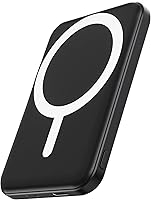
The Anker 621 MagGo Power Bank suits iPhone users who want a slim 5,000mAh magnetic battery for short top-ups without carrying a larger pack.
It measures 4.13 x 2.62 x 0.45 in and weighs 4.41 oz. Its magnetic attachment is designed for iPhone 15 and iPhone 14, while the compatible-device information includes iPhone 16, iPhone 15 series, iPhone 14 series, iPhone 13 series and iPad.
The unit has 1 USB Type-C port. Anker includes a 23.6 in USB-C to USB-C cable, a welcome guide and a 24-month warranty.
Wireless charging is convenient when you need to keep using the phone, but it can be slower than a wired connection and may create heat. Anker says the battery can reach 98°F to 118°F when the surrounding temperature is 77°F.
Choose this model for a pocket, purse or small everyday carry. Choose a larger wired power bank if you need several charges, multi-device charging or laptop support.
See more options in best magnetic power banks for iPhone and best wireless power banks.
Anker 737 Power Bank
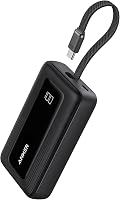
The Anker 737 Power Bank suits travelers and laptop users who need 24,000mAh capacity, 140W charging and a display that shows power information.
It has USB Type-A and USB Type-C ports and supports laptops, smartphones, iPhone models, Samsung devices, MacBook, Dell and AirPods. The power bank measures 6.13 x 2.14 x 1.95 in and weighs 1.4 lb.
The display helps you see output power, input power and an estimated recharge time. Anker specifies a 5A cable and a 140W charger for rapid two-way charging.
The included items are a 140W USB-C to USB-C cable, travel pouch and welcome guide.
The 24,000mAh capacity is useful for long trips, but the body is too large for buyers who only want a quick phone top-up. It is described as meeting airline carry-on requirements, though local airline and country rules still apply.
For more laptop-focused choices, see best power banks for laptops and best power banks for travel.
UGREEN Nexode 25000mAh 145W 3-Port USB-C Power
The UGREEN Nexode suits users who need a 25,000mAh battery, up to 145W total output and 3 ports for laptops, phones, tablets and handheld devices.
It supports USB PD3.1 and QC3.0. UGREEN states that one USB-C1 port can provide up to 140W and that the battery can power a 16 in MacBook Pro from 0% to 56% in 30 minutes.
The power bank measures 6.3 x 3.2 x 1.1 in and weighs 505g. It is compatible with iPhone, Google Pixel, MacBook, Dell, Samsung Galaxy, iPad, Nintendo Switch, Steam Deck, DJI devices and other listed electronics.
A 65W or higher adapter can recharge it in about 2 hours. A 20W adapter can take up to 6 hours.
The included 5A USB-C to USB-C cable is needed for full performance.
Choose it for a laptop-heavy travel kit or several high-demand devices. Its size and weight make it less attractive for someone who only needs a compact phone battery.
Compare high-capacity choices in best 20000mAh power banks and best fast charging power banks.
Power bank vs battery: what is the difference?
Power bank vs battery usually compares a complete charging product with the cells inside it. A power bank contains a rechargeable battery, but it also includes ports, control circuits and safety hardware.
A loose battery cell cannot safely replace a finished power bank. The pack manages charging and output, while the case protects the internal components.
The phrase “best battery power banks” can refer to models with higher capacity, better battery chemistry or stronger output. Look past the wording and compare the actual mAh, wattage, ports, cable requirements and size.
Lithium-ion and lithium-polymer cells are common in portable batteries. The products in this guide use either lithium-ion or lithium-polymer cells, but cell type alone does not determine which model is best for you.
How do you choose a portable battery power bank?
Choose a portable battery power bank by working through 6 questions:
- What device will you charge most often?
- How many full or partial charges do you need?
- Do you need wired, wireless or magnetic charging?
- Do you need to charge more than one device at once?
- Does a laptop require USB-C Power Delivery?
- Will the battery travel by plane, go camping or stay in an emergency kit?
For daily phone use, 5,000mAh to 10,000mAh is usually easier to carry. For tablets, travel and several phones, 20,000mAh is a more useful starting point.
For laptop charging, check wattage first. A high mAh number without enough USB-C output may not meet the laptop's needs.
Brand-specific comparisons can help once you know the required specifications. See best Anker power banks, best INIU power banks, best UGREEN power banks, best VEEKTOMX power banks, best VEGER power banks and best Vention power banks.
Which power bank features are worth paying attention to?
The most useful features depend on your routine. A display is useful when you need precise battery information, while wireless charging is useful when cable-free convenience matters more than speed.
A digital display can show remaining battery life more clearly than a row of lights. It may also show input, output or estimated recharge time, as on the Anker 737.
A built-in flashlight can help in an emergency kit. The BLAVOR adds dual flashlights and a compass carabiner, which may be useful outdoors but are unnecessary for ordinary office carry.
Solar charging can add backup value in bright outdoor conditions, but the panel may recharge slowly. It should not replace a wall charger when you need predictable recharge time.
For display-focused options, read best power banks with digital displays. For bulk kits, see best power bank multipacks for bulk buying.
Are wireless power banks better than wired models?
Wireless power banks are better for cable-free convenience, while wired models are usually better for speed, efficiency and wider compatibility. Choose wireless when alignment and ease matter, and choose wired when you need faster or higher-power charging.
Magnetic models work best when the phone and power bank use compatible magnetic positioning. The Anker 621 is designed around magnetic attachment and up to 7.5W wireless charging.
A wired USB-C model is more flexible for Android phones, tablets, laptops and accessories. It also avoids some of the energy loss and heat associated with wireless transfer.
For iPhone choices, compare best power banks for iPhone, best power banks for iPhone and iPad and best power banks for iPhone. For Android, see best fast charging power banks for Android.
How should you use and care for a power bank?
Charge the power bank with a suitable adapter and cable, then connect the device to the correct output. Keep the pack cool, dry and free from physical damage, and pause charging if it becomes unusually hot, swollen or damaged.
Use the cable required for the power level you want. The Anker 737 needs a 5A cable and 140W charger for its specified rapid charging, while the UGREEN model needs a 65W or higher adapter for about a 2-hour recharge.
Do not cover a power bank while it is charging. Heat can reduce charging speed, and connected devices can also warm up during demanding use.
Store the pack in a dry place away from extreme heat and sharp objects. Keep ports clean and avoid forcing a cable into a connector.
Read how to use a portable power bank for a simple setup guide. A portable power bank is not a replacement for an uninterruptible power supply, so use what is a portable UPS when you need backup power for equipment during an outage.
A UPS switches automatically when utility power fails, as explained in how a UPS battery backup switches to battery power. A power bank normally needs you to connect the device and begin charging.
What should you check before buying?
Check the capacity, usable charging needs, output wattage, ports, included cable, dimensions and travel rules. The best power bank battery is the one whose output matches your main device without adding more weight or features than you need.
For a compact phone pack, the Anker 621 is the smallest option here and uses magnetic wireless charging. For outdoor backup, the BLAVOR adds a flashlight, compass carabiner, wireless charging and a low-power solar panel.
For laptops and several devices, the Anker 737 and UGREEN Nexode provide much higher capacity and output. The Anker 737 has a smart display and 140W charging, while the UGREEN provides 25,000mAh and up to 145W total output.
Before ordering, confirm the connector, cable rating and device compatibility. Also measure the space in your bag, especially if you plan to carry a 1.4 lb laptop power bank.
Explore power banks by topic
Use this topic page when the power bank is only part of the charging setup. The right cable, base or connector can matter as much as the battery itself.
Check that any separate charger matches the voltage, wattage and connector needs of your power bank. A suitable base can make recharging more convenient at home or at a desk.
Final power bank battery buying advice
Choose a 5,000mAh magnetic power bank for a small iPhone top-up, a 10,000mAh BLAVOR for outdoor and emergency use, or a 24,000mAh to 25,000mAh USB-C model for laptops and several devices. That simple split covers most daily needs without overbuying.
Capacity answers how long the pack can help, while wattage and charging standards answer how quickly it can work. Match both to your device, then consider ports, cables, size, heat and travel rules before you buy.
For a compact pocket carry, a small magnetic battery is easy to attach and use for a short phone top-up. It suits commuters and anyone who prefers cable-free alignment for occasional charging.
For camping, hiking or an emergency kit, a midsize outdoor pack adds useful extras beyond stored energy. Flashlights, a compass and basic water resistance can be helpful when wall power is not available.
For a laptop, tablet and phone together, choose a high-output USB-C model with enough wattage for the most demanding device. A display can help you track input, output and remaining charge while you travel.
Do not buy the largest capacity by default. Extra energy adds weight, takes longer to recharge and may not improve speed for a phone that accepts limited input.
Check the included cable rating before you rely on fast charging. A lower-rated cable can limit output, even when the power bank and device support higher wattage.
Also measure the space in your bag and consider how warm the pack gets during use. Good ventilation and a cool spot help maintain steady charging and protect the battery.
If you are still comparing brands, start with best EcoFlow power banks, best Xiaomi power banks and the broader charging guide above. Compare capacity, output, ports and dimensions side by side.
The best final choice is the one you will actually carry and use. Match it to your main device first, then add features that fit your routine rather than features you may never need.
Frequently asked questions
What is the best capacity for a power bank?
A 10,000mAh power bank suits many daily phone users because it balances capacity and size. Choose 5,000mAh for a small emergency top-up, 20,000mAh for travel or several devices, and 24,000mAh to 25,000mAh when you also need to charge a tablet, laptop or game console.
Is a power bank the same as a portable battery?
Yes. Power bank, portable battery and portable charger usually describe a rechargeable battery pack that sends power to another device.
The useful differences are capacity, ports, output wattage, charging standards, size and whether the unit supports wireless charging or built-in cables.
Can a power bank charge a laptop?
A power bank can charge a laptop when its USB-C output supports the laptop's required charging standard and wattage. Check the laptop's input needs, use a suitable cable and remember that charging speed can fall as the battery fills or if the power bank gets warm.
Can you take a power bank on a plane?
Carry power banks in your cabin baggage and check the airline's current rules before flying. Capacity, labeling and local restrictions can matter.
The Anker 737 is described as meeting airline carry-on requirements, but it cannot be carried on domestic flights within China because it lacks China's 3C certification.
Are higher mAh power banks always better?
Higher mAh gives you more stored energy, but it also usually means more size and weight. A 5,000mAh magnetic battery may be easier to carry every day, while a 20,000mAh or larger power bank makes more sense for tablets, laptops, camping or several phones.