Power Bank vs Charger: Which Do You Need? (November 2026)
Choose a charger for daily use at home and a power bank for power away from the outlet. In a power bank vs charger comparison, the key split is location: a charger needs a wall outlet, while a power bank stores energy you can carry.
On this page (10 sections)
- Power bank vs charger: the quick verdict
- The two side by side in daily use
- Stored power or direct power: which do you need?
- Capacity: how much stored power is enough?
- Charging speed: wattage and cables explained
- Portability: size, weight and what you carry
- Features that change daily use
- Cost: cheap chargers vs power banks
- Who should buy which?
- Power bank vs charger: the final choice
Choose a charger for daily use at home and a power bank for power away from the outlet. This power bank vs charger guide compares stored portable power with charging directly from an electrical outlet, so you can see which fits your routine.
A wall charger is tethered to the grid. It gives you steady power as long as the outlet works.
A power bank carries its own battery. It gives you freedom from the outlet, but only until its stored charge runs out.
Our score weighs specs, features and buyer feedback against what you are shopping for. We compared the specs, checked capacities and weighed charging speed, size and included cables.


Power bank vs charger: the quick verdict
A charger wins for home and desk use; a power bank wins for travel and outages. The choice comes down to where you charge, not which device is better in general.
If you sit at a desk all day, a wall charger is simpler. You plug in once and your phone stays powered.
You never need to track a second battery level.
If you move around, a power bank gives you options. You can charge on a train, in a park or during a blackout.
You trade unlimited grid power for limited stored power.
Our power bank battery guide explains how stored capacity works. It helps you match milliamp hours to the number of charges you need.
When direct power still needs a backup
A charger alone leaves you exposed when the outlet is busy or the power fails. A power bank in a drawer or bag covers that gap without much effort.
Many homes keep both for that reason.
Think about your worst case day as well as your normal day. A normal day may need only a desk charger.
A travel day or an outage day needs stored power you can move.
The two side by side in daily use
A charger refills a phone directly from the wall; a power bank refills it from its own battery. That one difference shapes speed, cost and convenience.
A charger has no battery to manage. Its speed depends on its watt rating and your phone's limit.
You get power the moment you plug in.
A power bank has a battery to manage. You must charge it first, then use it later.
Its usable capacity is less than the headline number because of conversion losses.
| Feature | Wall charger | Power bank |
|---|---|---|
| Power source | Electrical outlet | Stored battery |
| Best location | Home, office, hotel | Travel, outdoors, outages |
| Capacity limit | None while plugged in | Fixed milliamp hours |
| Extra step | None | Recharge the bank itself |
| Portability | Needs an outlet nearby | Works anywhere |
| Typical use | Daily phone charging | Backup and on-the-go charging |
The table makes the trade clear in plain terms. Direct power is limited by location.
Stored power is limited by capacity. A charger asks you to go to the power.
A power bank brings the power to you, within its charge.
That location limit also affects sharing. A wall charger can serve anyone who can reach the outlet.
A power bank can serve anyone who can reach you.
Stored power or direct power: which do you need?
You need stored power when the outlet is not near you, and direct power when it is. Start with your day, not with a spec sheet.
Ask where your phone battery usually drops. If it drops at your desk, a charger fixes it.
If it drops on a commute or a hike, only a power bank helps.
Power bank vs charger for home use
At home, direct outlet charging is the simpler tool. Your phone can stay plugged in overnight, and you never worry about a bank running flat.
A power bank still helps at home during an outage. It can keep your phone alive when the grid fails.
Keep it charged and stored where you can grab it fast.
Power bank vs charger for travel
Travel splits the two roles. A power bank covers flights, trains and sightseeing days.
A charger covers hotel nights when you can recharge both devices.
Our power bank vs portable charger guide covers the naming overlap. The terms are close, but portable power still means stored power you carry.
On a travel day, capacity matters more than at home. A 10,000mAh bank may cover a light day, while a 20,000mAh bank covers heavy screen use and multiple devices.
At night, a wall charger refills both the phone and the bank for the next day.
Capacity: how much stored power is enough?
Choose 10,000mAh for a day of light use and 20,000mAh for long travel days. The headline number overstates what your phone receives.
Expect to lose 30% to 40% to heat and conversion. A 10,000mAh bank delivers about 6,000mAh to 7,000mAh.
That is roughly 2 phone charges.
A 20,000mAh bank delivers about 11,000mAh to 14,000mAh. Anker says its Zolo bank can charge an iPhone 15 up to 4 times.
That math fits a long day with heavy screen use.
Capacity also shapes multi device days. A phone and earbuds draw less than a phone and a tablet.
The Anker Zolo low current mode helps with small devices like earphones.
A simple estimate helps before you buy. Multiply the bank capacity by about 0.65, then divide by your phone battery capacity.
That gives a rough number of charges.
Charging speed: wattage and cables explained
Higher wattage means a faster top-up, but your phone sets the limit. A 45W bank will not force a phone that accepts less to charge faster.
The INIU bank outputs 45W. INIU says it can boost an iPhone 17 Pro Max to 76% in 30 minutes from 20%.
Your result will vary with your phone and its cable.
Cables matter as much as wattage. A weak cable can cap your speed.
Use the cable that came with the bank or a rated USB-C cable that matches its output.
Recharge speed matters too. The Anker Zolo recharges at 20W input and takes about 5.1 hours with a 20W wall charger.
The INIU recharges in about 2 hours with a 27W fast charger.
Speed also changes with how many devices share the bank. The BLAVOR bank can charge 3 devices at once, with USB-C 20W output among its options.
Sharing across three devices splits the available power.
Portability: size, weight and what you carry
A smaller bank is easier to carry daily; a larger bank is easier to share on trips. Weight and size decide whether you actually use it.
The BLAVOR bank weighs 9.3 ounces and measures 5.9 x 3.1 x 0.8 inches. INIU says its bank is 40% smaller and 36% lighter than conventional chargers of this size.
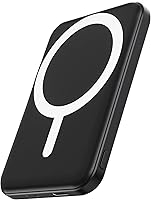
The Miady packs are the slimmest at 5.5 x 2.6 x 0.6 inches and 7.68 ounces each. That slim shape slides into a pocket or purse without bulk.
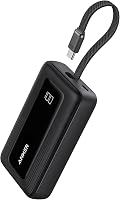
The Anker Zolo at 12.45 ounces is the heaviest here. You carry that weight in exchange for 20,000mAh and a built-in cable that saves bag space.
Thickness also matters. The INIU at 5.26 x 2.7 x 0.5 inches is thinner than most options here.
That thin profile suits bags and purses where space is tight.
Features that change daily use
Built-in cables, wireless charging and solar panels each solve a different problem. Match the feature to the situation where you run out of power.
A built-in USB-C cable, like the one on the Anker Zolo, removes a loose cord. It is rated for over 10,000 bends, so it should survive daily use.
You lose the option to swap it, though.
The BLAVOR bank offers 10W wireless charging and can charge 3 devices at once. That suits a phone plus earbuds on a nightstand.
Its solar panel tops up slowly at 1.15W max, so treat the sun as backup, not the main refill.
INIU takes the opposite approach with a detachable 0.4ft USB-C cable. If the cord wears out, you can swap it instead of replacing the bank.
Power bank vs charger safety and care
Store banks at partial charge, keep them dry and retire damaged units. Heat and moisture shorten battery life and raise risk.
BLAVOR rates its bank IPX5 waterproof, dustproof and shockproof. That helps outdoors, but it does not mean you should submerge it or leave it in rain for hours.
Keep any bank out of hot cars and direct sun when you can. Charge it in a cool, dry spot.
If a battery swells, smells sweet or gets hot without use, stop using it and recycle it through a battery program.
The Anker Zolo uses ActiveShield 2.0 to monitor temperature and adjust output. That protection matters most when you charge in a warm bag or a car.
Cost: cheap chargers vs power banks
A wall charger costs less upfront; a power bank costs more because it includes a battery. Cheap units in both types deserve extra scrutiny.
A basic charger has simpler parts. A power bank adds cells, electronics and a case.
That is why even budget banks cost more than budget plugs.
Compare value by usable features, not by headline capacity alone. A 2-pack like Miady spreads cost across 2 units.
A fast bank like INIU adds value if you use 45W speeds daily.
Our power bank vs solar charger comparison helps if solar is on your list. Solar adds a slow refill option, not a replacement for cable charging.
Warranty and support shape long term value too. The Anker Zolo lists an 18 month warranty, and INIU lists 3 year INIU Care.
A longer support period can matter if you carry a bank daily.
Who should buy which?
Buy a charger if you charge in one place; buy a power bank if you charge on the move. Some readers need both, and that is fine.
Choose a wall charger if you work at a desk, charge overnight and rarely leave outlets. It is the simplest setup with no battery to track.
Choose a power bank if you commute, travel or face outages. The best EcoFlow power banks guide covers larger portable options for longer trips.
Choose the Anker Zolo for long travel days. Choose the INIU for fast daily top-ups.
Choose the BLAVOR for outdoor backup with wireless charging. Choose the Miady 2-pack for a home and car split.
If you want a bank that plugs straight into the wall to refill, our best power banks with wall plugs guide covers that middle ground.
A simple test can point you to the right pick. Note where your phone hits 20 percent on a normal day.
If that happens at your desk, start with a charger. If it happens on a train, in a park or on a trail, start with a power bank.
Power bank vs charger: the final choice
Pick a charger for home, a power bank for travel, and both if your day spans both. That rule settles most power bank vs charger decisions.
Tell a friend your routine: desk, commute or trail. A desk routine points to direct outlet charging.
A moving routine points to stored portable power.
If you charge a tablet or laptop on the road, check our best power banks for iPad guide. iPad charging draws more power, so wattage and capacity matter more.
Our Anker Prime charging guide helps if you already use Anker Prime gear. It shows how bases and chargers pair with Prime banks for desk setups.
Whichever you choose, match capacity to your day and wattage to your devices. That gives you power where you need it, without paying for storage you will never use.
Frequently asked questions
Is a power bank the same as a charger?
No. A charger plugs into a wall outlet and draws power directly from the grid.
A power bank stores charge in its own battery, then you use that stored power later.
That is why a charger suits a desk and a power bank suits travel, outages and outdoor use.
Can a power bank replace a wall charger at home?
It can for short periods, but it is a poor daily replacement. You must recharge the power bank itself before it runs out, which adds a step.
A wall charger gives steady power without a battery limit, so it is simpler for daily home charging.
How many charges does a 10,000mAh power bank give?
Plan on about 2 phone charges from a fully charged 10,000mAh power bank. Conversion losses mean you get roughly 60% to 70% of the stated capacity in practice.
A 20,000mAh bank gives about twice that, or roughly 4 phone charges.
Are cheap chargers and power banks unsafe?
Cheap units vary widely in quality. Look for clear capacity, certified charging standards and temperature protection rather than low price alone.
A damaged or swollen battery should be retired and recycled safely, not used or stored indoors.
Which is better for travel, a power bank or a charger?
A power bank is better for travel because it works without an outlet. A charger is better once you reach your hotel, since it refills your phone directly and faster.
Many travelers carry both: a power bank for the day and a charger for overnight use.