Power Bank vs Portable Charger: Is There a Difference? (November 2026)
Power bank and portable charger usually mean the same battery-powered device. Compare capacity, output, ports, cable design and size instead of choosing by the name alone.
On this page (12 sections)
- Power bank vs portable charger: are they the same thing?
- How do power banks and portable chargers differ from wall chargers?
- Which capacity should you choose?
- Does output wattage matter more than the name?
- Which cable setup is easiest to live with?
- Which portable charger is best for daily carry?
- Which power bank is better for long travel?
- Which portable charger is best for slim fast charging?
- When does a 2-pack make more sense?
- Are power banks allowed on flights?
- How should you compare equivalent devices?
- Power bank vs portable charger: which should you buy?
Power bank and portable charger usually mean the same battery-powered device. The useful power bank vs portable charger comparison is about capacity, output, ports, cable design and how much weight you want to carry.
The names overlap because brands and retailers use both terms for rechargeable battery packs. A device called a portable charger may be a power bank, but the phrase can also describe a wall charger that has no stored battery.
Before you compare labels, confirm that the device has a stated battery capacity in milliamp-hours, or mAh. Our power bank battery guide explains how capacity, energy loss and charging needs affect the number of useful charges.


Power bank vs portable charger: are they the same thing?
A power bank is usually a type of portable charger, and the 2 terms often describe the same product. The phrase power bank focuses on the stored battery, while portable charger focuses on the job it performs.
A power bank stores energy internally and sends it to another device later. You charge the power bank from an outlet, then use it when your phone, tablet or other device is away from a wall socket.
For practical steps, read using a portable power bank.
Portable charger is a wider phrase. It may refer to a battery pack such as the Anker Power Bank or INIU portable charger, but it can also refer to a compact plug-in charger.
A plug-in wall charger transfers power but does not provide stored battery capacity by itself.
That is why a product name alone isn't enough. Look for the battery capacity, charging output and ports before you decide.
What is a power bank portable charger?
A power bank portable charger is a rechargeable battery pack that stores energy for later use. It normally has an input for recharging the pack and one or more outputs for charging other devices.
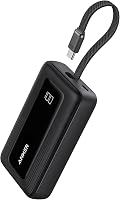
The Anker Power Bank has a 10,000mAh capacity, up to 30W output and a built-in 5.4-inch USB-C cable. The INIU 10000mAh 45W Fast Charging Portable Charger also stores 10,000mAh, but it uses a detachable 0.4-ft braided USB-C cable and provides 45W output.
Both fit the common meaning of power bank portable charger. Their different cable designs and output levels matter more than the wording on the front of the box.
How do power banks and portable chargers differ from wall chargers?
A power bank contains a battery, while a standard wall charger normally needs an outlet during use. Both can charge a phone, but only the power bank can keep working after you leave the outlet.
A wall charger is useful at home, work or in a hotel room. It can often provide steady power for a device, but it won't help when the outlet is far away or unavailable.
A battery pack is useful on a commute, flight, road trip or during a short outage. It has a limited stored capacity, and some energy is lost during voltage conversion and charging.
For a broader comparison of charging equipment, see our guide to power bank vs charger. It covers the difference between battery packs and chargers that draw power directly from an outlet.
Which capacity should you choose?
Choose 10,000mAh for lighter daily carry and 20,000mAh for longer trips or more devices. The capacity number describes stored battery energy, not the exact amount that reaches your phone.
The 10,000mAh Anker is 4.32 x 2.58 x 0.98 inches and weighs 223g. It suits a commuter or traveler who wants a compact backup and doesn't need the largest reserve.
The INIU is also a 10,000mAh model, with dimensions of 5.26 x 2.7 x 0.5 inches and a battery weight of 160g. Its slim shape and detachable cable make it a practical choice when pocket or bag space matters.
The Anker 20,000mAh model is 6.2 x 2.9 x 1.0 inches and weighs 15.2 ounces. Its larger reserve fits longer days, several charging sessions or devices that need more power.
Actual charge counts vary because conversion and charging create energy loss. A 20,000mAh power bank does not deliver 20,000mAh directly to a phone battery, and a 10,000mAh pack does not guarantee a fixed number of full charges.
Does output wattage matter more than the name?
Output wattage matters when you need faster charging or want to charge a larger device. A higher watt rating can help a compatible device charge faster, but the device and cable must also support the required power.
The compact Anker supplies up to 30W and supports up to 30W output with 20W input. It is a good match for phones, tablets and other devices that do not need laptop-level power.
The INIU supplies 45W. That gives it more output headroom than the 10,000mAh Anker, while its total capacity remains the same.
The larger Anker can share up to 87W across 3 devices, with up to 65W going to one device. That makes it the stronger choice here for a compatible laptop or for charging several devices during travel.
Don't treat the highest watt number as the best choice for every phone. Higher output can add size or cost, and your device may accept less power than the charger can provide.
Which cable setup is easiest to live with?
A built-in cable reduces what you need to pack, while a detachable cable is easier to replace or swap. Choose based on whether convenience or cable flexibility matters more to you.
The 10,000mAh Anker has a built-in 5.4-inch USB-C cable. It also has USB-C and USB-A connections, so you have more than one way to connect a device.
The 20,000mAh Anker has a built-in USB-C cable and connections for 3 devices. Its cable is designed for repeated bending, but you still need to check that USB-C is suitable for the devices you plan to charge.
The INIU includes a detachable 0.4-ft braided USB-C cable. If that cable no longer suits your setup, you can use a different compatible cable rather than replacing the whole power bank.
The Miady 2-Pack includes 2 USB-C cables, but Lightning cables are not included. If your devices use a different connector, plan for the cable you already own.
Which portable charger is best for daily carry?
The 10,000mAh models are the easiest starting point for daily phone backup. They balance stored energy with a smaller body, while the best choice depends on output and cable preference.
Choose the Anker if you want the cable attached to the battery pack. Its 4.32 x 2.58 x 0.98-inch body is compact enough for a small bag, and its 30W output covers many phone and tablet charging needs.
The trade-off is capacity. A 10,000mAh pack stores less energy than the 20,000mAh Anker, so it is better for normal daily backup than for repeated charging across several days.
The built-in cable also limits flexibility if your device uses another connector. In that case, use a suitable cable through the available USB-A or USB-C connection.
Which power bank is better for long travel?
The 20,000mAh Anker is the better fit for longer trips and higher-power devices. Its larger capacity and up to 65W single-device output give it more room for several charging needs.
This model can share up to 87W across 3 devices. That is useful when a phone, tablet and another compatible device need power without taking turns.
Its larger body adds carry weight compared with the 10,000mAh choices. Check the charging requirements of your laptop or tablet before relying on it, since device compatibility depends on the power input your equipment accepts.
For shoppers comparing Anker charging accessories, our guide to the best Anker Prime power bank charger covers chargers and charging bases that pair with Anker power banks.
Which portable charger is best for slim fast charging?
The INIU 10000mAh 45W Fast Charging Portable Charger is the strongest fit when slim size and higher output matter. It combines 10,000mAh capacity with 45W output and a detachable USB-C cable.
The 0.5-inch thickness makes it the slimmest option in this group by the listed dimensions. Its 3 output ports include 2 USB-C ports and 1 USB-A port, giving you more connection choices.
The detachable cable is a practical advantage for travelers who already carry different cables. It also avoids the built-in-cable trade-off, although you still need to pack or obtain the right cable for devices that don't use USB-C.
The capacity remains 10,000mAh, so choose the larger Anker if your main need is more stored energy rather than a slimmer shape.
When does a 2-pack make more sense?
A 2-pack makes sense when 2 people need separate backup or you want one charger at home and one in a bag. It gives you 2 independent 10,000mAh power banks instead of one larger shared unit.
Each Miady unit can charge up to 3 devices at once through dual USB-A ports and a USB-C port. USB-C works as both input and output, so the same connection can recharge the pack or power a compatible device.
The full set weighs 437g, and each charger has its own body and connections. That can be convenient for sharing, but it takes more total space than carrying one compact battery pack.
The set includes 2 USB-C cables, but not Lightning cables. Check the connectors on your devices before you travel.
Are power banks allowed on flights?
Check the airline and airport rules before flying, then keep the exact battery pack in your carry-on if permitted. The INIU data describes its 10,000mAh power bank as TSA-compliant for carry-on travel, but policies can change and airlines may add their own limits.
A capacity of 10,000mAh is below the common 100Wh threshold used for many consumer power banks, but you should still verify current rules for your route. Do not put a battery pack in checked luggage unless the airline specifically allows it.
Keep the power bank protected from damage and avoid carrying it with loose metal objects that could contact its ports. Follow the brand's instructions for storage, charging and use.
How should you compare equivalent devices?
Compare battery capacity, output, ports, cable design, size and weight in that order. Those details tell you whether 2 products with different names actually solve the same problem.
Use this quick checklist:
- Confirm that both devices have a rechargeable battery and a stated mAh capacity.
- Compare output wattage with the phone, tablet, game system or laptop you want to charge.
- Check whether the cable is built in, detachable or not included.
- Count the ports if you need to charge more than one device.
- Measure the body if it must fit a pocket, purse or travel pouch.
- Check the connector type for every device you plan to use.
- Review travel rules before taking the pack on a flight.
A product called portable charger is not automatically more powerful than one called power bank. The specifications decide whether the devices are equivalent.
Power bank vs portable charger: which should you buy?
Pick a power bank or portable charger by its battery and charging specifications, not by the label. Choose the compact Anker for a built-in USB-C cable, the larger Anker for longer trips and compatible higher-power devices, the INIU for slim 45W charging, or the Miady set for shared backup.
If you are comparing another brand, use the same decision rule. Capacity tells you how much energy is stored, output tells you what the pack can deliver, and the cable and port layout determine how easily it fits your devices.
For another brand comparison, see the best EcoFlow power banks guide. If your goal is backup power for equipment that must stay connected, read What Is the Difference Between a UPS and a Battery Backup? and [What Is a Portable UPS?
The Complete Guide](/what-is-a-portable-ups/) before choosing a battery pack.
Shoppers who prefer cable-free phone charging can also compare best wireless power banks, while those focused on another USB-C brand can browse the best UGREEN power banks.
Frequently asked questions
Is a power bank the same as a portable charger?
Usually, yes. Power bank and portable charger are overlapping names for a rechargeable battery pack that stores energy and sends it to a phone, tablet or other device.
Some sellers use portable charger for wall chargers too, so check for a stated battery capacity before buying.
What is the difference between a power bank and a portable charger?
The main difference is usually wording, not function. Power bank normally means a battery-powered charger that works away from an outlet, while portable charger can describe that same device or a small wall charger.
Capacity, output and ports tell you more than the product name.
Is a portable charger better than a power bank?
Neither name is automatically better. Choose the device with the capacity, output and cable setup that match your routine.
A 10,000mAh model is easier to carry, while a 20,000mAh model can provide more stored energy for long trips and several devices.
Can a power bank charge a laptop?
Some can, if the power bank provides enough output and the laptop accepts charging through its connection. The Anker 20,000mAh model here provides up to 65W to one device, while the 10,000mAh Anker provides up to 30W.
Check your laptop's charging requirement first.