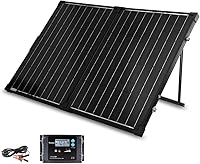
9 Best Foldable Solar Panels (November 2026)
The best foldable portable solar panels include the Renogy 200W Portable Solar Panel for Power for compact 200W charging, the ZOUPW 100W Portable Solar Panel for Power for lighter 100W trips, and the SOKIOVOLA N-Type 16BB 200W Portable Solar Panel for broad station compatibility.
On this page (7 sections)
- How we chose the best foldable solar panels
- The best portable fold up solar panels by use
- What should you compare in a folding solar panel?
- How does folded size affect portability?
- How much charging output can you expect?
- How do you use foldable solar panels safely?
- Which foldable solar panel should you choose?
The best foldable solar panels balance useful output with a packed size and weight you can manage. Renogy's 200W panel folds to 23.72 x 22.99 x 1.97 in, while ZOUPW's 100W model weighs 9.48 lb and DOKIO's 200W kit weighs 9.7 lb.
For a broader primer on what is a portable solar panel, start with how panels connect to batteries and power stations. The right portable folding solar panel depends on what you need to charge, how far you'll carry it, and whether your station accepts its connector and voltage.
Our picks at a glance
-
1
 Best for compact 200W charging
Renogy 200W Portable Solar Panel for Power
9.7/10 our score
See it on Amazon -
2
 Best for lighter 100W trips
ZOUPW 100W Portable Solar Panel for Power
9.7/10 our score
See it on Amazon -
3
 Best for broad station compatibility
SOKIOVOLA N-Type 16BB 200W Portable Solar Panel
9.4/10 our score
See it on Amazon
- 4
 Check it
DOKIO 200W Portable Foldable Solar Panel Kit
Best for 12V battery charging - 5
 Check it
ZOUPW 480W Bifacial Portable Solar Panel N-Type
Best for high output at camp - 6
 Check it
Ecosonique Technology 400W Portable Solar Panel for Power
Best for 400W in a compact fold - 7
 Check it
Renogy 400W Portable Solar Panel
Best for durable 400W travel - 8
 Check it
TWELSEAVAN 200W Portable Solar Panel for Power
Best for direct USB-C charging - 9
 Check it
BougeRV 200W Portable Solar Panel
Best for fiberglass reinforcement
How we chose the best foldable solar panels
The best foldable solar panels here combine stated output with practical packed dimensions, manageable weight, and connection options. For a brand-specific comparison, see our ALLPOWERS solar panel guide.
We compared those details and how each design fits likely use, from a 100W day-trip panel to larger 400W and 480W charging setups.
Our score weighs specs, features and buyer feedback against what you're shopping for. A panel's maximum wattage is only one part of the fit: check station input limits, voltage range, cable type, and how much space the folded panel takes in your vehicle or gear.
| Product | Best for | Output | Folded size | Weight | Our score |
|---|---|---|---|---|---|
| Renogy 200W Portable Solar Panel for Power | compact 200W charging | 200W maximum | 23.72 x 22.99 x 1.97 in | 13.89 lb | 9.7 |
| ZOUPW 100W Portable Solar Panel for Power | lighter 100W trips | 100W maximum | 24.13 x 21.06 x 1.77 in | 9.48 lb | 9.7 |
| SOKIOVOLA N-Type 16BB 200W Portable Solar Panel | broad station compatibility | 200W maximum | 21 x 23 in | 16.31 lb | 9.4 |
| DOKIO 200W Portable Foldable Solar Panel Kit | 12V battery charging | 200W panel | 20 x 27 x 1.1 in | 9.7 lb | 9.4 |
| ZOUPW 480W Bifacial Portable Solar Panel N-Type | high output at camp | 480W maximum | 22.5 lb | 8.5 | |
| Ecosonique Technology 400W Portable Solar Panel for Power | 400W in a compact fold | 400W maximum | 26 x 22 x 3 in | 20.3 lb stated | 8.2 |
| Renogy 400W Portable Solar Panel | durable 400W travel | 400W maximum | 33.7 x 27.95 in | 30.2 lb | 8.1 |
| TWELSEAVAN 200W Portable Solar Panel for Power | direct USB-C charging | 200W maximum | 23 x 22 in | 15.7 lb | 8.0 |
| BougeRV 200W Portable Solar Panel | fiberglass reinforcement | 200W maximum | 13.8 lb | 7.9 |
The best portable fold up solar panels by use
These foldable portable solar panels suit different storage limits and charging jobs. Read each pick's folded dimensions and connector details before deciding where it will travel and what it will power.
Renogy 200W Portable Solar Panel for Power: Best for compact 200W charging
- 200W maximum power
- 13.89 lb
- Folds to 23.72 x 22.99 x 1.97 in
- USB-C PD 45W and dual USB-A ports
A compact 200W option with direct USB charging and four kickstands. It uses MC4 output, and its 4-in-1 adapter is sold separately.
Pros
- Compact folded dimensions for a 200W panel
- USB-C PD 45W and dual USB-A
- Four kickstands with 40°, 50° and 60° angles
Cons
- 4-in-1 adapter sold separately
- MC4 output requires compatible input
Renogy's 200W panel is the leading all-round pick for buyers who want useful output without a broad, bulky folded package. At 13.89 lb, it folds to 23.72 x 22.99 x 1.97 in, a shape that can fit alongside other RV or car-camping gear.
Four kickstands offer 40°, 50° and 60° positions, so you can adjust the panel as the sun moves. Renogy also includes USB-C PD 45W and two USB-A ports for charging compatible devices directly.
For power stations, this panel has MC4 output only. Renogy's 4-in-1 adapter is sold separately, so match the MC4 output and your station's voltage requirements before packing it for a trip.
This is a strong choice when you want a 200W panel that also charges smaller devices without relying on the station. If you already own another Renogy panel or want to compare the brand's other options, see our guide to the best Renogy portable solar panel.
ZOUPW 100W Portable Solar Panel for Power: Best for lighter 100W trips
- 100W maximum power
- 9.48 lb
- Folds to 24.13 x 21.06 x 1.77 in
- Five connector types included
A lighter panel for modest charging needs, with a 5-in-1 cable for several common power station inputs. Its USB hub and cables need to stay dry.
Pros
- Lightest panel among these picks
- 5-in-1 connector cable included
- Built-in USB-C and dual USB-A charging
Cons
- 100W maximum output
- USB hub and cables are not fully waterproof
ZOUPW's 100W model is the lightest pick here at 9.48 lb, making it a better match for modest charging needs and frequent carrying. It folds to 24.13 x 21.06 x 1.77 in, with a magnetic handle and two adjustable kickstands.
Its included 5-in-1 cable has DC8020, XT60, Anderson, DC7909 and DC5521 connectors. Built-in USB-C PD and two USB-A ports can charge smaller devices directly, but keep the USB hub and cables dry even though the panel body has an IP67 rating.
A 100W panel won't suit every power station or energy need. The station may also accept less power than the panel can provide, so check its maximum solar input before you buy.
Choose this one when weight and connector choice matter more than higher panel output. For a trip where you want to compare broader charging setups, see our picks for best portable solar panels for camping.
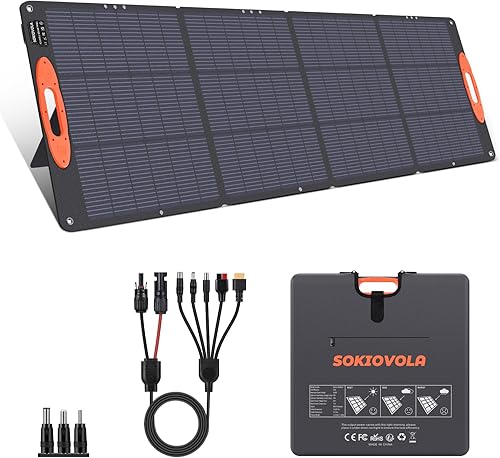
SOKIOVOLA N-Type 16BB 200W Portable Solar Panel: Best for broad station compatibility
- 200W maximum power
- 16.31 lb
- Folds to 21 x 23 in
- MC4 to 5-in-1 connector cable
This 200W panel packs into a 21 x 23 in shape and includes several common station connectors. At 16.31 lb, it is better suited to car-based trips than long hikes.
Pros
- Small folded footprint
- 5-in-1 connector cable included
- ETFE coating and IP68 rating
Cons
- Heavier than the 100W pick
- Power station input limits can reduce charging
SOKIOVOLA packs a stated 200W output into a panel that folds to 21 x 23 in. At 16.31 lb, it's portable by car or RV, though less appealing for a long walk from a parking area.
The included MC4-to-5-in-1 cable supports XT60, DC5521, DC7909, DC8020 and Anderson connections. Its ETFE coating and IP68 rating are useful features for outdoor trips, but confirm the connected station's input range and limits.
That input check matters even in strong sun. A station that caps incoming solar power will not take the panel's full rated output.
Pick SOKIOVOLA if folded footprint and multiple connector choices matter more than minimizing weight. If a complete panel and accessory setup is your priority, compare it with our best foldable solar panel kit.
DOKIO 200W Portable Foldable Solar Panel Kit: Best for 12V battery charging
- 200W panel
- 9.7 lb
- Folds to 20 x 27 x 1.1 in
- Separate PWM controller included
A slim 200W panel with an included PWM controller for 12V battery systems. Its 9.84 ft cable gives you room to place the panel in sun and keep connected gear shaded.
Pros
- Lightweight for a 200W panel
- PWM controller included
- Long cable for flexible placement
Cons
- Controller is PWM, not MPPT
- Confirm power station input limits before buying
DOKIO's 200W kit weighs 9.7 lb and folds to 20 x 27 x 1.1 in, one of the lightest choices here for its output class. It includes a separate PWM controller, which makes it relevant for compatible 12V battery systems.
The 9.84 ft cable lets you place the panel in sun while keeping the controller or power station in shade. Dual USB ports can charge small devices when the panel is connected to a 12V battery.
This kit's PWM controller is a different setup from a direct power station panel connection. Confirm how your battery or station should be connected, and check its input cap before choosing the 200W panel.
DOKIO fits buyers who value low weight, a slim pack, and a controller in the kit. If you expect to carry solar on foot, compare the carrying demands with our best portable solar panels for backpacking.
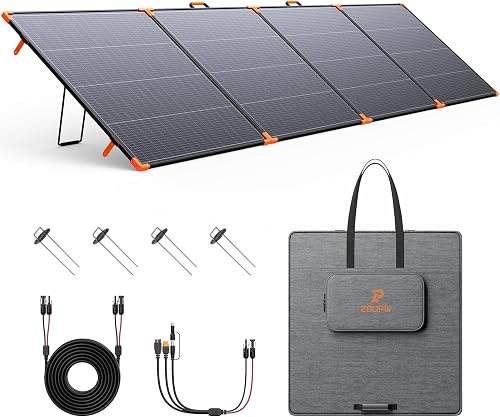
ZOUPW 480W Bifacial Portable Solar Panel N-Type: Best for high output at camp
- 480W maximum power
- 22.5 lb
- Bifacial design
- IP68 rating
A high-output folding panel for large power stations that accept its voltage. The bifacial design can use reflected light, while its 22.5 lb weight makes it a car-trip choice.
Pros
- Highest stated output here
- Bifacial design can capture reflected light
- Cable set and ground stakes included
Cons
- Requires a compatible high-voltage input
- Not recommended for long-term fixed connections
ZOUPW's 480W bifacial panel targets large power stations that can accept higher-voltage solar input. It weighs 22.5 lb and includes a storage bag, ground stakes, and connector cables.
The bifacial design can collect light from both sides, with the brand describing gains on reflective surfaces. That benefit depends on the surface and setup, so don't treat it as a fixed increase in output.
Before connecting it, confirm that your station supports the required input. ZOUPW advises verifying 50V+ input, and says the panel is not recommended for long-term fixed connections or shaded operation.
Choose this panel when higher rated output matters more than keeping the packed load light. Its size, weight, and voltage make it better suited to a vehicle-based backup setup than a small day pack.
Ecosonique Technology 400W Portable Solar Panel for Power: Best for 400W in a compact fold
- 400W maximum power
- 20.3 lb stated weight
- Folds to about 26 x 22 x 3 in
- Six-angle kickstand
This 400W option folds into a suitcase shape and includes MC4 cables with several station connectors. Check the station's voltage and input limits before connecting.
Pros
- 400W output in a six-fold design
- MC4 cable and adapter cable included
- Six-angle kickstand
Cons
- Weight differs between stated figures of 20.3 and 22.9 lb
- Confirm compatibility and input limits
Ecosonique Technology's 400W panel folds into a six-section shape measuring about 26 x 22 x 3 in. Its weight is given as 20.3 lb in the product description and 22.9 lb in the specifications, so use the higher figure when planning your load.
The included cables cover MC4 and adapters for XT60, Anderson and DC8020. Six kickstand angles help position the panel, while the rated 400W output makes station input limits especially important.
Check the station's accepted voltage, current and connector before use. Its maximum output is not the amount every power station will draw, and real output changes with sunlight and panel angle.
This pick suits a buyer seeking a higher-output panel that folds into a case-like form. Confirm the weight and folded storage space before settling on it for a trip.
Renogy 400W Portable Solar Panel: Best for durable 400W travel
- 400W maximum power
- 30.2 lb
- Folds to 33.7 x 27.95 in
- MC4 output cables
A larger folded package for buyers who want Renogy's 400W option with a carry case and fiberglass reinforcement. The 4-in-1 adapter cable is sold separately.
Pros
- 400W maximum output
- Carry case included
- Parallel wiring can reduce the effect of individual shadows
Cons
- Heaviest pick here
- Adapter cable sold separately
Renogy's 400W panel is designed for a larger charging job, but its 30.2 lb weight and 33.7 x 27.95 in folded size call for vehicle storage. A carry case is included, and fiberglass reinforcement, ETFE coating and an aluminum backsheet are part of its construction.
The output uses MC4 cables only. Renogy's 4-in-1 adapter is sold separately, so check your station's connector, voltage and current needs before buying.
Renogy says the panel has an IP67 rating and uses parallel wiring to help reduce the effect of individual shadows. Keep the connectors out of standing water, and remember that the 400W rating is measured under standard conditions.
Choose this panel if you want a higher-output Renogy option and can manage its larger packed size. For a more compact load, the 200W Renogy above is easier to carry and store.
TWELSEAVAN 200W Portable Solar Panel for Power: Best for direct USB-C charging
- 200W maximum power
- 15.7 lb
- Folds to 23 x 22 in
- USB-C PD 60W and two USB-A ports
A 200W panel with direct USB-C PD charging up to 60W and a broad adapter set for power stations. Four kickstands help set its angle toward the sun.
Pros
- USB-C PD 60W and two USB-A ports
- 8-in-1 connector options
- Compact 23 x 22 in folded size
Cons
- 15.7 lb is not suited to long-distance carrying
- Check station input limits
TWELSEAVAN's 200W panel folds to 23 x 22 in and weighs 15.7 lb. It has direct USB-C PD charging up to 60W, a QC3.0 USB port up to 18W, and another USB port rated at 5V/3A.
The included MC4 cable and three DC adapters provide several connection options for compatible power stations. Four adjustable kickstands help angle the panel, and the stated IP65 rating is for water resistance.
This panel gives you more output than a 100W model while keeping its folded footprint close to 2 ft on each side. Check the station's input limit and connector match, particularly if you plan to charge a battery station and devices at once.
Choose it when direct USB-C charging is a priority and 15.7 lb is acceptable for your setup.
BougeRV 200W Portable Solar Panel: Best for fiberglass reinforcement
- 200W maximum power
- 13.8 lb
- XT60 and DC7909 connectors
- IP65 water and dust resistance
A 200W foldable panel with fiberglass reinforcement and an 8.2 ft extension cable. Its stated folded dimensions are not available, so confirm packed space before choosing it.
Pros
- Fiberglass layer helps resist cracking
- XT60 and DC7909 connectors included
- 8.2 ft extension cable
Cons
- Folded dimensions are not specified
- Connector options are fewer than some picks
BougeRV's 200W panel combines N-Type cells with a fiberglass layer and weighs 13.8 lb. It includes XT60 and DC7909 connectors plus an 8.2 ft extension cable for placing the panel in sun while keeping connected gear nearby.
Its IP65 rating describes water and dust resistance for outdoor use. The folded dimensions aren't specified, so measure your storage space and confirm the packed size before choosing it for a tight vehicle compartment.
The connector set is narrower than some 5-in-1 options here. Verify that XT60 or DC7909 fits your power station, then check the station's input range and maximum accepted watts.
This is a practical pick when fiberglass reinforcement and a 200W rating matter, and you have room to confirm its folded size.
What should you compare in a folding solar panel?
Compare folded size, weight, output and connectors before choosing a foldable panel. Those four details determine whether it fits your storage space and can charge your gear.
A compact panel can still feel heavy on a long walk. The ZOUPW 100W and DOKIO 200W models are under 10 lb, while the Renogy 400W weighs 30.2 lb.
Output should match the power station rather than simply exceed it. Check the station's input wattage and voltage range, then compare the panel's cable and connector with the station port.
Some folding panels also have USB outputs for direct device charging. If you need to use a panel with a battery backup, first understand what a portable UPS is and whether your equipment needs backup power or just a way to recharge devices.
How does folded size affect portability?
Folded dimensions determine how easily a panel fits beside your other gear. A panel around 2 ft wide may fit an RV compartment, while a larger 400W model needs more room and a stronger lifting plan.
Weight is only part of portability. Handles, a carry case, cable storage and the number of folds can make setup and packing easier, but the panel still needs enough open space to face the sun.
For suitcase-style kits, compare the layout and included controller as well as the packed size. Our best portable solar panel kits for camping and best suitcase solar panel kit guides cover those formats.
How much charging output can you expect?
A panel's rated wattage is a maximum under set conditions, not a steady output promise. Cloud cover, sun angle, heat, shade and cable length can reduce the energy reaching a power station.
The station can also limit charging. If its input cap is 100W, a 200W panel may still deliver no more than the station accepts.
To get the most from a portable folding solar panel, point it toward direct sun and adjust its angle as needed. Keep the panel clear of shade, and follow the panel and power station instructions when connecting them.
How do you use foldable solar panels safely?
Use foldable solar panels on a stable surface, angle them toward direct sun, and keep connectors and devices dry as directed by the manufacturer. Never assume a panel's weather rating applies to its controller, USB ports or attached cables.
Before setup, verify the voltage and connector match for your power station or battery system. Keep cables clear of walkways, avoid placing heavy items on the panels, and pack the panel when conditions exceed its stated protection.
Our guide on how to use foldable solar panels walks through positioning and connection checks. For general portable panel setup and buying questions, see the portable solar panels complete buying guide.
Which foldable solar panel should you choose?
Choose Renogy's 200W panel for compact 200W charging with direct USB ports, ZOUPW's 100W panel for lower carry weight, or DOKIO for a light kit with a PWM controller. For higher output, compare the 400W and 480W options against your storage space and station input limits.
Folded size and connectors can matter more than the wattage printed on the panel. Check your power station's accepted input before choosing any portable fold up solar panel.
Our top 3 picks at a glance
-
1
Best for compact 200W charging
Renogy 200W Portable Solar Panel for Power
9.7/10 our score
See it on Amazon -
2
Best for lighter 100W trips
ZOUPW 100W Portable Solar Panel for Power
9.7/10 our score
See it on Amazon -
3
Best for broad station compatibility
SOKIOVOLA N-Type 16BB 200W Portable Solar Panel
9.4/10 our score
See it on Amazon
Frequently asked questions
Are foldable solar panels worth carrying?
Foldable solar panels can be useful when you need portable charging and have a place to set the panel in direct sun. Compare the folded size and weight with your vehicle storage or walking distance.
Their rated output is a maximum under specific conditions, so expect less when sunlight is weak, angled or blocked.
How many watts should a portable folding solar panel have?
Choose wattage based on the power station's solar input limit and the energy you need to replace. A 100W panel is lighter, while 200W and larger panels can provide more rated output but usually need more space and careful input checks.
Your station may cap the power it accepts.
Can foldable solar panels charge devices directly?
Some panels include USB ports for direct phone or tablet charging, such as the Renogy, ZOUPW 100W and TWELSEAVAN picks here. Other models focus on MC4 or adapter outputs for a power station.
Check which ports are built in before choosing a panel for device-only charging.
Can I leave a folding solar panel in the rain?
Weather protection varies by model, and a panel's rating may not cover its cables, controller or connected devices. For example, the ZOUPW 100W panel body is IP67 rated, but its USB hub and cables need to stay dry.
Disconnect and store the panel according to its instructions when conditions exceed its protection.
Why does my panel produce less than its rated watts?
Sun angle, cloud cover, shade, temperature and the power station's input limit can all reduce charging output. Rated wattage describes a maximum under standard test conditions, not a promise of the same output throughout the day.
Place the panel toward direct sun and check the station's accepted voltage and current.