Portable Solar Panel N-Type: Is It Worth Choosing?
N-type solar panels can suit portable charging when you want better performance in heat, low light or long-term outdoor use. Compare the panel's real output, folded size, connections and power station limits before choosing by cell type alone.
On this page (10 sections)
- Portable Solar Panel N-Type: Is It Worth Choosing?
- What does N-type mean in a portable solar panel?
- When should you choose N-type technology?
- What should you compare besides the cell type?
- Which portable products help with an N-type charging setup?
- How does heat affect an N-type portable panel?
- Are N-type panels better in shade or cloudy weather?
- How should you care for a portable solar panel?
- What is the best way to choose an N-type portable solar panel?
- FAQ
Portable Solar Panel N-Type: Is It Worth Choosing?
An N-type portable solar panel is worth choosing when efficiency, heat performance and long service life matter more than the lowest purchase cost. For many campers and emergency users, the cell type is only one part of the decision because the panel's folded size, output rating, controller and connection system shape the real experience.
N-type refers to the design of the solar cell, not a complete portable charging system. The same cell technology can appear in rigid panels, folding panels and other formats, so compare the full product rather than assuming every N-type panel will perform the same way.
If you are starting with the basics, read what is a portable solar panel first. It explains the panel, controller, cable and battery relationship before you compare cell technologies.
What does N-type mean in a portable solar panel?
N-type cells use an N-type silicon wafer structure that can reduce some common electrical losses. The practical goal is to keep more of the sunlight energy available as electrical output, although the panel's materials, wiring, temperature and controller still affect the result.
Traditional solar cells often use P-type silicon. N-type designs use a different charge-carrier arrangement, which can support lower degradation and better performance under some conditions.
Those benefits matter more when a portable panel spends many hours outside or must produce useful energy from a limited surface area.
Cell technology does not tell you the complete panel size or output. A compact N-type panel may produce less total power than a larger panel with another cell design, simply because it has less surface area.
The term also does not tell you whether the panel folds, includes a controller, works with a particular battery or has weather protection. Check each of those details separately.
Is N-type the same as monocrystalline?
N-type and monocrystalline describe different parts of the panel's design. Monocrystalline describes the silicon structure, while N-type describes the wafer's electrical type.
A panel can be both N-type and monocrystalline. That combination is common in newer high-efficiency solar products, but you still need the product's stated wattage, voltage, dimensions and connection details before deciding if it fits your setup.
For a wider comparison of panel designs, see what type of solar panel is best. The right choice depends on the space, weather, charging equipment and portability you need.
When should you choose N-type technology?
Choose N-type technology when you want to make better use of limited panel space or expect frequent outdoor charging. It can make sense for camping, van travel, emergency backup and other uses where you set up the panel repeatedly.
N-type can be a strong fit when:
- Your storage space is limited.
- You want more output from a similar panel footprint.
- The panel will spend many hours in outdoor heat.
- You plan to keep the panel for years.
- You charge a battery or power station away from a wall outlet.
- You prefer newer cell technology and accept that other parts of the system still control performance.
These advantages are not guarantees of higher daily energy. A shaded N-type panel can produce less than a well-positioned panel with another cell design.
Dirt, poor angle, damaged connectors and a full battery can also reduce useful charging.
When is another panel type a better choice?
Choose another panel type when price, availability, folded weight or simple compatibility matter more than cell efficiency. A panel that is easy to carry and correctly matched to your battery can be more useful than a technically advanced panel that stays at home.
A basic portable panel may suit occasional emergency charging. It may also be easier to replace or connect if your existing equipment uses common connectors.
Bifacial designs may help when reflected light can reach the rear of the panel. Compare that use case with our guide to the best bifacial portable solar panel before paying more for a rear-facing cell layout.
What should you compare besides the cell type?
Compare usable output, folded size, weight, connectors and input limits before choosing an N-type portable solar panel. These details determine whether you can carry, place and connect the panel without extra work.
Rated power and real charging conditions
A panel's wattage is a maximum rating under defined conditions. Outdoor output changes with sun angle, cloud cover, shade, temperature, dust and the device receiving the power.
Use the power rating to compare panels, not to promise a fixed charging speed. A 100W panel may be enough for phones, lamps and small battery systems, while a higher-wattage panel may better suit a larger 12V battery or power station.
The receiving device can also limit the result. If a power station accepts only a certain input level, a larger panel will not force more energy into it.
The station's limit becomes part of the charging setup.
Folded dimensions and weight
Folded dimensions decide whether you will actually bring the panel with you. Measure your storage space, vehicle compartment or emergency cabinet before choosing a larger panel.
Weight affects setup as well as transport. A heavier panel may need a stronger support surface, while a light foldable panel is easier to move as the sun changes.
Do not compare only the open panel size. The folded thickness, carrying shape and cable storage also affect how quickly you can pack it away.
Voltage, current and connectors
The panel and receiving equipment must match electrically and physically. Check voltage range, current, connector type and polarity before connecting a portable panel to a battery or power station.
A controller can protect a battery system, but it does not make every panel compatible with every battery. Follow the controller's connection order and the battery manufacturer's limits.
If the panel needs to sit farther from the battery, cable size and length matter. Longer or thinner cables can increase voltage drop.
The BougeRV 20 Feet 10AWG Solar Extension Cable uses tinned pure copper, male-to-female solar connectors, UV-resistant material and an IP67 waterproof ring on the male connector. It is rated for 30 A and 1000 volts of direct current, with one end fitted with connectors and the other end bare wire for a controller connection.
Keep connectors clean and fully seated. Never force a connector that does not match, and keep bare wire connections protected from contact with water or metal objects.
Which portable products help with an N-type charging setup?
The best supporting product depends on whether you need cable reach, a compact 12V panel or more charging capacity. The products below are not all N-type panels, but each can solve a different part of a portable solar system.
BougeRV 20 Feet 10AWG Solar Extension Cable
The BougeRV cable suits a setup where the panel must sit in direct sunlight while the controller or power station stays in a shaded position. Its 20 ft length gives you more placement flexibility than a short lead.
The cable uses 10AWG tinned pure copper and has male-to-female solar connectors. BougeRV states that the tinned coating improves corrosion and oxidation resistance compared with bare copper wire.
Its dual XLPE sheath is rated for use from -40°F to 194°F, and the cable has UV-resistant material for outdoor use. The male connector includes an IP67 waterproof ring and a built-in lock.
One end has installed connectors, while the other end is bare wire for connecting to a controller. An extra connector is included for an extended installation.
Choose it when distance and cable loss are the problem. It is an accessory, not a solar panel, so it cannot add generating capacity by itself.
DOKIO 100W Portable Foldable Solar Panel Kit
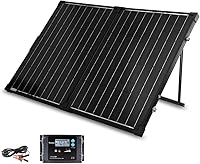
The DOKIO 100W Portable Foldable Solar Panel Kit suits a smaller 12V charging setup that needs a panel you can carry and store. It weighs 6 lb and folds to about 19 x 26 x 0.5 in.
The kit uses monocrystalline silicon and has a maximum power rating of 110W, a maximum voltage of 18V and a 12V DC output. It includes a standalone PWM controller, a bag and connection options listed as SAE, XT60, DC and alligator clips.
Its 9.84 ft cable lets you place the panel in sunlight while keeping the controller or power station farther away. The controller protects the 12V system from reverse polarity, overcharge, overload and short circuit.
The dual USB ports can supply phones, lights and small gadgets when connected to a 12V battery. They can also work in sunlight without a battery for emergency top-ups, although current can vary.
DOKIO notes that some power stations cap solar input at 60W. If your station has that limit, the panel cannot exceed it even in full sun.
Choose it for light portable charging and easier storage. It is not the right match for a power station whose input range does not accept its voltage or connector arrangement.
DOKIO 200W Portable Foldable Solar Panel Kit
The DOKIO 200W Portable Foldable Solar Panel Kit suits a larger 12V charging setup where you can carry more weight and need more panel capacity. It weighs 9.7 lb and folds to about 20 x 27 x 1.1 in.
This panel uses monocrystalline silicon and has a maximum power rating of 220W, a maximum voltage of 18V and a 12V DC output. It includes a bag, a standalone PWM controller and connection options listed as SAE to XT60, alligator clips and DC.
The 9.84 ft cable helps separate the panel from the controller or power station during setup. The controller protects against reverse polarity, overcharge, overload and short circuit.
The dual USB ports can power phones, lamps and small gadgets when connected to a 12V battery. They can also work in direct sunlight without a battery for emergency top-ups, though current may vary.
DOKIO notes that some power stations limit solar input to 100W to 150W. A station with that limit will cap the charging input even when the panel is in full sun.
Choose it for larger 12V charging needs where extra folded size and weight are acceptable. Confirm the power station's solar input limit first, because the station may accept only part of the panel's rated output.
How does heat affect an N-type portable panel?
Heat can reduce solar-panel voltage, so a panel's performance depends on both its cell design and its operating conditions. N-type technology may help with temperature-related losses in some designs, but it does not remove the need for airflow and good placement.
Avoid laying a foldable panel directly on hot asphalt or another surface that traps heat. Use the support method recommended for the panel and leave room for air to move around it.
Sunlight is necessary, but dark enclosed spaces can make the panel hotter without improving its output. Keep the controller and battery out of direct sun when the cable length allows.
Do not cover the panel with fabric, place objects over the cells or leave it folded while connected and producing power. Those habits can create uneven heating and reduce useful output.
Are N-type panels better in shade or cloudy weather?
N-type technology does not make a panel shade-proof or cloud-proof. A small shadow across part of a portable panel can reduce output sharply, depending on the panel's cell layout and bypass design.
Move the panel as the sun changes. Check nearby trees, railings, vehicle roofs and tent edges because narrow shadows can affect a meaningful part of the surface.
Cloudy conditions can still produce energy, but the amount varies. A larger panel may collect more total light than a smaller high-efficiency panel, so compare surface area and rated power rather than cell type alone.
If you need dependable power during storms or long darkness, pair solar charging with a stored battery. For equipment that must stay powered during an outage, our guide to what is a portable UPS explains how battery backup differs from solar generation.
How should you care for a portable solar panel?
Keep the panel clean, dry and free from sharp bends to protect its useful output. Portable panels need more careful handling than fixed panels because folding, packing and repeated setup add mechanical stress.
Use a soft, dry or lightly damp cloth to remove dust. Do not scrape the surface with hard tools, and follow the panel's own cleaning instructions if they differ.
Inspect cables and connectors before each outdoor setup. Look for cuts, crushed sections, loose housings or dirt inside the connector.
Disconnect power before cleaning or changing connections.
Fold the panel only along its intended hinges or sections. Do not place heavy gear on it, and store it in a dry location when it is not in use.
Water resistance varies by product. A waterproof panel or cable is not automatically safe to submerge, and water can still enter through a damaged connector or an exposed bare-wire connection.
Compare weather protection with our best waterproof portable solar panels guide if rain is a regular part of your use.
What is the best way to choose an N-type portable solar panel?
Choose N-type technology when its efficiency and long-term performance fit your space, weather and charging goals. Then confirm the details that control daily use: wattage, folded dimensions, weight, voltage, connectors, controller type and receiving-device limits.
Pick a compact panel when you carry it often or have limited storage. Pick a larger panel when you can manage the extra weight and need more energy for a 12V battery or power station.
Use a longer, heavier cable only when the panel must be placed away from the controller or battery. Keep the run as short as your setup allows, and match every connector before connecting the system.
An N-type portable solar panel can be a smart upgrade, but the best setup is the one you can position in clear sun, connect safely and store without damage. For a broader backup plan that includes fuel-powered options, see our portable generators guide.
FAQ
What is an N-type portable solar panel?
An N-type portable solar panel uses N-type semiconductor cells, which are designed to reduce some electrical losses inside the cell. In a portable setup, that may help with efficiency and long-term output, but the final result still depends on sunlight, temperature, wiring, the charge controller and the receiving battery or power station.
Are N-type solar panels better for portable use?
N-type panels can be better for portable use when you carry the panel often, charge in changing weather or want stronger long-term performance. They are not automatically the best choice because panel weight, folded size, cable length, connectors and the power station's input limit can matter more in daily use.
Do N-type solar panels work in cloudy weather?
N-type technology does not make a panel independent of sunlight, but a well-designed panel may continue producing useful power in weaker light. Cloud cover, panel angle, shade, dirt and the charge controller all affect output, so treat cloudy-weather performance as a system question rather than a cell-type promise.
Can I connect an N-type panel to any power station?
No. Match the panel's voltage, current, connector and maximum power with the power station's solar input range.
A panel can produce less than its headline rating in normal conditions, but the receiving station may still cap the input, so check both sides before connecting them.
Should you choose a portable solar panel with N-type cells?
Choose a portable solar panel with N-type cells if you want newer cell technology and can match the panel's size, output and connections to your charging system. Choose another design if lower weight, lower cost or simpler compatibility matters more than the possible efficiency and long-term benefits of N-type technology.
Frequently asked questions
What is an N-type portable solar panel?
An N-type portable solar panel uses N-type semiconductor cells, which are designed to reduce some electrical losses inside the cell. In a portable setup, that may help with efficiency and long-term output, but the final result still depends on sunlight, temperature, wiring, the charge controller and the receiving battery or power station.
Are N-type solar panels better for portable use?
N-type panels can be better for portable use when you carry the panel often, charge in changing weather or want stronger long-term performance. They are not automatically the best choice because panel weight, folded size, cable length, connectors and the power station's input limit can matter more in daily use.
Do N-type solar panels work in cloudy weather?
N-type technology does not make a panel independent of sunlight, but a well-designed panel may continue producing useful power in weaker light. Cloud cover, panel angle, shade, dirt and the charge controller all affect output, so treat cloudy-weather performance as a system question rather than a cell-type promise.
Can I connect an N-type panel to any power station?
No. Match the panel's voltage, current, connector and maximum power with the power station's solar input range.
A panel can produce less than its headline rating in normal conditions, but the receiving station may still cap the input, so check both sides before connecting them.