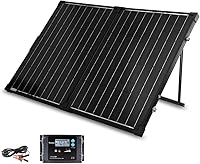
How to Choose a 100W Solar Panel Kit with an Inverter
A 100 watt solar panel kit with inverter works best when the panel, battery and inverter are sized as one system. Start with your daily watt-hours, pick a battery that can store them, then choose an inverter that can run your loads without wasting power at idle.
On this page (12 sections)
- What a 100 watt solar panel kit with inverter actually includes
- How much power will a 100W panel really make each day
- How to size the battery for a small solar charging system
- How to size the inverter for your AC loads
- What loads fit a 100W system and what loads do not
- Fixed panels versus portable foldable panels
- How efficiency, temperature and shade change real output
- Connectors, charge controllers and power station compatibility
- Series versus parallel wiring for a 100W kit
- Setup, placement and care in general terms
- Which of these three panels fits your use
- How to choose a 100 watt solar panel kit with inverter and close with a clear rule
A 100 watt solar panel kit with inverter is best sized from the load backward, not from the panel forward. A 100 watt panel can help charge phones, run LED lights and support small AC devices for short periods, but it will not match its nameplate output all day.
In real sun, you should expect less than 100 watts for much of the day. Angle, heat, shade, clouds and dirt all lower output.
A battery and inverter then decide how much of that energy you can actually use.
Before you buy, list what you want to run, for how long, and at what time of day. That list tells you the battery size and the inverter rating.
The panel size only tells you how fast the battery refills.
What a 100 watt solar panel kit with inverter actually includes
Most kits sold under this name do not include every part you need for AC power. A typical box holds a panel, cables and sometimes a charge controller, but the battery and inverter are often separate.
That matters because the three main parts do different jobs. The panel makes DC power from sunlight.
The charge controller protects the battery while it charges. The battery stores energy.
The inverter changes stored DC power to AC power that wall plugs use.
Some “kits” use the word kit loosely. One seller may mean panel plus cables.
Another may mean panel, battery and inverter in one bundle. Always check the included components list before you assume an inverter is in the box.
If you start with a basic panel, read what is a portable solar panel to understand the parts in plain terms. It explains how panels, controllers and storage work together before you spend on power conversion.
Panel only, panel kit, or full system
A panel only gives you a power source to pair with parts you already own. That suits buyers who already have a compatible battery, controller and inverter.
A panel kit adds the controller and cables you need to charge a battery safely. That is the usual starting point for RV, shed and backup use.
A full system adds a battery and inverter, so you can run AC devices right away. That costs more up front, but it removes guesswork about compatibility.
Rule: buy the parts as a matched system, not as separate bargains. Check voltage, connector type and input limits across every part.
How much power will a 100W panel really make each day
A 100 watt solar panel kit with inverter will not make 100 watts for 24 hours. In good sun it may approach its rating near midday, but morning, evening and cloudy periods produce far less.
A useful planning figure is 3 to 5 sun hours for a well placed panel in a sunny region. That means about 300 to 500 watt-hours of panel output before losses.
Heat, poor angle and shade can cut that figure sharply.
Efficiency matters here. Renogy says its N-Type panels reach 25% conversion efficiency, which helps when space is tight.
ZOUPW says its monocrystalline panel reaches 23.5% efficiency. Higher efficiency gives you more power from the same panel area, not free extra hours of sun.
That Renogy set is two panels, so treat it as 200W total rather than a single 100W panel. Each panel is listed at 34.1 by 22.8 inches and 14.3 pounds for the pair.
Rule: plan on 300 to 400 watt-hours on a good day from one 100W panel. If your loads need more, add panel capacity or accept lower use.
How to size the battery for a small solar charging system
The battery decides how much energy you can use after dark. A 100 watt panel in sun may refill a small battery each day, but a large battery will take several sunny days to fill.
For a 12 volt system, amp-hours convert to watt-hours by multiplying by 12. A 100Ah battery holds about 1,200 watt-hours before any limits on usable depth.
A 50Ah battery holds about 600 watt-hours.
Lithium batteries let you use more of their stored energy than many lead acid types, but you still need to respect the maker’s limits. Check the battery manual for charge current, temperature limits and low voltage cutoffs.
Our data shows a 12 volt focus for these panels. The Renogy two pack is described for 12V battery systems.
The portable Renogy panel works with 12V battery systems when paired with a compatible charge controller, which is not included.
Rule: size the battery for one cloudy day of essential loads, not for a week of wishful loads. A smaller battery that fills daily beats a large battery that stays half empty.
How to size the inverter for your AC loads
The inverter decides which AC devices you can run and for how long. Its watt rating is a ceiling, not a promise that a 100W panel can supply that much power all day.
A 300W inverter suits phones, LED lights, a small fan and a laptop for short periods. A 500W inverter gives more headroom for a small television or a power tool, but only if the battery can supply the current.
Startup surge matters for motor loads. Some devices draw two or three times their running watts for a moment at startup.
Check the device label for running watts and look for surge ratings in the manual.
Pure sine wave inverters cost more than modified sine wave types. They run cleaner with sensitive electronics, chargers and some motors.
For a home or RV system you plan to keep, pure sine wave is the safer default.
Rule: pick an inverter about 25% above your largest planned load. If your biggest load is 200W, start around 300W, not 2,000W.
What loads fit a 100W system and what loads do not
A 100 watt solar panel kit with inverter fits small, short loads best. Phones, tablets, LED lights, small fans, radios and laptop charging are realistic with a suitable battery.
A laptop can draw 45 to 65 watts while charging. That can run for a few hours from a charged battery, but it will drain a small battery faster than you expect.
Phones draw far less, so they are an easier fit.
Space heaters, hair dryers, microwave ovens, air conditioners and full size refrigerators do not fit. Those loads either exceed the inverter rating or drain the battery in minutes.
Even a short run can leave you with no power for lights at night.
That ZOUPW panel has one USB-C port rated at 15V/3A and two USB-A ports, including one QC3.0 port. It suits direct device charging without a power station, as ZOUPW describes.
Rule: run one larger load at a time and charge small devices in between. That habit protects the battery and keeps the system useful.
Fixed panels versus portable foldable panels
Fixed panels suit roofs, sheds and permanent mounts. They stay angled correctly, they do not need setup each day, and they can be wired in series or parallel for more capacity.
Portable foldable panels suit camping, emergencies and renters. You can move them to follow the sun, store them flat, and carry them to a job site.
The trade-off is more setup, more handling and more risk of damage.
Renogy lists this portable panel at 8.86 pounds in one description and 7.3 pounds in specs, with a folded size near 20.6 by 24.6 by 1.6 inches. It has one USB-C PD port at 45W max and two USB-A ports.
For portable use, compare the best portable 100 watt solar panel options by weight, folded size and connector type. Those three specs decide whether you will actually carry it.
Rule: choose fixed panels for daily home or RV use, and portable panels for trips and backup. Do not pay for portability you will not use.
How efficiency, temperature and shade change real output
Higher efficiency helps most when panel space is limited. A 25% efficient panel makes more power from the same sunlight and area than a 22.5% efficient panel, which Renogy uses as its comparison point.
Heat lowers output. Renogy lists a temperature coefficient of -0.29%/°C for its two pack, which means power drops as the panel gets hotter.
That is why a panel can make less power on a very hot afternoon than on a cool, bright morning.
Shade causes a bigger drop than most buyers expect. One shadow across part of a panel can reduce the whole panel’s output.
Renogy describes parallel wiring in its portable panel to limit the effect of partial shading across connected panels.
Dirt, snow and a poor angle also reduce output. A quick wipe with a soft cloth and water, plus a kickstand angle you can adjust, gives you more energy than buying a slightly larger panel and leaving it dirty.
Rule: protect output with angle, clean glass and no shade before you buy more panels. That order saves money.
Connectors, charge controllers and power station compatibility
Connectors decide whether your panel can actually connect to your battery or power station. MC4, XT60, Anderson, DC7909 and DC5521 are all common, and they do not fit each other without an adapter.
ZOUPW includes a 5-in-1 solar connector cable with DC8020, XT60, Anderson, DC7909/8mm and DC5521 connectors. ZOUPW says that cable fits 99% of power stations, and it includes a 10 foot cable for flexible positioning.
The Renogy portable panel has MC4 output cables only, and Renogy says its 4-in-1 adapter cable is sold separately. That is a key cost to plan for if your power station uses a different plug.
A charge controller protects a bare battery from overcharging. It is not built into every panel.
If you connect a panel straight to a 12V battery without a controller, you risk damage. If you connect a panel to a power station, check that station’s solar input limit first, because the station will only draw up to that limit.
Rule: match the connector and input limit before you order adapters. A quick check of your power station manual saves a return.
Series versus parallel wiring for a 100W kit
Series wiring adds voltage and keeps current the same. Parallel wiring adds current and keeps voltage the same.
That choice affects your charge controller and inverter battery voltage.
Most small 12V systems use parallel wiring for panels, because voltage stays near the battery voltage. Series wiring can raise voltage above a controller’s limit if you are not careful.
The Renogy two pack can be expanded, and Renogy notes the panels are 8% lighter and 11% smaller than a p-type PERC 100W panel. That smaller size helps on a van roof or trailer where space is tight.
Our data for the ZOUPW panel lists 24.3 volts maximum voltage and 20.16 volts output voltage. The Renogy portable panel lists 21.6 volts maximum voltage.
Those voltage figures tell you why a charge controller matters for battery charging.
If you want a ready made panel set to compare, see our best 100 watt solar panel kit guide. It breaks down what each kit includes so you can spot missing controllers or cables.
Rule: use parallel wiring for a standard 12V setup unless your controller manual tells you to use series. When in doubt, keep voltage low and current manageable.
Setup, placement and care in general terms
Good placement can add more energy than a bigger panel. Face the panel toward the sun at midday, angle it to match the season, and move it if trees or buildings cast shade.
For a portable panel, use kickstands to set the angle. ZOUPW says its two adjustable kickstands let you angle the panel at 45° to capture up to 25% more sunlight than flat laying.
Renogy’s portable panel also has kickstands for that purpose.
Keep the panel surface clean and dry before you fold it away. Wipe it with a soft cloth, let it dry, then close it without forcing the folds.
Store cables without tight bends and keep connector caps on when the panel is not in use.
IP67 ratings help in rain, but they do not make every part waterproof. Renogy describes its portable panel as IP67 waterproof with hail-resistant ETFE coating.
ZOUPW says its panel body is IP67 waterproof, but its USB hub and cables need to stay dry.
Rule: set the panel once in the morning, then check shade at noon and mid afternoon. Move it once if shade moves, and leave it alone if it does not.
Which of these three panels fits your use
The Renogy two pack fits fixed RV, roof and off grid mounts. You get two 100W N-Type panels at 25% efficiency, 16BB technology and IP67 protection, with solar connectors for a 12V system.
The ZOUPW panel fits power station and direct charging use. It folds to 24.13 by 21.06 by 1.77 inches, weighs 9.48 pounds, and includes the 5-in-1 cable and USB hub described above.
The Renogy portable panel fits camping and emergency carry use. It folds near 20.6 by 24.6 by 1.6 inches, has USB-C and USB-A outputs, and uses N-Type cells at 25% efficiency.
If you only need panels without storage, our best 100 watt solar panel roundup helps you compare panel only choices. If you want storage included, compare kits that bundle a battery.
Rule: pick the panel form that matches where it will live, then size the battery and inverter around it. Form first, then capacity, then conversion.
How to choose a 100 watt solar panel kit with inverter and close with a clear rule
A 100 watt solar panel kit with inverter works when you treat it as a small energy system, not as a single gadget. Start with your loads in watt-hours, pick a battery that can hold that energy, then add an inverter that can run the largest load with headroom.
Buy a fixed two panel set for a roof or shed. Buy a foldable panel with the right connectors for a power station or camping.
Add a charge controller whenever you charge a bare battery, and keep USB hubs and cables dry even when the panel itself is waterproof.
Our score weighs specs, features and buyer feedback against what you are shopping for. Higher efficiency, lighter weight and included cables raise a score because they solve real setup problems.
For your next step, read our best 100 watt solar panel kit with battery guide if you want storage in the same purchase. Then check the inverter wattage against your largest load before you order.
Final rule: if your daily loads exceed about 400 watt-hours, add panel capacity or reduce loads. A 100W system rewards realistic use, and it punishes oversized expectations.
Frequently asked questions
What size inverter do I need for a 100 watt solar panel kit?
A 300 to 500 watt pure sine wave inverter fits most 100 watt solar panel kit with inverter setups for lights, phones and small appliances. Check your largest load first, then add headroom for startup surges.
A larger inverter wastes more power when it runs empty.
Do I need a battery with a 100 watt solar panel kit with inverter?
Yes, if you want power after sunset or on cloudy days. The panel makes power during the day, the battery stores it, and the inverter turns stored DC power into AC power for household devices.
Without a battery, you only get power while the sun shines.
Can one 100 watt panel run a refrigerator or air conditioner?
One 100 watt panel is usually too small for a refrigerator or air conditioner, even with a battery. Those devices draw high startup power and run for long periods.
A 100 watt system suits small devices, lighting, charging and short, light loads.
What is the difference between a solar panel kit and a kit with battery?
A panel kit usually includes the panel, cables and a charge controller. A kit with battery adds storage so you can use power at night.
An inverter is separate from both and converts DC battery power to AC power.
Read our guide to a best 100 watt solar panel kit with battery to compare storage options.