Best 100W Solar Panel Kits: Top 8 Picks (November 2026)
The best 100 watt solar panel kits for off grid power include the Renogy 100W Portable Solar Panel for camping and travel, the ECO-WORTHY 200 Watts 12 Volt/24 Volt Solar for fixed RV power, and the DOKIO 100W Portable Foldable Solar Panel Kit for light travel.
On this page (16 sections)
- Our top 100 watt solar panel kits at a glance
- Renogy 100W Portable Solar Panel
- ECO-WORTHY 200 Watts 12 Volt/24 Volt Solar
- DOKIO 100W Portable Foldable Solar Panel Kit
- Renogy 100W 12V Solar Panel Starter Kit
- Topsolar Solar Panel Kit 100 Watt
- Voltset 100W 12V Solar Panel Kit
- DOKIO 100W Portable Foldable Solar Panel Kit
- ECI Power 100W 12V Solar Power Kit
- How these 100 watt solar panel kits compare
- Is a 100W solar panel kit enough for your RV or cabin?
- Portable or rigid: which 100 watt solar panel kit fits your trip?
- What should a charge controller do in a 100W kit?
- Should you buy a kit with a battery or add one later?
- How do you set up and care for a 100W solar panel kit?
- Which 100W solar panel kit should you buy?
The best 100 watt solar panel kit for most people is the Renogy 100W Portable Solar Panel, because it pairs a foldable 100W panel with a pre-installed 20A controller and alligator clips. It suits camping, RV trips and 12V battery charging without permanent mounting.
If you want a fixed roof setup, choose a rigid starter kit instead.
A 100 watt kit is a starter size for small battery powered off grid systems. It can top up a 12V battery, run small lights and charge phones through a controller.
It will not run a full home load on its own. Your battery size, sun hours and daily use decide what it can really do.
Start with what is a portable solar panel if you are new to foldable panels. That guide explains how suitcase panels differ from rigid roof panels.
It also explains why a charge controller matters before you connect a battery.
Our picks at a glance
-
1

-
2
 Best for fixed RV power
ECO-WORTHY 200 Watts 12 Volt/24 Volt Solar
9.7/10 our score
See it on Amazon -
3
 Best for light travel
DOKIO 100W Portable Foldable Solar Panel Kit
9.5/10 our score
See it on Amazon
- 4
 Check it
Renogy 100W 12V Solar Panel Starter Kit
Best for expandable starter systems - 5
 Check it
Topsolar Solar Panel Kit 100 Watt
Best for simple fixed mounting - 6
 Check it
Voltset 100W 12V Solar Panel Kit
Best for monitored charging - 7
 Check it
DOKIO 100W Portable Foldable Solar Panel Kit
Best for adapter flexibility - 8
 Check it
ECI Power 100W 12V Solar Power Kit
Best for battery included bundles
Our top 100 watt solar panel kits at a glance
The Renogy portable and the ECO-WORTHY twin panel kit lead for different jobs. One travels with you, the other stays mounted and makes more power.
The rest fill gaps for light travel, fixed mounting, monitored charging and battery bundles.
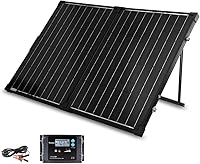
Renogy 100W Portable Solar Panel
Renogy 100W Portable Solar Panel: Best for camping and travel
- 100 watts maximum power
- 25% N-Type cell efficiency
- 20A PWM charge controller pre-installed
- Folds to suitcase size, 17.4 lb
- Alligator clip cables
A foldable 100W suitcase with a pre-installed 20A controller and alligator clips for 12V batteries and portable power stations.
Pros
- Folds for car and RV storage
- Controller already installed
- Adjustable kickstand for sun angle
Cons
- Heavier than the smallest foldable picks
- Less suited to permanent roof mounting
This Renogy kit suits campers and RV owners who want power without drilling into a roof. It folds to suitcase size and weighs 17.4 lb, so it fits in a car storage area or an RV bay.
The adjustable kickstand lets you tilt the panel toward the sun during the day.
Renogy says the N-Type cells reach up to 25% conversion efficiency. That helps in low light, though real output still depends on sun hours and angle.
The maker says up to 500Wh per day with 5 hours of sunlight. Treat that as a best case figure for clear conditions.
The pre-installed 20A PWM controller is the big convenience here. You get alligator clip cables and 4-stage charging for 12V batteries and portable power stations.
That means less wiring thought at setup. No separate controller to mount or wire in a tight space.
Low-iron tempered glass and an aluminum frame suit outdoor use in rain and dust. Renogy gives a 5-year materials and workmanship warranty for the panel and a 2-year warranty for the controller in its specs.
Check the exact terms before you order.
Trade-off: it is heavier than the 6 lb DOKIO foldable options. It also works best for temporary placement, not as a permanent roof array.
If you want that, look at the rigid Renogy starter kit below.
ECO-WORTHY 200 Watts 12 Volt/24 Volt Solar
ECO-WORTHY 200 Watts 12 Volt/24 Volt Solar: Best for fixed RV power
- Two 100W monocrystalline panels
- 30A PWM charge controller
- 200 watts maximum power
- Z mounting brackets included
- 16.4 ft solar cables
Two rigid 100W panels with a 30A controller, brackets and cables for RV, camper and off grid systems.
Pros
- Double the panel wattage
- Includes brackets and cables
- Can connect for 12V or 24V use
Cons
- Not portable in the same way
- Needs roof or fixed mounting space
ECO-WORTHY suits RV and camper owners who need more than 100W from a fixed setup. This kit gives you two 100W monocrystalline panels, so total maximum power is 200 watts.
That extra panel helps a larger battery bank recover after morning use.
The kit includes a 30A PWM charge controller, two sets of Z mounting brackets, solar cables and connectors. That is a complete fixed mounting set in one box.
Pre-drilled holes on the panel backs help with fast installation on a roof or frame.
ECO-WORTHY says daily output can reach 800Wh under 4 hours of full sunshine. That figure assumes strong, direct sun and a battery state that can accept the charge.
In shade or winter sun, expect less. Size your battery and loads around a conservative daily estimate.
The panels use monocrystalline cells with up to 21.5% efficiency. The aluminum frames and IP65 junction box suit outdoor exposure.
ECO-WORTHY says the panels can withstand strong wind and snow loads. That matters for a roof that stays out in all seasons.
Trade-off: this is not a carry-anywhere kit. At 31.6 lb for the kit, it is built for fixed use.
You also need roof space for two panels. If portability matters more, the foldable picks will fit your life better.
DOKIO 100W Portable Foldable Solar Panel Kit
DOKIO 100W Portable Foldable Solar Panel Kit: Best for light travel
- 100W foldable panel
- Standalone PWM controller
- Weighs 6 lb
- Folds to 19 x 26 x 0.5 in
- 9.84 ft cable and USB ports
A 6 lb foldable panel with a separate PWM controller, long cable and USB ports for 12V batteries and small devices.
Pros
- Very light to carry
- Separate controller is easy to replace
- Long cable for flexible placement
Cons
- Fabric design needs more care in rain
- Lower controller rating than 30A rigid kits
DOKIO suits travelers who care most about weight. It weighs 6 lb and folds to 19 x 26 x 0.5 in, so it slides into a bag or under a seat.
That makes it a strong pick for tent camping, van life and emergency backup in a car.
The 9.84 ft cable gives you room to place the panel in direct sun while keeping the controller or power station in shade. That helps safety and comfort.
You can set the power station under an awning while the panel sits in open sun.
A standalone PWM controller protects the 12V system from reverse polarity, overcharge, overload and short circuit. A separate controller is easy to replace or upgrade later.
That is a plus if you change batteries or power stations over time.
USB ports help with phones, lights and small gadgets when connected to a 12V battery. DOKIO notes the ports can work in sunlight without a battery for emergency top-ups, though current may vary.
Do not rely on that for critical charging.
Trade-off: the fabric foldable design needs more care than tempered glass rigid panels. DOKIO warns against leaving the fabric case in heavy rain or harsh sun for days.
It is a travel panel first, not a permanent outdoor fixture.
Renogy 100W 12V Solar Panel Starter Kit
Renogy 100W 12V Solar Panel Starter Kit: Best for expandable starter systems
- 100W monocrystalline panel
- 30A Wanderer PWM controller
- Z brackets and cables
- Supports expansion up to 400W
- Bluetooth monitoring option
A rigid 100W starter kit with a 30A controller, brackets and cables, built to expand with more panels later.
Pros
- 30A controller leaves growth room
- Includes mounting hardware
- Optional Bluetooth monitoring
Cons
- Fixed panel needs mounting space
- Bluetooth module is separate
Renogy's starter kit suits RV and off grid owners who want one rigid panel now and room to grow. It pairs a 100W monocrystalline panel with a 30A Wanderer PWM controller.
That controller leaves more headroom than the 10A and 20A options here.
Renogy says the kit can generate an average of 500Wh per day, depending on sunlight. The panel has 22.5% cell efficiency.
Those numbers help you compare kits, but your daily result will change with season, angle and battery charge state.
The kit includes Z brackets and cables for mounting. Renogy says the system can expand up to 400W with additional panels.
That matters if your first panel proves too small for a larger battery bank. Check wiring and controller limits before you add panels.
The Wanderer controller has an RS232 Bluetooth port. With a Renogy BT-1 module, you can monitor voltage and current in the Renogy DC Home app.
That module is separate, so factor it into your setup if remote monitoring matters to you.
Trade-off: this is a fixed panel, so you need a roof or frame and a place to run cables. It is not as easy to move for sun tracking as a suitcase panel.
For permanent mounting, that trade-off is often worth it.
Topsolar Solar Panel Kit 100 Watt
Topsolar Solar Panel Kit 100 Watt: Best for simple fixed mounting
- 100W monocrystalline panel
- 30A PWM charge controller
- Four Z mounting brackets
- Red and black solar cable
- 12V and 24V system use
A fixed 100W monocrystalline kit with a 30A controller, Z brackets and solar cable for 12V battery charging.
Pros
- Full mounting set included
- 30A controller for expansion
- Pre-drilled holes for fast mounting
Cons
- No portable folding design
- Panel size is large for small roofs
Topsolar suits buyers who want a straightforward fixed kit for a 12V battery. It includes a 100W monocrystalline panel, a 30A PWM controller, four Z brackets and red and black solar cable.
That covers the main parts for RV, cabin, boat and backup use.
The panel measures 45.6 x 20 x 1.37 in and weighs 15.84 lb. That size needs a clear mounting area, so measure your roof or shed wall first.
Pre-drilled holes on the back help you secure it with the included brackets.
Topsolar says the 30A controller can expand the system up to 260W in a 12V setup or 520W in a 24V setup. That gives you a path to add panels later.
Confirm battery type settings and cable size before you expand.
The controller provides protection against overcharge, overvoltage, discharge, short circuit and reversed polarity. Those protections matter when a panel stays connected for long periods.
They do not replace correct wiring and battery sizing.
Trade-off: there is no folding or portable design here. The efficiency figure is 19.5%, lower than the 25% claim on the Renogy portable panel.
For a fixed install at a budget price tier, the complete hardware set may matter more than peak efficiency.
Voltset 100W 12V Solar Panel Kit
Voltset 100W 12V Solar Panel Kit: Best for monitored charging
- 100W panel
- 20A smart charge controller
- Digital display
- USB and Type-C ports
- Four Z brackets and alligator cable
A 100W rigid kit with a 20A smart controller, digital display and USB ports for RV, boat and off grid use.
Pros
- Display shows voltage and charging status
- Includes brackets and alligator cable
- USB and Type-C charging ports
Cons
- Fixed panel is not for suitcase travel
- 20A controller limits future expansion more than 30A
Voltset suits RV and boat owners who want to see charging status at a glance. Its 20A smart controller has a digital display for voltage, current and battery level.
That makes daily checks faster than guessing from a small indicator light.
The panel uses A+ grade monocrystalline cells with 23% to 25% conversion efficiency. Voltset says that can deliver up to 20% more power than comparable products.
Real gains depend on sun and panel angle, so treat that as a maker claim.
The controller uses bulk, float and trickle charging modes. That staged approach helps as the battery nears full charge.
It also supports LiFePO4, AGM, gel, flooded lead acid and other 12V battery types listed by Voltset. Set the controller for your battery type at setup.
USB and Type-C ports on the controller help charge phones and tablets on the go. That is handy at a campsite or dock.
It does not replace a power station for larger AC loads.
Trade-off: the rigid panel needs mounting space and is not a suitcase option. The 20A controller is fine for one 100W panel, with less expansion room than a 30A controller.
If you plan to add panels soon, a 30A kit may save you a later swap.
DOKIO 100W Portable Foldable Solar Panel Kit
DOKIO 100W Portable Foldable Solar Panel Kit: Best for adapter flexibility
- 100W foldable panel
- Standalone PWM controller
- Weighs 6 lb
- SAE, XT60 and alligator connectors
- Storage bag and adapters included
A 6 lb foldable 100W kit with a separate PWM controller, multiple connectors and a storage bag for travel use.
Pros
- Many connector types in the box
- Light and easy to store
- Separate controller can be upgraded
Cons
- Fabric case needs weather care
- Two DOKIO kits overlap in use
This second DOKIO kit suits travelers who want many connector choices in one box. It weighs 6 lb and folds to 21 x 20 x 1 in, so it is easy to pack for road trips and van camping.
The 9.85 ft cable lets you keep the controller shaded while the panel faces the sun.
The package includes a standalone PWM controller, SAE, XT60 and alligator connectors, DC adapters, a cable, storage bag and manual. That range helps if you switch between a 12V battery, a power station and small devices.
Fewer extra adapters to buy later can be a real time saver.
Dual USB ports deliver power for phones and lights when linked to a 12V battery. DOKIO notes they can also work in sunlight without a battery for emergency charging, with varying current.
Use a battery for steady device charging when you can.
Monocrystalline cells help with conversion in weak sunlight. The surface is weather resistant for outdoor use.
DOKIO still advises against leaving the fabric case in heavy rain or harsh sun for days at a time.
Trade-off: this kit overlaps heavily with the other DOKIO pick above. Choose between them by connectors and folded shape, not by headline watts.
Both warn you to check your power station input limit, because some stations cap input below 100W.
ECI Power 100W 12V Solar Power Kit
ECI Power 100W 12V Solar Power Kit: Best for battery included bundles
- 100W monocrystalline panel
- 12V 20Ah LiFePO4 battery
- 10A PWM charge controller
- Solar and battery cables
- Mounting brackets
A complete bundle with a 100W panel, 12V 20Ah LiFePO4 battery, 10A controller and cables for small off grid projects.
Pros
- Battery included in one bundle
- Digital display on controller
- Cables and brackets included
Cons
- 10A controller is smallest here
- Battery capacity is modest for larger loads
ECI Power suits buyers who want a panel and a battery in one bundle. It includes a 100W monocrystalline panel, a 12V 20Ah LiFePO4 battery and a 10A PWM controller.
That removes the need to shop for a battery separately for a small project.
The kit also includes 10 ft MC4 solar cables, 6 ft battery cables and mounting brackets. That makes it a starter system for an RV, trailer, shed or garden project.
ECI Power says the battery is lab tested for at least 2000 cycles at 80% depth of discharge.
The 10A controller automatically recognizes 12V and 24V systems. It uses a CC-CV charging algorithm for LiFePO4 batteries.
A digital display shows state of charge and battery health data. Those features help you set up and monitor a small system without extra meters.
The controller also regulates charging based on ambient temperature. It protects against overcharge, overdischarge, overload and short circuit.
That is useful for a system that sits outdoors through seasonal changes.
Trade-off: the 10A controller is the smallest here, so expansion is limited. The 20Ah battery is also modest, so it suits lights and small devices more than heavy daily loads.
If you already own a battery, a panel-only kit may give you more value.
How these 100 watt solar panel kits compare
The Renogy portable leads on travel convenience, the ECO-WORTHY leads on fixed wattage, and the ECI Power kit leads on battery inclusion. Those three facts drive most of the choice.
The other picks trade a little peak performance for lower weight, better monitoring or more connectors.
| Product | Best for | Maximum power | Output voltage | Controller | Our score |
|---|---|---|---|---|---|
| Renogy 100W Portable Solar Panel | camping and travel | 100 watts | 12 volts | 20A PWM | 9.7 |
| ECO-WORTHY 200 Watts 12 Volt/24 Volt Solar | fixed RV power | 200 watts | 12 volts | 30A PWM | 9.7 |
| DOKIO 100W Portable Foldable Solar Panel Kit | light travel | 110 watts | 12 volts | PWM | 9.5 |
| Renogy 100W 12V Solar Panel Starter Kit | expandable starter systems | 100 watts | 12 volts | 30A PWM | 9.3 |
| Topsolar Solar Panel Kit 100 Watt | simple fixed mounting | 100 watts | 12 volts | 30A PWM | 9.1 |
| Voltset 100W 12V Solar Panel Kit | monitored charging | 100 watts | 12 volts | 20A smart | 8.8 |
| DOKIO 100W Portable Foldable Solar Panel Kit | adapter flexibility | 110 watts | 18 volts | PWM | 8.5 |
| ECI Power 100W 12V Solar Power Kit | battery included bundles | 100 watts | 24 volts | 10A PWM | 8.2 |
We compared specs, controller size, included hardware and portability across all eight kits. We checked maximum power, output voltage, controller amps and what each box includes.
We also weighed buyer feedback patterns for weight, setup ease and charging use.
Our score weighs specs, features and buyer feedback against what you're shopping for. A score favours a kit that fits a 100W searcher with fewer missing parts.
It does not mean a lower scored kit will fail you. It means it solves a narrower job.
Rigid kits make more sense for RV roofs because they stay mounted and face the sun all day. Portable kits make more sense for camping because you can move them as the sun moves.
Battery bundles make sense only if you need storage right now.
Is a 100W solar panel kit enough for your RV or cabin?
A 100W kit is enough for small 12V loads, light use and battery top-ups, but not for running a full RV or cabin on its own. It can charge a 12V battery during the day for lights, fans and phone charging at night.
It will struggle with high draw appliances.
How to size your battery first
Size the battery bank before you choose the panel. Your daily load in watt-hours sets the storage you need.
Then size the panel to refill that storage in your expected sun hours.
A 20Ah battery and a 200Ah battery need very different panels.
How to estimate daily power
Use sun hours, not peak watts, for daily estimates. A 100W panel in 4 hours of strong sun makes far less than 100W x 24 hours.
The maker figures here use 4 to 5 hours of good sun.
Plan around your local winter hours for a safe estimate.
Portable or rigid: which 100 watt solar panel kit fits your trip?
Choose portable if you camp in different spots, and rigid if the panel will live on a roof. Portable suitcases let you chase sun and pack away after a trip.
Rigid panels save daily setup time and stay put in wind.
What portability really costs you
Portable panels trade durability and output for carry ease. Fabric foldable panels are light but need care in rain.
Tempered glass suitcases are tougher but heavier.
Rigid glass panels handle seasons best but need mounting space.
When a fixed panel is better
A fixed Renogy or Topsolar panel suits an RV that parks in one place most days. You mount it once, wire it once and let it work.
That is easier than unfolding and aiming a suitcase every morning.
For portable detail, see our best portable 100 watt solar panel guide. It compares foldable options in more depth.
It helps if weight and folded size are your top filters.
What should a charge controller do in a 100W kit?
A charge controller limits voltage and current so your battery charges safely. It stops the panel from pushing voltage too high as the battery fills.
It also blocks reverse flow at night in many designs.
PWM vs controller size
All kits here use PWM controllers, so size matters more than type. A 10A controller fits one small panel and a small battery.
A 30A controller leaves room to add panels later.
Match the amp rating to your panel and battery plan.
Battery type settings
Set the controller for your battery chemistry at setup. LiFePO4, AGM, gel and flooded batteries charge differently.
Several kits here list multiple battery types.
Use the correct profile before first charging.
If you want controller focused picks, see best 100 watt solar panel with charge controller. That page narrows the field by controller features.
It is useful if a display or Bluetooth monitoring matters to you.
Should you buy a kit with a battery or add one later?
Buy a battery bundle only if you need storage now and want one matched set. The ECI Power kit includes a 12V 20Ah LiFePO4 battery, which suits small projects.
If you already own a larger battery, a panel-only kit is usually the better spend.
What a 20Ah battery can and cannot do
A 20Ah 12V battery holds 240Wh before losses, so it suits lights and small devices. It cannot run a fridge or power tools for long.
Check your load in watts and hours before you promise it more than that.
When to shop batteries separately
Shop separately if you want more storage or a specific brand. A larger battery bank will need more panel watts to refill in a day.
That may push you toward a 200W fixed kit or two panels.
For storage first shopping, see best 100 watt solar panel kit with battery. It compares bundles by battery size and panel setup.
It helps you avoid a bundle that is too small for your load.
How do you set up and care for a 100W solar panel kit?
Set up a kit by placing the panel in full sun, connecting the controller to the battery first, then connecting the panel. That order helps the controller detect the battery voltage.
Follow the manual for your exact kit.
Panel angle and sun tracking
Tilt and aim the panel at the sun, then adjust it as the day moves. Portable panels with kickstands make this easy.
Fixed panels work best when your parking spot or roof angle is already close to the sun path.
Cleaning and weather care
Clean the glass with water and a soft cloth, and keep fabric cases dry when you can. Dirt and shade cut output fast.
For rigid panels, check mounts and cable seals each season.
Tighten loose hardware before it moves in wind.
If you plan to run AC devices from solar, read 100 watt solar panel kit with inverter. An inverter adds cost and losses, so size it carefully.
It also changes battery and controller needs.
Which 100W solar panel kit should you buy?
Pick the Renogy 100W Portable Solar Panel for camping and travel, the ECO-WORTHY dual panel kit for fixed RV power, and the DOKIO 6 lb kit for lightest carry. Pick the Renogy starter kit or Topsolar kit for a fixed 12V setup with a 30A controller.
Pick Voltset if a digital display matters most.
Pick the ECI Power bundle only if you need a battery included now. Its 20Ah battery suits small loads and simple projects.
For larger daily use, buy storage and panels separately and size them as a system.
If you want panel-only options without a controller, see our best 100 watt solar panel guide. That helps when you already own a controller.
For this post, the best 100 watt solar panel kit is the one whose form, controller and included parts match how you will actually use it each day.
Our top 3 picks at a glance
-
1
-
2
Best for fixed RV power
ECO-WORTHY 200 Watts 12 Volt/24 Volt Solar
9.7/10 our score
See it on Amazon -
3
Best for light travel
DOKIO 100W Portable Foldable Solar Panel Kit
9.5/10 our score
See it on Amazon
Frequently asked questions
What does a 100W solar panel kit include?
Most kits include a 100W panel, a charge controller and cables for a 12V battery. Some add mounting brackets, alligator clips or a battery.
Check what is in the box for your use, because portable suitcases and rigid roof kits set up differently.
Can a 100W kit charge a 12V battery?
Yes, a 100W panel with a suitable controller can charge a 12V battery in sunlight. Renogy sets out 12V battery and power station use for its portable kit.
Match the controller and battery type before you connect anything, and check your power station input limit.
Is a portable kit or a rigid kit better?
A portable kit suits camping and travel because you can move it to follow sunlight. A rigid kit suits an RV roof or shed where fixed mounting is fine.
Choose by how you travel and where the panel will sit most days, not by wattage alone.
Do I need a charge controller?
Yes for direct battery charging, because a controller limits voltage and current. The kits here use PWM controllers rated from 10A to 30A.
A controller also helps protect against overcharge, short circuit and reverse polarity.