How to Choose a 400W Flexible Solar Panel Setup
A 400 watt flexible solar panel setup usually means two 200W panels or four 100W panels. Match the array to your mounting space, controller, battery or power station input, and cable route.
On this page (9 sections)
- How should you build a 400 watt flexible solar panel setup?
- Is two 200W panels or four 100W panels better?
- How much mounting space does a 400W array need?
- What cable length and wire size should you choose?
- Can portable panels make a 400W setup?
- When is a 200W portable panel the better choice?
- How do you match the array to a battery or power station?
- How should you position and care for flexible panels?
- What is the best 400 watt flexible solar panel setup for you?
A 400 watt flexible solar panel setup is usually built with two 200W panels or four 100W panels. That split is only the starting point, because the right choice depends on where the panels will sit and what equipment will receive the power.
Choose the arrangement that fits your roof, van, boat, trailer or portable layout while keeping the array within your controller or power station input limits. A roof with one broad clear section may suit two larger panels, while a boat deck or van roof with vents and hatches may need smaller units in separate pockets.
The 400W figure is a rated maximum, not a promise of constant output. It describes what the array is rated to produce under standard test conditions, so real output will move up and down as sunlight changes.
Shade, panel angle, cable length, heat and changing sunlight all affect how much energy reaches your battery or power station. A panel partly shaded at midday may lose useful output for the rest of the afternoon, and a panel angled away from the sun may never reach its rated power.
That is why planning should start with the receiving equipment rather than the panel label. Check the battery voltage, controller limits and any solar input cap on a power station before deciding how many panels to buy or how to wire them.
Think about day to day use as well. A fixed array needs a clean surface and a protected cable route, while a portable array needs room to unfold, angle and store the panels when not charging.
If you are new to this equipment, start with our guide to what is a portable solar panel. It explains the difference between portable panels, batteries, controllers and power stations before you size an array.
Reading that guide first can stop you mixing up the parts of the system. Once you know which box charges and which box stores energy, it is easier to judge whether a 400W array is too much, too little or a good match.
A sensible plan also leaves room for changes in weather and use. Clouds, seasons, tree shade and temporary roof loads will affect output, so the setup should be easy to reach, clean and check for loose connections.
Keep the whole system in view from the start, including cables, connectors and mounting hardware. Panels, wiring and receiving equipment must work as one path, and a weak link anywhere can limit the benefit of the full 400W rating.
How should you build a 400 watt flexible solar panel setup?
The simplest choices are two matching 200W panels or four matching 100W panels. Matching panels keep planning simpler because voltage and current are easier to compare with the controller or power station you plan to use.
Two larger panels usually mean fewer sections and connections, while four smaller panels can fit around separate roof areas. Neither option is always better, so the surface and electrical limits should decide the layout.
Measure the usable length and width, then mark vents, hardware, hatches and curved sections that cannot hold the full panel area. A single large roof dimension can hide the small gaps that break up a layout.
Note where cables will enter the vehicle, where a controller can sit in shade, and where you can walk without stepping on panels or cables. Plan the cable route at the same time as the panels.
Check panel voltage and current against the charge controller, battery system or power station before connecting anything, and confirm that connector types match or can be adapted safely. Do not assume a power station can accept the full 400W rating.
Some systems cap solar input below the array maximum, so the equipment may limit charging even in strong sun. Extra panel capacity will not force more power through that input.
For a battery system, the controller sits between panels and battery and sets the practical limits. Confirm maximum solar voltage, maximum solar current and battery type, because an undersized controller cannot be made suitable by careful wiring.
For a power station, look for maximum solar input in watts, not battery capacity. The station may have a large battery but a modest solar input, so a 400W array could still charge at a much lower rate.
A short route from a roof array to an interior controller is simpler to protect, while a long route may need extra length, strain relief and protection from doors, wheels and walkways. Handling matters on boats and vans too, as larger panels may need two people to position.
Sketch the array on paper before you buy, using real panel dimensions and the real cable route. That sketch will show whether two 200W panels or four 100W panels fit, and whether the electrical path can accept the total.
Is two 200W panels or four 100W panels better?
Two 200W panels suit a larger, more open mounting area, while four 100W panels can suit a layout with several smaller spaces. The better choice depends on handling, storage, wiring and the shape of the surface you have to work with.
A two-panel arrangement has fewer units to position and fewer panel-to-panel connections to plan. It may be easier to keep the array visually simple on a broad roof or ground-mount frame, and simpler layouts are often easier to clean and inspect.
Four 100W panels give you more layout options. You may be able to place them around vents or other fixed objects, but more panels can also mean more cable routing and more connection points to check over time.
Storage changes the balance for portable use. Four smaller kits can be carried and stored one at a time, while two larger panels are fewer to move but each one takes more space when folded and more care when carried in wind.
Wiring also deserves a close look before you choose. More panels can mean longer total cable runs and more places where a connector can be pulled loose, so the route from each panel to the controller should be traced in advance.
For a closer look at the larger format, see our guide to the best 200 watt flexible solar panel. If your mounting spaces are narrow or divided, compare the best 100 watt flexible solar panel options instead.
The honest trade-off is between simplicity and fit. Two 200W panels reduce the number of parts to manage, while four 100W panels can fit spaces that a larger panel cannot use at all.
How much mounting space does a 400W array need?
A 400W array needs the combined footprint of its panels plus room for cable routing and access. Do not size the surface from wattage alone because two panels with the same rating can have different dimensions.
Use this planning process:
- Measure the clear mounting area.
- Record the length and width of every section.
- Mark vents, roof edges, seams and hardware.
- Compare the space with the actual panel dimensions.
- Leave a practical route for cables and connectors.
- Confirm that the surface can accept the planned mounting method.
Flexible panels can suit curved surfaces, but flexibility does not remove the need for a clean, usable mounting area. Avoid placing a panel where repeated rubbing, sharp edges or standing loads could damage it.
A portable setup needs a different space calculation. You need room to unfold, angle and store the panels, plus a safe route from the panel to the controller or power station.
What cable length and wire size should you choose?
Choose cable length by measuring the real route from the array to the controller or power station. Longer runs need careful attention to voltage drop, while excess cable can create loops that are harder to protect and organize.
This BougeRV cable is useful when the panels must sit away from shaded equipment or when a portable array needs a longer route. Its 10AWG size is intended to minimize power loss compared with 12AWG and 14AWG cables, and its maximum current is 30A with a maximum voltage of 1000V DC.
The cable includes one black and one red 20-foot piece, plus an extra connector. One end has connectors installed, while the other end is bare wire for a controller connection.
Confirm that your system uses the required solar connector type before wiring.
Keep connectors clean and fully seated. The IP67 waterproof ring and built-in lock help with outdoor connections, but a sealed connector still needs correct assembly and strain relief.
Can portable panels make a 400W setup?
Portable panels can form part of a 400W charging plan when their combined rated output fits your equipment's input limits. They are useful when you need to set up panels only during charging or when a permanent mounting surface is unavailable.
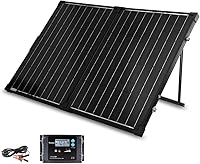
The DOKIO 100W kit has a 9.84-foot cable, dual USB ports and SAE, XT60, DC and alligator-clip connector types. Its controller protects a 12V system from reverse polarity, overcharge, overload and short circuit.
Four matching 100W kits would reach a nominal 400W total, but you must still check the controller and power station input limits. The kit's maximum power is 110W, maximum voltage is 18V and output voltage is 12V DC, so use the actual system specifications when planning connections.
DOKIO also notes that some power stations cap input at 60W. If your equipment has such a limit, adding more panel capacity will not make that input accept the full array.
When is a 200W portable panel the better choice?
A 200W portable panel is the better starting point when you want fewer folding units and have room to handle a larger panel. It can reduce the number of separate panels needed to approach a 400W array.
A 200W portable panel is the better starting point when you want fewer folding units and have room to handle a larger panel. It can reduce the number of separate panels needed to approach a 400W array, while still folding away for storage.
The DOKIO 200W kit folds to about 20 x 27 in and weighs 9.7 lb. That size suits an RV, van, boat or trailer where a larger folded panel would be awkward to carry or store.
It has a 9.84-foot cable, dual USB ports and SAE-to-XT60, alligator-clip and DC connector options. The cable lets you place the panel in direct sun while keeping the controller or power station in shade.
Its standalone PWM controller protects a 12V system against reverse polarity, overcharge, overload and short circuit. A separate controller is also easier to replace or upgrade than one built into the panel.
Two matching kits would create a nominal 400W arrangement, subject to the input limits of the battery system or power station. That total is a planning figure, not a guarantee, because sunlight, angle, shade and equipment limits affect output.
Maximum power is 220W, maximum voltage is 18V and output voltage is 12V DC. Check those figures against the controller and battery or power station specifications before buying.
DOKIO notes that some power stations cap solar input at 100W to 150W. Check that limit before choosing a 200W kit or planning two together, because a capped input will limit charging in full sun.
The dual USB ports can help phones, lamps and small gadgets when connected to a 12V battery. They can also work in direct sunlight without a battery for emergency top-ups, though current may vary, so treat them as backup rather than the main plan.
One 200W kit is simpler to set up than two smaller kits, but it needs more unfolded space and a secure place to stand. Route the cable so it cannot be pulled or tripped over.
If your power station accepts the input and you have room for the folded size, this can be a practical step toward a 400W portable setup without doubling the units to carry.
How do you match the array to a battery or power station?
Match the array to the input specifications of the equipment that receives the solar power. The battery voltage, controller type, maximum solar voltage and maximum solar current all affect whether the setup is suitable.
For a 12V battery system, use a controller designed for the panel arrangement and battery type. A separate controller can protect against conditions such as overcharge and short circuit, but it does not make an incompatible array safe.
For a power station, check its maximum solar input before buying panels. A 400W array connected to a 100W input may still work within that system's design, but the power station will limit how much it accepts.
Also check connector types. A panel kit may use SAE, XT60, DC or alligator-clip connections, while a fixed array may use solar connectors and a bare-wire controller connection.
If your setup uses a microinverter instead of battery charging, read our guide to a 400 watt solar panel with micro inverter. The wiring and equipment decisions differ from a 12V battery system.
How should you position and care for flexible panels?
Place panels where they receive the most direct sunlight available, with as little shade as possible. Even a small shaded section can reduce the useful output of an array, so check nearby vents, rails, trees and roof equipment throughout the day.
For portable panels, use the cable length to keep the controller or power station in a shaded, dry location when possible. Do not leave cables across walkways where they can be pulled or damaged.
Clean dust and dirt with a method suitable for the panel surface. Keep connectors dry while disconnected, avoid sharp bends in cables and check that locking connectors remain secure.
Flexible panels need a mounting surface that supports them without creating repeated folds or abrasion. Follow the panel manufacturer's mounting instructions and avoid placing weight on the active surface.
If you're comparing brands and mounting styles, our guide to EcoFlow flexible solar panels covers flexible and rigid panel trade-offs.
What is the best 400 watt flexible solar panel setup for you?
Choose two matching 200W panels when you have one broad mounting area and want fewer panel sections. Choose four matching 100W panels when separate smaller spaces give you a better fit around vents, hatches or curved sections.
Choose a portable 100W kit when storage and light handling matter most. Smaller kits can be easier to carry, fold and store, and they may suit a power station with a lower solar input cap.
Choose a portable 200W kit when fewer units are more useful and your power station can accept its input. A 200W panel can reduce the number of kits needed for a higher total, but it still needs room to unfold and a cable route to shaded equipment.
Before buying, confirm the usable mounting area, cable route, connector type, controller limits and power station input ceiling. Write those details down and compare them with the panel specifications, because a mismatch in any one of them can limit the whole setup.
Think about care as well as capacity. The best setup is one you will clean, check and store properly, with cables routed safely and connectors kept dry and secure while the system is not in use.
A well-matched 400 watt flexible solar panel setup is one that fits the surface and the receiving equipment, not simply one with a 400W label. When the layout, wiring and input limits all line up, the array has a better chance of giving steady and useful power in everyday use.
Frequently asked questions
How many panels make 400 watts?
Two 200W panels make a nominal 400W array, while four 100W panels reach the same rated total. The best layout depends on your available mounting area, panel dimensions, wiring plan and the input limits of your charge controller or power station.
Is a 400 watt solar panel really 400 watts?
A 400W rating describes the array's maximum rated power under test conditions. Actual output changes with sunlight, panel angle, shade, temperature, wiring and the limits of the battery system or power station connected to it.
Can I connect 100W and 200W solar panels together?
You should match panel electrical characteristics and follow the controller's voltage and current limits before combining different panel sizes. A mixed array can be harder to configure, so two matching 200W panels or four matching 100W panels usually make planning simpler.
What cable size should I use for a 400W solar setup?
Cable size depends on current, voltage, distance and the system design. A 10AWG cable can reduce power loss compared with 12AWG and 14AWG cables, but confirm connector type, current rating and controller requirements before wiring the array.