Best 400W Bifacial Solar Panels: Top 9 Picks (November 2026)
The best 400 watt bifacial solar panels include the Callsun N-Type 16BB 400W Bifacial Solar Panel for 60V portable power stations, the Callsun N-Type 16BB 400W Bifacial Solar Panel for weather-resistant rooftop arrays, and the JJN Bifacial 2Pcs 425 Watt N-Type Solar for high-output off-grid arrays.
On this page (16 sections)
- The best 400 watt bifacial solar panels compared
- How we chose these 400 watt bifacial solar panels
- 1. Callsun N-Type 16BB 400W Bifacial Solar Panel: Best for 60V portable power stations
- 2. Callsun N-Type 16BB 400W Bifacial Solar Panel: Best for weather-resistant rooftop arrays
- 3. JJN Bifacial 2Pcs 425 Watt N-Type Solar: Best for high-output off-grid arrays
- 4. JJN 400W Bifacial Solar Panel: Best for compact rigid installations
- 5. Callsun 450W Bifacial Solar Panel 2-Pack: Best for fewer high-power panels
- 6. Renogy 400W Portable Solar Panel for Power: Best for foldable camping setups
- 7. ZOUPW 480W Bifacial Portable Solar Panel N-Type: Best for portable high-voltage charging
- 8. Renogy Bifacial Solar Panel 2PCS 400 Watt: Best for larger two-panel arrays
- 9. EPOCH 430W Bifacial Solar Panels: Best for marine and RV mounting
- How does bifacial gain work in a 400 watt solar panel?
- How do you connect 400 watt bifacial solar panels safely?
- Are rigid or portable 400 watt bifacial solar panels better?
- What should you check before installing a 400 watt solar panel?
- Which 400 watt bifacial solar panel should you choose?
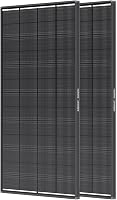
The best 400 watt bifacial solar panels are the Callsun N-Type 16BB 400W pair, because two 200W modules provide 400W total output, 25.6% efficiency and rear-side generation. The dual-module layout also helps one section keep working when the other is partly shaded.
We compared the panels by rated output, bifacial design, cell type, shade handling, size, weight, connection details and how well each model fits a fixed or portable setup. Our score weighs specs, features and buyer feedback against what you're shopping for.
A bifacial panel needs useful light behind it. If your panel will sit flush against an opaque roof, the rear-side benefit may be smaller than it would be over a bright or open surface.
Start with our guide to what is a portable solar panel if you're deciding between a fixed module and a foldable blanket. For a strict portable shortlist, compare these best 400 watt portable solar panels.
Our picks at a glance
-
1
 Best for 60V portable power stations
Callsun N-Type 16BB 400W Bifacial Solar Panel
9.7/10 our score
See it on Amazon -
2
 Best for weather-resistant rooftop arrays
Callsun N-Type 16BB 400W Bifacial Solar Panel
9.6/10 our score
See it on Amazon -
3
 Best for high-output off-grid arrays
JJN Bifacial 2Pcs 425 Watt N-Type Solar
9.3/10 our score
See it on Amazon
- 4
 Best for compact rigid installationsCheck it
- 5
 Check it
Callsun 450W Bifacial Solar Panel 2-Pack
Best for fewer high-power panels - 6
 Check it
Renogy 400W Portable Solar Panel for Power
Best for foldable camping setups - 7
 Check it
ZOUPW 480W Bifacial Portable Solar Panel N-Type
Best for portable high-voltage charging - 8
 Check it
Renogy Bifacial Solar Panel 2PCS 400 Watt
Best for larger two-panel arrays - 9
 Check it
EPOCH 430W Bifacial Solar Panels
Best for marine and RV mounting
The best 400 watt bifacial solar panels compared
The Callsun 400W pairs lead this roundup because they match the target output closely while adding N-Type cells, transparent backsheets and dual-module designs.
That combination suits buyers who want a true 400W class array without giving up rear-side light collection.
The other picks make sense when you need more output, smaller modules, a foldable format or a larger array.
JJN and Renogy offer higher total power for systems built beyond a single 400W input.
Renogy and ZOUPW suit portable use where storage and quick deployment matter more than fixed mounting.
The Callsun 200W modules are rigid and need planned roof or rack space.
Each panel measures 51.3 x 30.3 x 1.4 inches, so measure before you decide.
Their series voltage near 54.6V open circuit fits many 60V-class portable power stations.
Still check your own device limits, because wattage alone never confirms compatibility.
The dual-module layout helps when one section is partly shaded.
The transparent backsheet can add energy from reflected light where the rear side is not blocked.
That makes the Callsun pair the balanced starting point for most fixed setups.
| Product | Best for | Power | Size | System fit | Our score |
|---|---|---|---|---|---|
| Callsun N-Type 16BB 400W Bifacial Solar Panel | 60V portable power stations | 400W total | 51.3 x 30.3 x 1.4 in each | 12V/24V systems and 60V-class power stations | 9.7 |
| Callsun N-Type 16BB 400W Bifacial Solar Panel | weather-resistant rooftop arrays | 400W total | 51.3 x 30.3 x 1.4 in each | 12V/24V systems and 60V portable systems | 9.6 |
| JJN Bifacial 2Pcs 425 Watt N-Type Solar | high-output off-grid arrays | 850W total | 44.7 x 1.2 x 67.8 in each | 12V/24V/48V PV systems | 9.3 |
| JJN 400W Bifacial Solar Panel | compact rigid installations | 400W total | 53.7 x 30.3 x 1.18 in each | RV, home, farm, marine and off-grid use | 9.2 |
| Callsun 450W Bifacial Solar Panel 2-Pack | fewer high-power panels | 450W per panel | 69.37 x 44.65 x 1.18 in each | Home rooftops, RVs and off-grid systems | 9.0 |
| Renogy 400W Portable Solar Panel for Power | foldable camping setups | 400W | 8.9 | ||
| ZOUPW 480W Bifacial Portable Solar Panel N-Type | portable high-voltage charging | 480W | 8.9 | ||
| Renogy Bifacial Solar Panel 2PCS 400 Watt | larger two-panel arrays | 400W per panel | 44.7 x 1.4 x 67.8 in each | Home, farm, shed, camper and marine systems | 8.8 |
| EPOCH 430W Bifacial Solar Panels | marine and RV mounting | 400W listed maximum power | 44.6 x 1.2 x 67.8 in | 8.0 |
How we chose these 400 watt bifacial solar panels
The best match depends on your available space and the input limits of the device you plan to charge. A panel's watt rating alone does not confirm that it will work with a portable power station, charge controller or inverter.
For a grid-connected array, compare a 400W solar panel microinverter that matches the panel's electrical limits.
We gave more weight to panels that provide clear power, voltage, current, cell and connection information. Bifacial designs also need a practical rear-light path, so the installation surface matters.
For a fixed RV, marine or rooftop project, measure the mounting area before comparing efficiency. The Callsun 200W modules measure 51.3 x 30.3 x 1.4 inches each, while the JJN 200W modules measure 53.7 x 30.3 x 1.18 inches.
For a portable setup, packed size and weight may matter more than rigid-panel construction. The Renogy blanket folds to 16.54 x 15.83 x 4.13 inches and weighs 16.1 lb, while the ZOUPW panel weighs 22.5 lb and includes a storage bag.
The score is a buying aid, not a measured power guarantee. Real output changes with sun angle, heat, shade, wiring, controller efficiency and the connected device's input limit.
1. Callsun N-Type 16BB 400W Bifacial Solar Panel: Best for 60V portable power stations
Callsun N-Type 16BB 400W Bifacial Solar Panel: Best for 60V portable power stations
- 2 x 200W panels
- 25.6% efficiency
- Bifacial transparent backsheet
- Dual-module anti-shade design
Two 200W N-Type 16BB panels combine for 400W, with bifacial generation and a dual-module layout that limits the effect of partial shade.
Pros
- 25.6% efficiency
- Series setup reaches about 54.6V Voc
- Tempered glass and aluminum frame
Cons
- Rigid panels need mounting space
- Each panel weighs 23.8 lb
The Callsun pair is the strongest choice for a 400W array feeding a compatible portable power station. It includes 2 x 200W N-Type 16BB panels, with up to 25.6% conversion efficiency and bifacial generation through a transparent backsheet.
Each panel measures 51.3 x 30.3 x 1.4 inches and weighs 23.8 lb. That makes the pair a better fit for a planned RV, van, marine or rooftop installation than for a quick campsite setup.
The two panels can be connected in series for 400W total, about 47.48V operating voltage and about 54.62V open-circuit voltage. That setup is intended for many portable power stations with 60V-class solar input limits, but you still need to check your station's exact limits.
The dual-module parallel design divides each panel into 2 independently operating sections. If trees, buildings or other obstacles shade one section, the other can continue producing power.
Tempered glass, an aluminum alloy frame and an IP68-rated junction box support outdoor use. Callsun also gives this model a low temperature coefficient of -0.30%/K and a 25-year performance commitment with at least 84.5% rated output after 25 years.
Use this pair when you want a close match to a 400W solar input and have room for rigid modules. If your system needs a charge controller, compare these best 400 watt solar panel charge controller options before wiring the array.
2. Callsun N-Type 16BB 400W Bifacial Solar Panel: Best for weather-resistant rooftop arrays
Callsun N-Type 16BB 400W Bifacial Solar Panel: Best for weather-resistant rooftop arrays
- 2 x 200W panels
- 25.6% efficiency
- Transparent backsheet
- 2400 Pa wind and 5400 Pa snow load ratings
This Callsun pair adds bifacial generation, anti-shade design and published wind and snow load ratings for outdoor installations.
Pros
- N-Type 16BB cells
- IP68 junction box
- Pre-drilled mounting holes
Cons
- Rigid two-panel setup
- 24.95 kg total listed weight
This second Callsun pair has the same core 400W layout, with 2 x 200W N-Type 16BB panels and up to 25.6% efficiency. Its transparent backsheet lets the rear side capture reflected light when the installation leaves space behind the modules.
Each panel measures 51.3 x 30.3 x 1.4 inches. The package includes the 2 x 200W panels, and the back has pre-drilled mounting holes compatible with standard Z-brackets and universal solar rail mounts.
The dual-module anti-shade design splits each panel into 2 independent halves. That can reduce the effect of a partial shadow compared with a single uninterrupted section, although no panel can produce full output when much of its surface is shaded.
The construction uses 3.2 mm tempered glass, an aluminum alloy frame, N-Type monocrystalline cells and a transparent backsheet. Callsun lists an IP68 junction box, 2400 Pa wind-load tolerance and 5400 Pa snow-load tolerance.
This model suits a fixed rooftop, RV or off-grid array where weather exposure and mounting points matter. Its series voltage is about 54.6V open circuit, so compare it with your controller or power station before connecting.
3. JJN Bifacial 2Pcs 425 Watt N-Type Solar: Best for high-output off-grid arrays
JJN Bifacial 2Pcs 425 Watt N-Type Solar: Best for high-output off-grid arrays
- 2 x 425W panels
- 850W total
- N-Type 16BB cells
- UL 61730
JJN gives you two 425W bifacial panels for an 850W total array, making this better suited to larger off-grid systems than a strict 400W setup.
Pros
- 25% efficiency
- Black corrosion-resistant aluminum frame
- 2400 Pa wind and 5400 Pa snow load ratings
Cons
- 94.6 lb listed package weight
- Panels only
JJN's pair is the high-output option in this group. It contains 2 x 425W N-Type bifacial panels, for 850W total, so it is better for a larger off-grid array than for a device limited to 400W.
The panels use N-Type 16BB cells and have a stated efficiency of 25%. Their transparent backsheets allow front and rear light collection, while the black corrosion-resistant aluminum frames support outdoor mounting.
Each panel measures 44.7 x 1.2 x 67.8 inches. The package is listed at 94.6 lb and contains the panels only, so plan for compatible mounting hardware, wiring and system protection.
JJN lists a 2400 Pa wind-load rating, a 5400 Pa snow-load rating, an IP65 junction box and IP68 connectors. The panels have MC4 connectors and are described for 12V, 24V and 48V PV systems.
Choose this pair when your charge controller, inverter and mounting area can handle 850W. It is not the right match for a portable power station with a 400W maximum solar input.
4. JJN 400W Bifacial Solar Panel: Best for compact rigid installations
JJN 400W Bifacial Solar Panel: Best for compact rigid installations
- 2 x 200W modules
- 23% efficiency
- 10BB cell design
- Bifacial rear-side generation
This 400W pair uses two 200W rigid modules with a compact footprint and bifacial generation for RVs, boats and off-grid cabins.
Pros
- Compact 200W modules
- Black aluminum frame
- IP65 junction box
Cons
- 23% efficiency
- Panels only
This JJN setup delivers 400W through 2 x 200W bifacial modules. It uses 10BB monocrystalline cells with stated efficiency up to 23%, giving you a lower-efficiency option than the Callsun pairs while keeping the target output.
Each panel measures 53.7 x 30.3 x 1.18 inches and weighs 46.2 lb according to the product data. The panels use an aluminum frame, monocrystalline silicon and tempered glass.
The bifacial design can use light from the rear side when the installation leaves room for reflected light. JJN gives examples of higher rear-side gain on white reflective surfaces and lower gain on grass, but the actual result depends on the site.
The panels have MC4 connectors, an IP65 junction box and IP67 connectors. JJN also lists 2400 Pa wind-load and 5400 Pa snow-load tolerance.
This pair fits buyers who want a rigid 400W setup for an RV, boat, farm or off-grid cabin. Measure the roof or rack carefully because two full-size panels need more length and width than a foldable blanket.
5. Callsun 450W Bifacial Solar Panel 2-Pack: Best for fewer high-power panels
Callsun 450W Bifacial Solar Panel 2-Pack: Best for fewer high-power panels
- 2-pack of 450W panels
- 25.6% efficiency
- N-Type 16BB cells
- Double-glass construction
Each panel is rated at 450W, so this pair is aimed at buyers who want more output per module than a standard 400W panel.
Pros
- Bifacial generation
- Dual-module anti-shade design
- Anodized aluminum and tempered glass
Cons
- Larger than the 200W-module pairs
- May exceed a 400W input limit
The Callsun 450W pair is for buyers who want more than 400W from each module. Each panel is rated at 450W, uses N-Type 16BB cells and has stated efficiency up to 25.6%.
Each panel measures 69.37 x 44.65 x 1.18 inches. That larger footprint can reduce the number of panels in a high-capacity array, but it also demands more roof, rack or ground-mount space.
The bifacial design uses a transparent rear side to collect reflected and ambient light. The dual-module parallel architecture is intended to reduce power loss when one half receives shade, dirt or uneven sunlight.
Construction includes low-iron tempered glass, an anodized aluminum alloy frame and double-glass design. Callsun lists a maximum voltage of 30.08V, 2400 Pa wind-load tolerance, 5400 Pa snow-load tolerance and an IP68 rating.
Choose this model only when your charge controller or inverter accepts its higher panel power. For mounting guidance, see best 400 watt solar panel mount, then confirm that the mount suits this panel's larger dimensions.
6. Renogy 400W Portable Solar Panel for Power: Best for foldable camping setups
Renogy 400W Portable Solar Panel for Power: Best for foldable camping setups
- 16-fold solar blanket
- 25% efficiency
- 16.09 lb weight
- 2 shoulder straps
Renogy turns 400W of solar capacity into a foldable blanket for SUVs, vans, campers and tight campsites.
Pros
- Lightweight foldable design
- Multiple setup methods
- UL 61730 certified
Cons
- 4-in-1 adapter sold separately
- Not a rigid bifacial panel
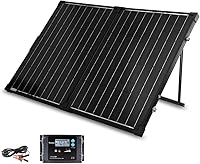
Renogy is the easiest pick when you need 400W without carrying rigid glass panels. This 16-fold solar blanket weighs 16.1 lb and folds to 16.54 x 15.83 x 4.13 inches.
You can spread it across a windshield, place it on sunny ground or hang it between trees or racks. Tie-downs, stakes or weights can help secure it in windy campsites, but the setup still needs clear sun across the blanket.
The blanket uses N-Type cells and has stated efficiency of 25%. It provides MC4 output only, and the 4-in-1 adapter is sold separately.
Renogy names compatibility with Jackery Explorer 1000 v2, EcoFlow DELTA 3 and DELTA 3 Max, Anker SOLIX S2000, C1000 Gen 2 and C2000 Gen 2, plus other models that meet the required specifications. Check your power station's voltage, current and connector needs before ordering.
The package includes 1 x 400W solar blanket and 2 shoulder straps. It is UL 61730 certified and has a 2-year material and workmanship warranty.
Choose Renogy when storage and deployment matter more than a fixed bifacial array. If you want a rigid Renogy setup, compare these best Renogy 400 watt solar panel kits.
7. ZOUPW 480W Bifacial Portable Solar Panel N-Type: Best for portable high-voltage charging
ZOUPW 480W Bifacial Portable Solar Panel N-Type: Best for portable high-voltage charging
- 480W output
- 25%+ efficiency
- Foldable bifacial design
- 4-in-1 connector cable
ZOUPW combines bifacial generation, folding portability and 480W output for large power stations that support its voltage.
Pros
- IP68 waterproof rating
- Includes storage bag, cables and ground stakes
- Composite material coating
Cons
- Not recommended for long-term fixed installation
- Verify power-station input limits
ZOUPW gives portable users 480W, bifacial generation and a foldable format. Its 42.5V architecture is aimed at larger power stations that support the required input voltage.
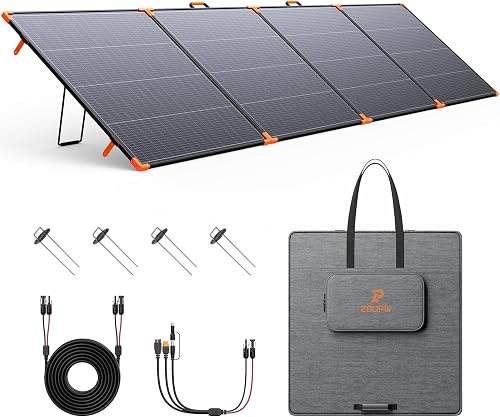
The panel weighs 22.5 lb and measures 138.6 x 0.9 x 32.6 inches when open. It includes a storage bag, 2 ft 12AWG 4-in-1 connector cable, 13 ft 12AWG solar connector extension cable and 4 ground stakes.
The 4-in-1 cable supports XT60, DC7909, DC8020 and Anderson connections. ZOUPW describes those connectors for EcoFlow Delta, Bluetti Elite, Anker, Jackery and other systems, but you must verify your device's input requirements before connecting.
The bifacial design can collect rear light from snow, sand, grass or concrete. The panel has a composite material coating, IP68 waterproofing and a stated upper temperature rating of 140 F.
ZOUPW does not recommend long-term fixed, series or parallel connections. Choose it for temporary outdoor charging, and avoid stepping on it, placing heavy objects on it or leaving it under long-term shade.
8. Renogy Bifacial Solar Panel 2PCS 400 Watt: Best for larger two-panel arrays
Renogy Bifacial Solar Panel 2PCS 400 Watt: Best for larger two-panel arrays
- 2 x 400W panels
- N-Type 16BB cells
- 25% efficiency
- Dual-module design
This Renogy package contains two 400W bifacial panels, giving buyers an 800W setup when both panels fit the system design.
Pros
- Bifacial rear-side generation
- 16BB N-Type cells
- Fewer panels for higher array output
Cons
- Each panel is larger than a 200W module
- System details need careful voltage planning
This Renogy package contains 2 x 400W bifacial solar panels, giving you an 800W setup when both panels are used. It is designed for home, farm, shed, camper, marine and off-grid systems rather than a strict 400W power-station input.
Each panel measures 44.7 x 1.4 x 67.8 inches and weighs 45.4 lb. The larger rigid modules can produce more array power with fewer panel positions, but they need careful roof and rack planning.
Renogy uses N-Type 16BB cells with stated efficiency of 25%. The bifacial design can collect reflected light from snow, sand, concrete, white gravel and light-colored rooftops.
The dual-module design gives each panel two independently operating power zones. A branch, chimney, vent or passing shadow can affect one section while the other continues producing.
Choose this pair when your system is designed for 800W or more and has enough space for two large modules. If your target is a single 400W input, select a model whose total output matches that limit.
9. EPOCH 430W Bifacial Solar Panels: Best for marine and RV mounting
EPOCH 430W Bifacial Solar Panels: Best for marine and RV mounting
- N-Type 16BB cells
- Bifacial design
- 25% claimed efficiency
- IP68 junction box
EPOCH offers a rigid bifacial panel with N-Type 16BB cells, pre-drilled mounting holes and MC4 connectors for outdoor systems.
Pros
- Pre-drilled mounting holes
- IP67 MC4 connectors
- 2400 Pa wind and 5400 Pa snow load ratings
Cons
- Title says 430W while maximum power is listed as 400W
- Panels only
EPOCH is a rigid N-Type 16BB bifacial panel with pre-drilled mounting holes, MC4 connectors and outdoor-focused construction. Its title refers to 430W, while the maximum power field lists 400W, so confirm the exact rated output before planning the array.
The panel measures 44.6 x 1.2 x 67.8 inches. It uses monocrystalline cells, an aluminum frame and tempered glass, with a stated efficiency of up to 25%.
EPOCH describes the panel as suitable for RVs, rooftops, cabins, yachts and other off-grid uses. The pre-drilled holes are intended to work with ground mounts, Z-brackets, corner brackets, pole mounts and tilt mounts.
The panel has an IP68 junction box and IP67 MC4 connectors. It also lists tolerance for 5400 Pa snow loads and 2400 Pa negative wind loads.
Choose EPOCH when you want a conventional rigid panel with broad mounting options. Because the title and maximum power data differ, verify the exact specification before pairing it with a controller or inverter.
How does bifacial gain work in a 400 watt solar panel?
Bifacial gain comes from light reaching the panel's rear side. The effect is strongest when the panel is raised above a reflective surface, while a dark or opaque surface behind it gives the rear cells less useful light.
Bright ground can help, but it does not guarantee a fixed percentage increase. Sun angle, panel height, rear clearance, dirt, shade and the color of the surface all change the result.
A flush rooftop installation may still benefit from a bifacial panel's front-side cells, but don't size your battery or power station around the highest possible rear-side gain. Use the panel's rated front-side output for conservative planning.
How do you connect 400 watt bifacial solar panels safely?
First compare the panel's open-circuit voltage and operating current with the solar input limits of your power station, charge controller or inverter. The Callsun 200W pair, for example, reaches about 54.6V open circuit in series.
Series wiring raises voltage while keeping current closer to one panel. Parallel wiring raises current while keeping voltage closer to one panel, so the correct choice depends on the input limits and the system design.
Panels with different ratings, ages or electrical behavior should not be mixed casually in one series or parallel string. ZOUPW also warns against long-term fixed, series or parallel connections for its portable panel.
If your system uses a battery, the charge controller must match the panel array and battery system. Use a fuse, disconnect and cable sizes that fit the installation plan, and follow the equipment instructions.
Are rigid or portable 400 watt bifacial solar panels better?
Rigid panels are better for a planned RV roof, marine installation, rooftop array or ground mount.
They provide a stable mounting format, but they are heavier, larger to transport and harder to reposition.
Once rigid panels are fixed, you can plan wiring, cable routes and maintenance around them.
That stability works well for daily charging at a home, cabin or vehicle base.
The trade-off is space, because two full-size modules need a clear length and width.
The Callsun 200W panels each measure 51.3 x 30.3 x 1.4 inches and weigh 23.8 lb.
Lifting and securing that size on a roof takes planning and suitable hardware.
A rigid array also stays in place during travel and weather, which helps consistent output.
Portable panels are better when you move between campsites or store the equipment between uses.
Renogy's blanket is lighter and more compact when folded, while ZOUPW adds bifacial output and included cables but weighs more.
The Renogy 400W blanket weighs 16.1 lb and folds to 16.54 x 15.83 x 4.13 inches.
That folded size fits an SUV, van or camper storage area far more easily than rigid modules.
You can spread it on sunny ground, across a windshield or between supports at camp.
The trade-off is setup, because the surface must stay clear and the blanket needs securing in wind.
ZOUPW weighs 22.5 lb and provides 480W with a 42.5V architecture for larger power stations.
It includes a storage bag, extension cable, 4-in-1 connector cable and ground stakes.
That kit helps temporary charging, but it is not meant for long-term fixed mounting.
Choose the rigid Callsun pair for a 400W system with a 60V-class input.
Choose Renogy when folded storage is the main need, or ZOUPW when your power station accepts its 42.5V architecture.
For everyday home or RV use, rigid panels usually give steadier long-term service.
For travel, work sites and emergency backup, portability may matter more than fixed efficiency.
Match the format to how often you will move, store and unpack the system.
What should you check before installing a 400 watt solar panel?
Check the available length and width first.
Rigid panels need clear roof or rack space, and the rear side needs room for reflected light if you want bifacial gain.
Measure the mounting area and leave space for rails, brackets and safe walking access.
Next, check voltage and current.
A panel can be labeled 400W and still exceed a power station's maximum voltage or current when wired with another panel.
Compare open-circuit voltage and operating current with your controller or power station limits.
Confirm the connector type and cable path.
MC4 or solar connectors may need an adapter for a portable power station, and cable length can add voltage drop.
Plan cable routing before mounting, so connectors stay accessible and dry.
Finally, plan for shade, heat and cleaning.
Output below the rated wattage is normal when sunlight, temperature, wiring and device efficiency differ from test conditions.
Keep the front and rear surfaces clean, because dirt can reduce both sides of a bifacial panel.
Check nearby trees, vents and chimneys that may shade one section during the day.
Which 400 watt bifacial solar panel should you choose?
Choose the Callsun N-Type 16BB 400W pair when you want the closest match to a 400W solar input, 25.6% efficiency and a dual-module design for partial shade. Choose the second Callsun pair when published wind and snow load ratings matter most.
Pick JJN's 850W pair or Renogy's 800W pair only when your system is designed for a larger array. Choose Renogy's blanket for compact storage, and choose ZOUPW for portable 480W output when its input requirements fit your power station.
For a fixed installation, compare your panel dimensions, mounting points and controller limits before choosing a brand. For portable charging, compare folded size, weight, included cables and the power station's solar input range.
Our top 3 picks at a glance
-
1
Best for 60V portable power stations
Callsun N-Type 16BB 400W Bifacial Solar Panel
9.7/10 our score
See it on Amazon -
2
Best for weather-resistant rooftop arrays
Callsun N-Type 16BB 400W Bifacial Solar Panel
9.6/10 our score
See it on Amazon -
3
Best for high-output off-grid arrays
JJN Bifacial 2Pcs 425 Watt N-Type Solar
9.3/10 our score
See it on Amazon
Frequently asked questions
What are the best 400 watt bifacial solar panels?
The best 400 watt bifacial solar panels here are the Callsun N-Type 16BB pairs. They combine two 200W modules, 25.6% efficiency, transparent backsheets and dual-module anti-shade design.
Choose Renogy if folding storage matters, or choose ZOUPW if your power station supports its 42.5V input and you want portable 480W output.
Do bifacial solar panels produce more power?
Bifacial solar panels can produce more total energy when light reaches the rear side. Reflections from snow, sand, gravel, concrete or other bright surfaces can help, but the gain depends on panel height, ground color, sun angle, shade and installation layout.
A rear side that is blocked cannot contribute much.
Are 400 watt bifacial solar panels good for RVs?
Yes, 400 watt bifacial solar panels can suit RVs when the roof has enough space and the charge controller or power station accepts the panel voltage and current. Rigid pairs need mounting hardware and careful wiring.
A foldable Renogy blanket is easier to store and deploy when permanent roof mounting is not practical.
Can I connect two 200W panels to a portable power station?
You can connect two 200W panels when the combined voltage and current stay within the power station's solar input limits. The Callsun pair reaches about 54.6V open-circuit voltage in series, which suits many 60V-class inputs.
Always compare Voc, operating current and the station's maximum solar input before connecting.
What is the difference between 400 watt solar panel bifacial and portable panels?
A rigid 400 watt solar panel bifacial setup is built for mounting on a roof, rack or ground structure. A portable panel folds or packs for temporary use and usually prioritizes storage, handles or included cables.
Choose rigid panels for a fixed array and a foldable model for campsites or mobile charging.