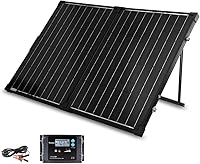
7 Best Portable Solar Panel Kits (November 2026)
The best portable solar panel kits include the Renogy 100W Portable Solar Panel for simple 12V charging, the ECO-WORTHY 200 Watts 12 Volt/24 Volt Solar for higher daily output, and the SOLPERK Solar Panel Kit 20W 12V Solar for battery maintenance.
On this page (5 sections)
The Renogy 100W Portable Solar Panel is the best portable solar panel kit for most buyers because it combines a foldable suitcase design, 25% efficiency, a pre-installed 20A PWM controller and 12V charging support. The ECO-WORTHY 200W kit suits higher daily output, while the GRECELL bundle adds a 1000W power station.
That balance matters for a first setup. You get a panel you can carry, a controller already fitted, and clips that connect straight to a 12V battery or a compatible power station.
A portable solar panel system can mean a panel and controller only, or a full package with cables, mounting parts and stored battery power. Our comparison focuses on what each kit includes, how much panel capacity it offers and where its charging setup makes sense.
Wattage is only one part of the decision. Controller type, connector style, folded size and the solar input limit of your battery or power station shape what you can actually use each day.
The kits here range from a 20W trickle charger for battery maintenance to 200W and 300W folding panels for larger systems. There is also a complete bundle that pairs a panel with a power station for AC devices.
Portability creates a trade-off. A light folding kit is simpler to carry and store, while a heavier fixed kit may suit an RV that stays in one place for longer periods.
If you are new to this equipment, start with our guide to what is a portable solar panel. For charge-control basics, see the best portable solar panels with charge controllers.
Use those guides to check the basics, then return to the picks below with your battery voltage and input limit in mind. That order helps you avoid buying more panel capacity than your system can accept.
Our picks at a glance
-
1

-
2
 Best for higher daily output
ECO-WORTHY 200 Watts 12 Volt/24 Volt Solar
9.7/10 our score
See it on Amazon -
3
 Best for battery maintenance
SOLPERK Solar Panel Kit 20W 12V Solar
9.6/10 our score
See it on Amazon
- 4
 Check it
DOKIO 200W Portable Foldable Solar Panel Kit
Best for lightweight 200W portability - 5
 Check it
GRECELL 1000W Portable Power Station & 200W
Best complete solar power bundle - 6
 Check it
Go Power GP-PSK-130 130W Portable RV Solar
Best for RV connection options - 7
 Check it
DOKIO 300W Foldable Solar Panel Kit
Best for maximum panel capacity
The best portable solar panel kits by use
The best portable solar panel kit depends on your battery voltage, solar input limit, carrying needs and required output. The picks below are ordered by score, with the highest scores first.
Our score weighs specs, features and buyer feedback against what you're shopping for. We checked the stated power, controller, connections, portability and intended charging use.
That means a smaller kit can rank well for maintenance use, while a larger kit ranks well for daily charging or travel. The order reflects fit for the stated use, not a claim that one wattage suits everyone.
Renogy 100W Portable Solar Panel: Best for simple 12V charging
- 100W maximum power
- 25% efficiency
- Pre-installed 20A PWM charge controller
- Folded size of 24.8 x 2 x 2.8 in
The foldable suitcase design and pre-installed 20A controller make this a practical starting point for 12V batteries and power stations.
Pros
- 25% efficiency
- Adjustable kickstand
- Alligator clip cable included
Cons
- Lower panel capacity than the 200W and 300W kits
- 17.4 lb carry weight
Renogy is the strongest all-around choice for a simple 12V portable solar panel system. Its 100W panel uses N-Type cells with up to 25% conversion efficiency, and the foldable case weighs 17.4 lb.
The pre-installed waterproof 20A PWM charge controller reduces the number of separate parts you need to arrange. The package includes a Solar Connector to Alligator Clips Cable with a 15A fuse, so it is aimed at direct 12V battery and compatible power-station setups.
An adjustable aluminum alloy kickstand helps you angle the panel toward the sun. The folded size is 24.8 x 2 x 2.8 in, which is useful when storage space matters.
Renogy also uses low-iron tempered glass, an aluminum frame and an IP65-rated junction box. The trade-off is capacity: this is a 100W kit, so buyers needing more solar input should compare the 200W and 300W options below.
Choose it for a compact 12V setup with a built-in controller. Read our best Renogy solar panel kit guide if you want to compare more kits from the same brand.
ECO-WORTHY 200 Watts 12 Volt/24 Volt Solar: Best for higher daily output
- 200W maximum power
- 2 pieces of 100W monocrystalline panel
- 30A PWM charge controller
- Series or parallel connection
Two 100W panels and a 30A controller suit RV, camper and off-grid setups that need more capacity than a 100W folding kit.
Pros
- 200W panel capacity
- 12V or 24V connection options
- 16.4 ft solar cables
Cons
- 31.6 lb total weight
- Not a folding suitcase design
ECO-WORTHY is the better fit when your portable solar panel system needs 200W from 2 pieces of 100W monocrystalline panels. The kit includes a 30A PWM charge controller, 2 sets of Z mounting brackets, 16.4 ft solar cables, 2-in-1 connectors and a 4.92 ft tray cable.
Its panels can connect in series for 24V or in parallel for 12V. That gives you more wiring choices than a basic single-panel kit, but it also makes this a heavier setup at 31.6 lb.
The stated panel size is 35.2 x 23.1 x 1.3 in per panel. The aluminum frame and IP65 junction box suit fixed or semi-portable RV, camper, vehicle and off-grid use.
For more RV-specific choices, compare portable solar panel kits for RVs.
ECO-WORTHY gives a stated daily output of 800Wh under 4 hours of full sunshine. Treat that as a condition-based estimate, since sunlight, angle and the connected system affect actual charging.
Choose it when 200W capacity and 12V or 24V wiring matter more than suitcase-style portability.
SOLPERK Solar Panel Kit 20W 12V Solar: Best for battery maintenance
- 20W maximum power
- 10A MPPT controller
- 360-degree adjustable bracket
- Alligator clip and O-ring connections
This compact 20W kit is aimed at maintaining 12V batteries in cars, boats, motorcycles, tractors, trailers and RVs.
Pros
- Light 3 lb design
- Adjustable mounting bracket
- MPPT controller
Cons
- 20W output is not suited to fast power-station charging
- Mounting style is less travel-focused
SOLPERK is the right choice for maintaining a 12V battery rather than quickly filling a large power station. Its 20W monocrystalline panel is designed for batteries in cars, boats, motorcycles, tractors, trailers, RVs and similar equipment.
That maintenance role suits vehicles and machines that sit unused for periods. A small panel can help offset the slow drain that leaves a battery flat before the next start.
The kit includes a 10A MPPT controller, 360-degree adjustable mounting bracket, alligator clip, O-ring and mounting accessories. The SAE connector and 3 lb weight make it easy to position near a vehicle or small battery setup.
The adjustable bracket is useful when the panel cannot be fixed in the ideal spot. You can tilt it toward the sun during the day and move it as the light changes.
The controller uses a 3-stage charging design and has indicator lights for charging status. SOLPERK also describes protection against overcharging, over-voltage and short circuits.
Those lights give a simple check on charging progress without extra meters or apps. They also help you spot a problem early when a battery is not responding as expected.
This is the smallest panel here, so its role is different from the 100W, 200W and 300W kits. Choose it for battery maintenance and trickle charging, not for running larger appliances or recharging a high-capacity station quickly.
For a lawn mower, trailer or boat battery, that limited output is often the point. It keeps the battery ready without the bulk of a larger folding kit.
DOKIO 200W Portable Foldable Solar Panel Kit: Best for lightweight 200W portability
- 200W panel capacity
- 9.7 lb weight
- 20 x 27 in folded size
- Separate PWM controller and dual USB ports
The light foldable frame gives campers and RV users 200W-class capacity without the 31.6 lb weight of the ECO-WORTHY kit.
Pros
- 9.7 lb carry weight
- Long cable
- Dual USB ports
Cons
- Power stations may limit actual input
- Separate controller needs placement
DOKIO's 200W foldable kit is the portable capacity pick because it weighs 9.7 lb and folds to about 20 x 27 in. That is much lighter than the ECO-WORTHY 200W kit for campers, vans, boats and emergency backup use.
Weight matters when a panel is carried from a vehicle to a pitch site. A 9.7 lb kit is easier to move across uneven ground than a heavier fixed setup.
A 9.84 ft cable lets you place the panel in direct sunlight while keeping the separate PWM controller or power station in a shaded area. The controller protects a 12V system against reverse polarity, overcharge, overload and short circuit.
That cable length also helps on sites where the best sun is not beside the battery. You can set the panel in an open patch and keep electronics cooler in shade.
The kit also has dual USB ports for phones, lamps and small gadgets when connected to a 12V battery. It can provide direct sunlight top-ups without a battery, though current can vary.
USB charging is handy for headlamps and phones at camp, but it is a secondary use. The main purpose remains charging a 12V battery or feeding a compatible power station.
Check your power station's input limit before choosing this panel. Some stations accept only 100W to 150W, so the station may limit the usable input even when the panel has more capacity.
That limit is a design feature, not a fault in the panel. Matching the panel to the station gives you the fastest charge your system can handle safely.
GRECELL 1000W Portable Power Station & 200W: Best complete solar power bundle
- 1000W portable power station
- 200W foldable solar panel
- 23% panel conversion rate
- Pure sine wave AC output
This kit pairs a 1000W portable power station with a foldable 200W panel for buyers who need both solar input and stored power in one bundle.
Pros
- Pure sine wave AC
- 60W USB-C PD
- Solar, AC and vehicle charging
Cons
- More equipment than a panel-only kit
- Power-station input limits still matter
GRECELL is the best complete bundle for buyers who need a panel and stored power together. The package pairs a 1000W pure sine wave portable power station with a foldable 200W monocrystalline solar panel.
The station has 2 independent 100-120V AC outlets, a 60W USB-C PD port, QC 3.0 USB-A ports, a 12V 10A car socket, a wireless charging pad and a DC 5525 port. It also supports pass-through charging.
The panel uses an ETFE surface and has a stated 23% conversion rate. An adjustable kickstand helps with positioning, and series or parallel connection is supported for compatible expansion.
Other built-in features include an LED light, SOS flash mode, LCD display, auto cooling fan and battery-management protection against overcharge, over-discharge, overload, short circuit and overheating.
Choose this when a portable solar panel kit should also power AC devices and store energy. For a panel-focused comparison, see the best portable power station solar charger guide.
Go Power GP-PSK-130 130W Portable RV Solar: Best for RV connection options
- 130W maximum power
- Adjustable angle legs
- Anderson-style, SAE and XLR connections
- Nylon storage case
The multiple connection options and adjustable legs make this a useful RV, camping or marine kit when battery access varies.
Pros
- Several connector types
- Supports AGM or lithium batteries
- Folding design
Cons
- 28.7 lb weight
- Lower power than the 200W and 300W kits
Go Power suits RV and marine buyers who need several connection choices. The 130W folding kit includes Anderson-style connectors, an SAE plug, an XLR plug, ring terminals and battery clamps.
That range helps when the battery access point changes from trip to trip. You are more likely to find a connector that fits an existing RV, boat or trailer setup.
Adjustable angle legs help you position the panels toward the sun. The kit supports AGM or lithium batteries and includes a 10A controller, battery clamps and a heavy-duty nylon case.
The legs are practical on a campsite where the ground is not flat. A small tilt adjustment can improve exposure without moving the whole panel.
The nylon case adds protection during transport between sites. That matters for a folding kit that may be packed and unpacked often on long trips.
At 28.7 lb, it is heavier than the DOKIO 200W and 300W foldable kits. Its advantage is the connection range and a design aimed at RV, camping and marine use rather than maximum wattage.
Choose Go Power when your existing battery setup makes connector flexibility more useful than the lightest carry weight. It is a fit for varied connections, not for shoppers chasing the highest wattage per pound.
DOKIO 300W Foldable Solar Panel Kit: Best for maximum panel capacity
- 300W maximum power
- 15.2 lb weight
- PWM controller
- 9.85 ft cable and dual USB ports
The 300W capacity suits larger solar input needs, but the connected power station may accept only 100W to 200W.
Pros
- Highest panel capacity here
- 15.2 lb weight
- Multiple adapters included
Cons
- Power station input cap may limit output
- Longer folded shape
DOKIO's 300W kit is for buyers who want the highest panel capacity in this group. It uses monocrystalline cells, weighs 15.2 lb and folds to 19.3 x 37.4 x 1.1 in.
The separate PWM controller protects a 12V system against reverse polarity, overcharging, overload and short circuits. A 9.85 ft cable lets you move the panel into direct sun while keeping electronics in the shade.
The package includes SAE, XT60 and alligator clips, DC 5521, 5525, 35135 and 6440 adapters, a storage bag and a manual. Dual USB ports can charge phones, headlamps and other small devices from a 12V battery.
The main trade-off is system compatibility. Many power stations limit solar input to 100W to 200W, so a 300W panel may not deliver its full rated input to every station.
Choose it when your connected system can accept higher solar input and you can store its longer folded shape.
How do you choose a portable solar panel kit?
Choose by the battery or power station input limit first, then compare panel wattage, controller type, connectors and folded size. A larger panel can charge faster only when the rest of the system accepts the extra input.
That input limit is the ceiling for the whole system. If your power station accepts 150W, a 300W panel will not push 300W into it in normal use.
A 20W kit such as SOLPERK fits battery maintenance. A 100W kit such as Renogy is easier to carry for general 12V charging.
Those smaller kits suit a battery that needs topping up between uses. They also suit short trips where storage space and carry weight matter more than speed.
The 200W and 300W DOKIO kits make sense when your station or battery system can use their capacity. They are lighter for their wattage than some fixed kits, which helps for vans and camping.
Check voltage before connecting anything. The ECO-WORTHY kit supports series or parallel wiring for 24V or 12V use, while several other kits are built around 12V systems.
Wiring in series raises voltage, while parallel wiring keeps voltage lower and adds current. Pick the method that matches your battery bank and controller rating.
Connector style is the next practical check. SAE, XT60, alligator clips and MC4 connections each suit different setups, and adapters add bulk if you get them wrong.
Folded size decides where the kit lives when it is not in use. A slim folding panel can slide behind a seat, while two fixed panels need roof space or a trailer rack.
Daily use should guide the final pick. If you will set up the kit every weekend, quick folding and simple clips may beat maximum wattage.
If the kit will stay mounted on an RV for a season, higher capacity and fixed wiring may be worth the extra effort.
What should you check before connecting a portable solar panel?
Check the panel voltage, battery voltage, controller rating, connector type and power-station solar input range. Never assume that a panel's maximum wattage is the same as the input your station can accept.
Panel voltage must suit the controller and battery system. A mismatch can stop charging or cause damage if connections are made without checking.
Most kits here are built around 12V systems, while the ECO-WORTHY kit can be wired for 24V use.
Controller rating should cover the panel output. The controller regulates charging and helps protect the battery from overcharging during bright sun.
Connector type decides whether the kit connects cleanly. Alligator clips suit quick battery access, while SAE, XT60 and MC4 connections suit more fixed or vehicle setups.
Power station input range needs a direct check in the manual. Some stations cap solar input at 100W to 200W, so a larger panel may deliver less than its rating.
A charge controller is especially important when a panel connects directly to a battery. PWM designs are simpler and common in compact kits, while MPPT can extract more usable power in some conditions.
Battery chemistry also matters for charging settings. AGM, flooded, gel and lithium batteries do not all accept charge in the same way, so follow the kit instructions for your battery type.
Check cable condition before every connection. Damaged insulation, loose clips or corroded contacts can cause poor charging and safety problems.
Keep polarity in mind when you connect clips, and confirm positive and negative before clamping.
If your setup needs AC power, you may also need an inverter. Our guide explains what portable solar panel inverter means for this type of system.
Test the setup in daylight before a trip. A short trial at home shows whether connectors fit, the controller lights respond, and charging starts as expected.
How do you set up and care for portable solar panels?
Set the panel in direct sunlight, angle it toward the sun and keep the controller or power station shaded when the cable allows. Avoid placing the panel where trees, vehicles or tent walls create partial shade.
Partial shade can cut output sharply for the shaded cells. Moving the panel a short distance into open sun often helps more than changing the angle alone.
Place the panel on stable ground where it will not tip in wind. A kickstand or legs should grip the surface before you walk away.
Connect the panel to the controller first, then connect to the battery or station in the order given in the instructions. That sequence helps the controller read the system correctly.
Keep connectors dry and inspect cables before use. Fold the panel only after it is clean and dry, then store it in its case or bag where the glass, cables and brackets will not be crushed.
Wipe glass with a soft cloth and clean water. Dirt reduces output, while harsh cleaners can harm coatings or frames over time.
Dry clips and connectors before packing, as moisture trapped in a case can corrode contacts.
Check kickstands, legs and hinges for tightness. A loose stand can shift during the day and leave the panel pointing away from the sun.
Store the kit away from heavy items that could press on the glass. For fixed panels, check mounting brackets and cable runs after rough travel, as bolts can loosen and cables can rub over edges.
Keep the manual with the kit for connector and controller details. For a complete power solution, compare these kits with the best portable solar power station options that include panels and stored battery capacity.
A power station adds stored energy for use after dark. That matters when your main need is AC power rather than daytime battery charging.
Which portable solar panel kit should you buy?
Pick the Renogy 100W Portable Solar Panel if you want the best balance of foldable storage, 12V charging and a pre-installed controller. Choose ECO-WORTHY for a 200W 12V or 24V setup, SOLPERK for battery maintenance and DOKIO 200W for lighter high-capacity travel.
Those picks cover the main needs in this group. Renogy suits general 12V use, while SOLPERK suits small batteries that mainly need topping up.
Choose GRECELL when you need a complete 1000W power station and 200W panel bundle. Go Power is the better match for varied RV connectors, while DOKIO 300W is for systems that can accept higher solar input.
Before you buy, check your battery voltage and your power station input limit. That step prevents a mismatch between panel capacity and the rest of your system.
Also check folded size and weight against your vehicle storage. The best kit is the one you will carry, set up and pack away without trouble.
If you travel light, a folding kit is easier to fit in. If you stay in one place for longer, a fixed 200W setup may suit better.
If AC devices matter, stored power should be part of the plan. A bundle with a power station covers that need in one package.
Match connectors to your battery access points. The right plug or clip makes setup faster and reduces the need for adapters.
Read the controller details for your battery type. That helps you set charging correctly and protect battery life.
In short, start with the input limit, then choose by portability and use. That order leads to a kit that fits your system instead of one that only looks strong on paper.
Our top 3 picks at a glance
-
1
-
2
Best for higher daily output
ECO-WORTHY 200 Watts 12 Volt/24 Volt Solar
9.7/10 our score
See it on Amazon -
3
Best for battery maintenance
SOLPERK Solar Panel Kit 20W 12V Solar
9.6/10 our score
See it on Amazon
Frequently asked questions
What is the best portable solar panel kit for most people?
The Renogy 100W Portable Solar Panel is the best portable solar panel kit for most buyers who need a foldable 12V charging setup. It combines a 100W panel, 25% efficiency, an adjustable kickstand and a pre-installed 20A PWM controller.
Choose a higher-capacity kit when your battery or power station accepts more solar input.
What should a portable solar panel kit include?
A portable solar panel kit may include the panel, charge controller, cables, connectors, brackets, a case or a power station. Check each package carefully because the Renogy includes a controller and alligator clip cable, while the GRECELL kit also includes a 1000W power station.
Match every connector to your battery or power station.
Is a 200W portable solar panel better than a 100W panel?
A 200W portable solar panel can supply more input when sunlight and the connected battery system support it. It is not automatically better for every setup.
A 100W kit is easier to carry and may match a smaller power station, while a 200W kit needs more storage space and may weigh more.
Can a portable solar panel charge a power station?
Yes, when the panel output, connector and voltage fit the power station's solar input range. The DOKIO kits warn that some power stations cap solar input below the panel's maximum.
Confirm the station's input limit before choosing a 200W or 300W panel.
Do portable solar panels need a charge controller?
A charge controller helps regulate charging between a panel and a battery. The Renogy, ECO-WORTHY, SOLPERK, DOKIO and Go Power kits include controllers, while a power-station setup may use its own internal charging system.
Check the wiring instructions before connecting a panel to a battery.