What Inverter Do You Need for Portable Solar Panels?
You need an inverter that matches your battery voltage and can handle your appliances' running watts plus startup surge. Choose the inverter only after checking the panel, charge controller, battery and power station limits.
On this page (10 sections)
- What does a portable solar panel inverter do?
- Which inverter type fits portable solar panels?
- How many watts should a portable solar panel inverter have?
- What voltage should the inverter use?
- How does panel wattage affect the inverter?
- Do you need a charge controller with the inverter?
- How should you size the cables?
- Can you use a portable solar panel with an inverter generator?
- What should you check before connecting the system?
- Which portable solar panel inverter setup should you choose?
You need an inverter that matches your battery voltage and can handle your appliances' running watts plus startup surge. A portable solar panel creates DC power, while most household devices use AC power, so the inverter is the bridge between the battery system and those devices.
The inverter does not make the panel produce more power. It simply changes stored battery power into a form that household plugs can use.
The correct setup depends on the complete path: panel, cable, charge controller, battery or power station, inverter and load. One weak link can limit the whole system, even when the other parts are well matched.
Start with the device you want to run, then work backward to the battery and solar input. That order keeps the choices practical and avoids buying a large inverter for a small battery.
Battery voltage comes first because the inverter must match it exactly. A 12V system needs a 12V inverter, and the panel and controller must suit a 12V battery as well.
Running watts matter next, along with the extra demand some devices need when they start. A fan, pump or motor may ask for more power for a short moment than it uses while running.
Runtime then depends on stored battery capacity, not only on panel size. A bigger panel can recharge a battery faster in good sun, but it cannot replace energy that is not available after dark.
If you are still comparing panel types, begin with our guide to what is a portable solar panel. For a complete system, our best portable solar panel kit guide can help you compare matched components.
What does a portable solar panel inverter do?
A portable solar panel inverter converts DC electricity from a battery into AC electricity for devices such as chargers, lamps or small appliances. The panel itself produces DC power, but the inverter normally uses stored battery power rather than changing raw panel output directly.
A charge controller manages the panel's connection to a battery. An inverter then draws from that battery and supplies AC power.
A portable power station combines these functions in one enclosure.
This distinction matters because solar output changes with sunlight. A battery and charge controller provide a more stable source for the inverter than a panel connected directly to an AC load.
Read what is a power inverter in a UPS to see how the same DC-to-AC job fits into an uninterruptible power system.
Which inverter type fits portable solar panels?
The right inverter type depends on the devices you plan to power. A pure sine wave inverter is the safer choice for sensitive electronics and devices with motors, while a modified sine wave inverter may suit simpler loads if the device maker allows it.
Pure sine wave inverter
A pure sine wave inverter produces AC power that more closely follows utility power. It is a strong fit for laptops, monitors, medical equipment, chargers and appliances with motors or electronic controls.
Choose this type when you want broad device compatibility. It usually costs more, but compatibility is more important than saving space or money if the load is sensitive.
Modified sine wave inverter
A modified sine wave inverter can power some basic loads, such as simple lights or certain heating devices. Some chargers, motors and electronic equipment may run poorly, create extra noise or draw more power.
Use this type only when you have checked the requirements of every device. If you are unsure, pure sine wave gives you a simpler compatibility decision.
Inverter built into a power station
A portable power station includes a battery, charging system, outlets and an inverter. This reduces separate wiring, but you still need to match the solar panel's voltage, connector and input limit to the station.
Some power stations cap solar input below the panel's maximum output. That cap can be normal system design, so check the station's input limit before choosing a panel.
How many watts should a portable solar panel inverter have?
Choose an inverter with more continuous watt capacity than the total running load, then check its surge capacity for devices that start with a brief power spike. A panel's watt rating does not tell you the inverter size by itself.
Add the running watts of the devices you may use at the same time. Then identify loads with motors, compressors or heating elements because their startup demand can be higher than their normal running draw.
For example, a phone charger and small lamp need far less inverter capacity than a refrigerator or power tool. A larger inverter does not create more solar energy.
It only gives the system more ability to supply a compatible load when the battery can support it.
Also check the battery's voltage and maximum output. A high-watt inverter connected to a battery that cannot supply enough current may shut down or place stress on the system.
What voltage should the inverter use?
The inverter's input voltage must match the battery system, such as a 12V battery setup. Do not choose by output wattage alone.
A 12V battery system needs an inverter designed for that input voltage.
The panel and charge controller must also work together. A portable panel may be intended for a 12V battery, while a power station may require a specific DC input range and connector.
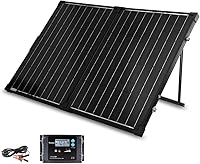
The DOKIO 100W Portable Foldable Solar Panel Kit is designed for 12V battery charging and includes a standalone PWM controller. Its 9.84 ft cable helps place the panel in sunlight while the controller or power station stays shaded.
The panel folds to about 19 x 26 in and weighs 6 lb. Its controller includes protection against reverse polarity, overcharge, overload and short circuit, but the inverter still needs to match the battery system and connected loads.
This option suits phones, lights and small gadgets more than large AC appliances. Check a power station's input limit because some stations accept less than the panel's maximum output.
How does panel wattage affect the inverter?
Panel wattage affects how quickly the battery can recharge, while inverter wattage affects how much AC load the system can run. These are related but different jobs.
A 100W panel cannot continuously replace a large load using sunlight alone. The battery supplies the difference, and the panel restores some of that energy when conditions allow.
The DOKIO 200W Portable Foldable Solar Panel Kit is also intended for 12V battery charging and includes a separate PWM controller. Its 9.84 ft cable supports a flexible panel position, while its folded size is about 20 x 27 in and its weight is 9.7 lb.
Its dual USB ports can supply phones, lamps and small gadgets when connected to a 12V battery. The panel's higher output does not mean every power station will accept 200W, so check the station's solar input limit before connecting it.
For another way to compare controller-equipped options, see our guide to best portable solar panels with charge controllers.
Do you need a charge controller with the inverter?
You need a suitable charge controller between a solar panel and a battery unless the power station already has the required solar charging system inside. The inverter does not replace the charge controller.
The controller manages how panel power reaches the battery. Panel output changes as sunlight changes, so the battery needs a controlled charging path instead of a direct connection.
The controller also helps protect the battery from conditions such as overcharge. That protection matters because a battery can be damaged when charging is badly matched to its system.
It must match the panel output and battery system. Check voltage, current, connectors and polarity before making the connection, and follow the maker instructions for the exact order of setup.
A PWM controller can be a practical fit for a straightforward 12V portable setup. It suits a simple system where the panel, battery and controller are chosen to work together from the start.
The DOKIO kits above include standalone PWM controllers. They are designed to connect to a compatible 12V battery system through that charging path, with protection against reverse polarity, overcharge, overload and short circuit.
A separate controller has daily benefits beyond the first setup. You can keep it in shade while the panel stays in direct sun, and a separate unit is simpler to inspect or replace if your system changes.
It also makes the limits easier to see. The panel, controller and battery each have their own ratings, and each rating needs to fit the next part in the chain.
Do not use the inverter as a shortcut around charging. The inverter draws from the battery and supplies AC power, while the controller handles the solar side of the system.
If you are comparing a panel and controller as a bundle, our best Renogy solar panel kit guide covers another common way to build a matched solar setup.
Keep the controller dry, ventilated and away from damage where you can. A clean, secure connection helps the battery charge as intended and makes later checks much simpler.
How should you size the cables?
Use cable length, wire gauge, current and connector type together. Longer cable runs can increase voltage loss, so use a suitable gauge and keep the route as short as your setup allows.
The BougeRV 20 Feet 10AWG Solar Extension Cable has male-to-female solar connectors, one red and one black 20 ft cable, and a bare-wire end for connection to a controller. Its 10AWG cable is intended to reduce power loss compared with 12AWG and 14AWG cable.
It is rated for outdoor use with UV-resistant material, XLPE insulation and an IP67 waterproof and dustproof ring on the male connector. The cable is rated for a maximum current of 30A and maximum voltage of 1000V DC.
Use the connector type and polarity required by your panel and controller. Keep connectors clean, locked and protected from standing water, and avoid placing cable where vehicles or sharp edges can damage it.
Can you use a portable solar panel with an inverter generator?
A portable solar panel and an inverter generator serve different roles. The solar panel charges a battery, while the inverter generator creates AC power from fuel.
They are not automatically interchangeable. One depends on sunlight and stored energy, while the other depends on fuel and an engine that must run to make power.
A battery inverter can run AC devices when its battery has enough stored energy. It works quietly from the battery, but it cannot create new energy and it will stop being useful when the battery is drained.
A generator can supply AC power while running. That can be useful for heavier loads or longer use, but it brings fuel, noise, exhaust and routine care into the setup.
Solar compatibility varies by model. Some generators have charging inputs for a battery, while others only provide AC outlets and have no solar charging path at all.
Check the manual before connecting a panel to any generator. Voltage, current, connector type and charging limits all need to match, and a wrong connection can damage equipment.
A solar panel can still help in a generator setup by charging a separate battery system. That keeps the solar path and the fuel path separate, with each part doing the job it was built for.
This approach suits backup planning when sunlight is uncertain. The battery system can run selected devices quietly, while the generator can recharge batteries or run larger loads when fuel and conditions allow.
Do not assume a generator will charge a solar battery in the right way. Use a suitable charge controller or a power station input that is made for solar charging.
If you need longer backup during poor sunlight, compare the system with our portable generators buying guide. Keep the solar battery system and generator requirements separate when checking fuel, charging and output needs.
Think about care as well as power. Solar gear needs clean panels and protected cables, while a generator needs fuel storage, ventilation and safe outdoor placement.
What should you check before connecting the system?
Check every connection before switching on the inverter. The panel, controller, battery, cable and inverter must agree on voltage, current, connectors and polarity.
Use this order:
- Identify the devices you want to run and add their running watts.
- Check startup demand for motors, compressors and other surge loads.
- Choose an inverter with suitable continuous and surge capacity.
- Match the inverter input voltage to the battery system.
- Confirm the panel and charge controller suit the battery.
- Check the power station's solar input limit if you use one.
- Confirm connector type and polarity before plugging in.
- Keep the panel, controller and cables dry, shaded where practical and free from damage.
A portable solar panel can be useful for charging a battery, but it does not guarantee that the battery can run every appliance. Capacity, sunlight, cable losses and inverter limits all affect the result.
Which portable solar panel inverter setup should you choose?
Choose a pure sine wave inverter matched to your battery voltage when you need dependable compatibility with electronics, chargers or motor-driven devices. Pair it with a charge controller that matches the panel and battery.
That pairing covers the two main jobs in the system. The controller manages solar charging for the battery, and the inverter turns stored DC power into AC power for household devices.
Choose the DOKIO 100W kit for a lighter 12V charging setup. It folds to about 19 x 26 in, weighs 6 lb, and includes a standalone PWM controller and dual USB ports.
That kit suits campers and van users who value portability. It is a practical fit for phones, lights and small gadgets, rather than large AC appliances that need more stored energy.
Choose the DOKIO 200W kit when you want more solar input and accept the added weight. It folds to about 20 x 27 in, weighs 9.7 lb, and also includes a standalone PWM controller and dual USB ports.
The larger panel can recharge a compatible 12V battery more quickly in good sun. It still needs a check against any power station input limit, since some stations accept less than the full panel output.
Choose the BougeRV cable when a longer connection helps position the panel away from the controller or power station. It is a 20 ft 10AWG cable with male to female solar connectors and a bare wire end for a controller connection.
The thicker cable is meant to reduce power loss over a longer run. Its connectors, UV resistant material and sealed male connector also suit outdoor placement when the panel needs better sun than the shaded equipment area.
A power station can simplify the setup when it already includes a battery, inverter and solar input. Even then, the panel voltage, connector and input limit must match the station before you connect it.
The main rule is simple: size the inverter for the AC load, size the battery for the runtime, and size the solar input for the recharge plan. That keeps the portable solar panel inverter from becoming the weak link in the system.
Frequently asked questions
Do portable solar panels need an inverter?
Portable solar panels don't need an inverter to charge a compatible battery through a charge controller. You need an inverter when you want to turn the battery's DC power into AC power for household devices.
Some portable power stations already include both the battery and inverter.
What size inverter do I need for a portable solar panel?
Choose an inverter by the devices you will run, not by panel wattage alone. Add the running watts of the connected devices, allow extra capacity for startup surges, and confirm that the battery and charge controller can support the system.
Can I connect a solar panel directly to an inverter?
Usually, you should not connect a portable solar panel directly to a standard battery inverter. A suitable charge controller or power station input should regulate the panel's variable output and charge the battery before the inverter supplies AC power.