EcoFlow 110W Portable Solar Panel Review: Worth It? (November 2026)
The EcoFlow 110W Portable Solar Panel suits smaller EcoFlow charging setups that can use a 110W panel and MC4 connectors. Its foldable design, IP68 rating and adjustable carry case stand out, while compatibility and input limits still need checking.
On this page (7 sections)
- What stands out about the EcoFlow 110W portable solar panel?
- What should you check before pairing it with a power station?
- How does the adjustable case help during setup?
- Is the EcoFlow panel suitable for outdoor use?
- How does it compare with other options?
- Which alternative fits your setup?
- Is the EcoFlow 110W Portable Solar Panel worth choosing?
The EcoFlow 110W Portable Solar Panel is a foldable option for smaller EcoFlow charging setups that accept its MC4 connector and 110W maximum power. Its adjustable carry case and IP68 water and dust resistance suit outdoor use, but check your power station's solar input limits before buying.
We compared its stated features with two alternatives: another 110W panel with an adapter cable and a Jackery bundle with a 200W panel. The right choice depends on your station, connection needs and how much panel capacity you want.
What stands out about the EcoFlow 110W portable solar panel?
The EcoFlow 110W stands out for combining a 23% conversion rate, MC4 connector, IP68 rating and adjustable carry case. The case serves as a kickstand, so the panel can be angled toward the sun while charging.
EF ECOFLOW 110W Portable Solar Panel: Best for compact EcoFlow setups

- 110W maximum power
- 23% conversion rate
- IP68 water and dust resistance
- Foldable case with adjustable kickstand
A foldable 110W panel with an adjustable carry case that doubles as a kickstand. Check your power station's connector and solar input limits before choosing it.
Pros
- Carry case doubles as an adjustable kickstand
- IP68 water and dust resistance
- MC4 connector
- 23% conversion rate
Cons
- 110W maximum power may be limiting for larger stations
- Power station compatibility and input limits still need checking
At 110W maximum power, it is aimed at smaller charging setups. A station may accept less than the panel's maximum, so check the station's solar input limit and connector requirements before pairing them.
The panel is foldable and weighs 3.99 kg. That makes the carry case and setup angle relevant when you plan to move it between a vehicle, campsite or home.
Who is the EcoFlow 110W panel best for?
It makes sense if you already have a compatible EcoFlow power station and want a portable panel for modest solar input. The integrated kickstand case is useful when you need to reposition the panel during the day.
Consider a higher-wattage panel if your station can accept more solar input and you want to collect more power in suitable sunlight. The EcoFlow solar panel specs guide explains how to compare panel output and station limits.
What should you check before pairing it with a power station?
Check the station's solar input connector and maximum input power before choosing a panel. A connector that physically fits does not prove the station can accept the panel's full output.
The EcoFlow panel uses MC4 connectors and is described as compatible with most power stations that have solar connectors. Check the manual for your exact model to confirm any required cable, voltage range and input ceiling.
If the station has a lower input limit than the panel's maximum, it may accept less than 110W. Sunlight, panel angle and shade also affect actual charging, so the maximum rating is not a promise of steady output.
For an overview of panel types and their role in portable charging, start with what a portable solar panel is. If you are comparing an EcoFlow station, see the guides to the best solar panel for EcoFlow DELTA 2 and the best solar panel for EcoFlow DELTA 3.
How does the adjustable case help during setup?
The carry case doubles as a kickstand that lets you adjust the panel angle. A sun-facing angle can help the panel receive more direct sunlight, though the best position changes as the sun moves.
Set the panel on a stable, flat surface with the case supporting it. Keep the panel clear of shade from trees, vehicle doors or nearby gear, and reposition it when the sun shifts.
The foldable design can simplify carrying and storage compared with a rigid panel, but check the folded dimensions against your available space. For setup steps and connection guidance, read how to use an EcoFlow solar panel.
Is the EcoFlow panel suitable for outdoor use?
The panel has an IP68 water and dust resistance rating, and EcoFlow describes it for outdoor settings such as camping and RV use. Follow the manual for limits and care, and keep electrical connections and the power station protected from water.
An outdoor rating does not mean every part of a charging setup can get wet. Route cables so they do not sit in puddles, and disconnect or cover equipment if conditions exceed the manual's guidance.
The 110W panel weighs 3.99 kg, so consider how far you will carry it from your vehicle to the charging spot. If your setup needs a larger panel for longer stays or greater input, compare it with the EcoFlow 400W portable solar panel review.
How does it compare with other options?
The EcoFlow panel is the most directly matched of these choices for a compact EcoFlow charging setup. The MHPOWOS alternative includes a multi-connector cable, while the Jackery option combines a power station with a 200W panel.
| Option | Panel capacity | Connection or bundle detail | Consider it if |
|---|---|---|---|
| EF ECOFLOW 110W Portable Solar Panel | 110W | MC4 connector; adjustable carry case | You want a foldable panel for a compatible EcoFlow setup |
| MHPOWOS 110W Portable Solar Panel for Power | 110W | Cable for Anderson, XT60, DC7909 and DC5521 | Your station needs one of its supported cable connections |
| Jackery Solar Generator 1000 v2 and 200W | 200W | Includes a 1,070Wh station and 200W panel | You want a full Jackery station-and-panel bundle |
The MHPOWOS panel lists a 23.5% conversion rate and IP67 water resistance. Its cable supports several connector types, but its maker notes that cables are not fully waterproof, so keep connection points dry.
The Jackery package includes an Explorer 1000 v2 and 200W solar panel. It is a broader setup than a panel-only purchase, and Jackery says the station can charge to 80% in 6 hours using the included 200W panel.
If you are weighing flexible and rigid models around this size, compare the EcoFlow 100 watt solar panel options. For emergency power needs that call for battery backup, the guide to what a portable UPS is covers a different kind of power solution.
Which alternative fits your setup?
Choose the MHPOWOS if its included cable matches your station's input and you want a 110W panel with two kickstands. Its 20V output and the station's input limits still need to line up.
MHPOWOS 110W Portable Solar Panel for Power: Best for included adapter options

- 110W maximum power
- 23.5% conversion rate
- IP67 water resistance
- Anderson, XT60, DC7909 and DC5521 cable
A 110W foldable option with a cable for several connector types and two kickstands. Confirm the exact connector and input limit your power station needs.
Pros
- Adapter cable supports several connector types
- Two kickstands for positioning
- 23.5% conversion rate
Cons
- IP67 rating applies to the panel, not fully waterproof cables
- The 20V output and station input limit need checking
Choose the Jackery bundle if you need a power station as well as a panel, and want 200W of solar panel capacity in the package. The station has a 1,070Wh capacity and 1,500W AC output, so it serves a broader role than a standalone panel.
Jackery Solar Generator 1000 v2 and 200W: Best for a station-and-panel bundle
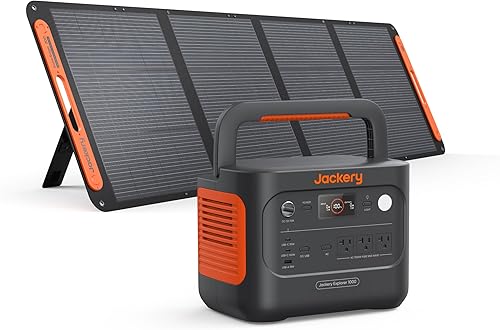
- Explorer 1000 v2 power station
- 200W solar panel included
- 1,070Wh capacity
- Solar charging to 80% in 6 hours
A bundled power station and 200W panel for shoppers who need a complete Jackery setup with more solar panel capacity than a single 110W panel.
Pros
- Includes a 200W panel and power station
- 1,070Wh station capacity
- Solar charging to 80% in 6 hours
Cons
- A complete station bundle is a larger purchase than a panel alone
- The station and panel ship separately
A bundle can simplify buying the main pieces together, but check the model details and connection requirements for your intended use. Jackery notes that the station and panel ship separately.
Is the EcoFlow 110W Portable Solar Panel worth choosing?
The EcoFlow 110W panel is a strong fit when portability, an adjustable case and compatibility with your EcoFlow station matter most. Its 110W maximum power makes it a focused option for a smaller setup.
Choose the EcoFlow if your station supports its connector and input range. Pick the MHPOWOS if its cable types better match your power station, or the Jackery bundle if you need a station and 200W panel together.
Frequently asked questions
Can the EcoFlow 110W panel charge any power station?
The EcoFlow 110W panel uses an MC4 connector and is described as plugging into most power stations with solar connectors. Check your station's connector needs and maximum solar input first, since compatibility and input limits vary by model.
Is the EcoFlow 110W panel waterproof?
EcoFlow gives this panel an IP68 water and dust resistance rating for outdoor use. Keep the power station and connection points protected, and follow the panel manual for care and exposure limits.
How do you position the EcoFlow 110W panel?
Its carry case doubles as an adjustable kickstand, so you can set the panel's angle toward the sun. Reposition it as the sun moves, and keep the panel stable on a flat surface.
Should I choose a 110W or 400W EcoFlow panel?
Choose the 110W panel for a smaller charging setup where portability and a lower panel capacity fit your needs. A larger setup may benefit from more panel capacity, but check the station's solar input limits and compare the EcoFlow 400W portable solar panel review before deciding.


