EcoFlow RIVER 2 Max Review: Worth It? (November 2026)
The EcoFlow RIVER 2 Max is a strong midsize power station for camping, electronics backup and light home use. Its 499Wh battery, 1000W output and 13.3 lb weight make it easier to carry than larger EcoFlow models.
On this page (9 sections)
- Is the EcoFlow RIVER 2 Max a good fit?
- EcoFlow RIVER 2 Max review at a glance
- How fast does the EcoFlow RIVER 2 Max recharge?
- Can it protect electronics during an outage?
- Battery design and everyday care
- RIVER 2 Max versus larger EcoFlow alternatives
- How should you size a portable power station?
- What are the main trade-offs?
- Verdict: should you buy the EcoFlow RIVER 2 Max?
The EcoFlow RIVER 2 Max is a capable midsize power station for camping, electronics backup and selected home essentials. Its 499Wh LiFePO4 battery, 1000W output and 13.3 lb weight give it a useful balance between runtime and portability.
It suits people who carry power between a campsite, an RV and a storage shelf rather than leaving a large unit in one place. The 10.6 x 10.2 x 7.7 in size makes storage and transport easier to plan, while the battery and output remain well above what a small power bank can handle.
In daily use, the 499Wh capacity is best treated as a reserve for smaller loads over a limited period. EcoFlow gives a rough runtime formula of 499Wh multiplied by 0.85, divided by the operating wattage, which helps you compare a phone and laptop with a much heavier appliance before you set off.
The 1000W output also needs a sensible approach to load planning. X-Boost can support devices up to 1000W, but you should still check each appliance and keep the combined demand in mind.
The main limitation is capacity. It cannot replace a 2048Wh DELTA model for long outages, large appliances or repeated high-wattage use, but it is easier to move and simpler to size for smaller loads.
That trade off defines the whole ownership experience. It is strongest when the job is portable and moderate, and weaker when the job demands long runtime or sustained heavy loads.
For charging, the 1 hour AC recharge is handy before a trip, while solar charging up to 220W gives an off grid option when a suitable panel and sunlight are available. The panel itself is optional, so off grid readiness needs to be planned in advance.
Is the EcoFlow RIVER 2 Max a good fit?
The RIVER 2 Max is a good fit when you need portable battery power without carrying a large home-backup unit. It suits camping, RV trips, residential essentials and electronics that can run from its AC, USB-C and other ports.
Its 499Wh capacity gives you a practical midsize reserve. For a rough estimate, EcoFlow gives this formula: runtime is about 499Wh multiplied by 0.85, divided by the operating wattage of your appliances.
That formula is more useful than guessing from the battery number alone. A low-power electronics setup can last much longer than a device that draws several hundred watts.
The RIVER 2 Max also supports up to 1000W output through X-Boost. EcoFlow says X-Boost can run devices requiring up to 1000W, but high-demand appliances should be checked before use because their starting and running needs vary.
If you are comparing the wider category, our guide to the best portable power station explains how capacity, output and charging choices affect the buying decision.
EcoFlow RIVER 2 Max review at a glance
The RIVER 2 Max stands out for its combination of a 499Wh LiFePO4 battery, 1000W output and 13.3 lb weight. That combination makes it more portable than the larger DELTA options below.
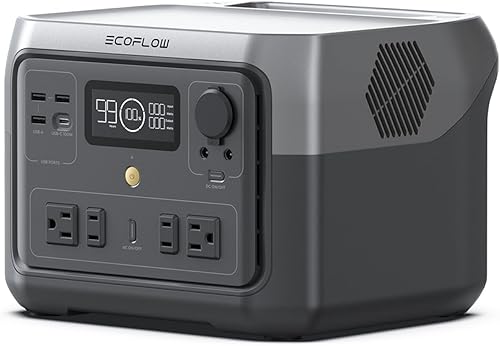
EF ECOFLOW Portable Power Station River: Best for portable camping power
- 499Wh LiFePO4 battery
- 1000W output
- 13.3 lb weight
- 1-hour AC recharge
- 220W solar input
A compact midsize station for camping, RV trips, electronics backup and residential essentials. Its 499Wh battery and 13.3 lb weight keep it easier to carry than the larger alternatives here.
Pros
- Lightweight 13.3 lb design
- 499Wh LiFePO4 battery
- 1-hour AC recharge
- 220W solar charging
- Automatic switch to battery supply within 30 milliseconds
Cons
- Smaller battery than the 2048Wh alternatives
- Solar panel is optional
- 1000W output needs careful appliance selection
The unit measures 10.6 x 10.2 x 7.7 in, so check your storage space before a trip. Its compact size helps with transport, while the 499Wh battery keeps the station aimed at moderate loads rather than whole-home backup.
What the RIVER 2 Max can power
The RIVER 2 Max can power devices up to 1000W with X-Boost, while its listed AC outlets provide up to 300W. This makes the operating mode and the appliance requirements important when you choose what to connect.
It can suit phones, laptops, small electronics and selected appliances. The right setup depends on each device's wattage, startup demand and the total load connected at the same time.
Avoid choosing by appliance name alone. Check the wattage label or manual, then leave room below the station's limits for devices that draw more power when they start.
How fast does the EcoFlow RIVER 2 Max recharge?
The RIVER 2 Max can recharge from a standard AC outlet in about 1 hour, according to EcoFlow's X-Stream charging claim. That short recharge time helps when you need to refill the station between trips or after a short outage.
Solar charging takes up to 220W of solar input and can recharge the unit in as fast as 2.3 hours under suitable conditions. The solar panel is optional, so include the panel, cable and placement needs in your planning if off-grid charging matters.
Solar times depend on available sunlight and the charging setup. Keep the panel positioned where it can receive steady light, and avoid treating the fastest stated time as a guarantee for every day.
Car charging is not included among the stated charging options for this model. If car-based charging is essential, confirm the exact setup before choosing the RIVER 2 Max.
Can it protect electronics during an outage?
The RIVER 2 Max automatically switches to battery supply within 30 milliseconds when grid power stops while the unit is plugged into a wall outlet. That makes it useful for some electronics backup situations.
It is not a reason to connect every sensitive device without checking its requirements. Computers, networking equipment and medical devices can have specific power needs, so confirm compatibility and backup expectations before relying on any portable station.
Connect only the equipment you need to keep running. A smaller load gives you more usable runtime and makes it easier to monitor whether the station is operating within its limits.
For a broader comparison of EcoFlow's product families, see EcoFlow DELTA vs RIVER before choosing between portability and longer backup time.
Battery design and everyday care
The RIVER 2 Max uses a 499Wh LiFePO4 battery with battery management system protection. The system monitors voltage, current and temperature while the station operates.
EcoFlow describes the LiFePO4 cells as suitable for more than 10 years of use. That is a brand claim, not a promise that every battery will have the same service life, because storage, temperature and charging habits affect battery condition.
Keep the unit dry and use it in the conditions allowed by the instructions. Avoid blocking ventilation areas, placing heavy items on top or storing it where heat or moisture can build up.
Recharge it before a planned trip, then check the connected load before switching on appliances. Store cables with the station so the setup is ready when you need it.
The included items are the RIVER 2 Max power station, an AC charging cable and a quick start guide. The product data also identifies 5-year service, so review the current service terms for your location.
RIVER 2 Max versus larger EcoFlow alternatives
The RIVER 2 Max is the portable choice here, while both DELTA products have 2048Wh batteries and 2400W output. That difference matters more than small changes in dimensions when you plan for outages or high-demand appliances.
EF ECOFLOW DELTA 3 Max Portable Power: Best for high-demand backup

- 2048Wh LFP battery
- 2400W output
- 3400W X-Boost
- 0–80% charging in 1.13 hours
- 10ms transfer time
A larger choice for home backup, RV camping and appliances that need more sustained power. Its 2048Wh battery and 2400W output offer much more capacity than the RIVER 2 Max.
Pros
- 2048Wh LFP battery
- 2400W output
- 3400W X-Boost mode
- 0–80% charging in 1.13 hours
- 10ms transfer time
Cons
- Larger than the RIVER 2 Max
- Less suited to carrying when a 2048Wh station is enough
- Solar panel is optional
The EF ECOFLOW DELTA 3 Max Portable Power has a 2048Wh LFP battery and 2400W output. It also lists 3400W X-Boost, 0–80% charging in 1.13 hours, a 10ms transfer time and a 10-hour runtime.
Its dimensions are 9.4 x 12 x 19.44 in. That taller form and larger battery suit home backup, RV camping and appliances that need more energy, but it is a different carry choice from the 13.3 lb RIVER 2 Max.
Choose the DELTA 3 Max when you need more reserve and higher output. Choose the RIVER 2 Max when moving the station easily matters more than running large loads for longer.
EF ECOFLOW Portable Power Station DELTA: Best for expandable home backup

- 2048Wh LiFePO4 battery
- 2400W output
- 3400W X-Boost
- Expandable capacity up to 6kWh
- 30 dB charging
Choose this larger DELTA model when expandable capacity, quiet charging and multiple charging options matter more than low carry weight. It supports AC, solar and car charging.
Pros
- 2048Wh LiFePO4 battery
- Expandable up to 6kWh
- 2400W output
- 3400W X-Boost
- AC, solar and car charging
Cons
- 23 kg weight
- Much larger than the RIVER 2 Max
- Extra batteries are needed for the expanded capacity
The EF ECOFLOW Portable Power Station DELTA has a 2048Wh LiFePO4 battery and 2400W output. It supports X-Boost up to 3400W and offers expandable capacity up to 6kWh with up to 2 extra batteries.
This model measures 12.2 x 9.7 x 20 in and weighs 23 kg. It also supports AC, solar and car charging, with charging volume levels starting at 30 dB under the stated conditions.
Choose it when expandable backup is the priority. Its larger battery and 23 kg weight make it less convenient for short camping trips where the RIVER 2 Max already covers your devices.
For another midsize comparison, read our EcoFlow RIVER 2 Pro review. If you want a newer RIVER option, the EcoFlow RIVER 3 Plus review may help with your shortlist.
How should you size a portable power station?
Choose capacity by listing the devices you need, their wattage and the number of hours you want them to run. Then leave room for conversion losses and for devices whose demand changes during use.
For the RIVER 2 Max, start with 499Wh and use the 0.85 estimate for a rough planning figure. Add the watt-hours for your devices instead of assuming that a 1000W output rating means the battery can run a 1000W load for a full hour.
Output and capacity solve different problems. Output determines what the station can run at one time, while capacity affects how long the connected devices can keep running.
Charging speed also matters. The RIVER 2 Max's 1-hour AC recharge is useful when you have access to a wall outlet, while its optional solar setup is more useful when you need charging away from the grid.
What are the main trade-offs?
The RIVER 2 Max's biggest strength is balance. It offers more battery and output than a small power bank, but it remains far easier to carry than a 2048Wh DELTA station.
Its main trade-off is runtime. A 499Wh battery cannot match the reserve of the DELTA 3 Max or the expandable DELTA model, especially when you run heaters, cooking appliances, power tools or other high-demand equipment.
The 1000W X-Boost claim also needs careful use. Check appliance requirements before connecting a load, and remember that the total connected demand still affects runtime.
The optional solar panel is another planning point. The station supports up to 220W solar input, but off-grid use requires the appropriate panel and a location with useful sunlight.
Verdict: should you buy the EcoFlow RIVER 2 Max?
The EcoFlow RIVER 2 Max is the better choice for portable camping power, electronics backup and moderate residential essentials. Its 499Wh LiFePO4 battery, 1000W output, 1-hour AC recharge and 13.3 lb weight create a practical middle ground.
Pick the RIVER 2 Max when portability and quick AC charging matter most. It is the easier unit to move between a vehicle, a tent, and a cupboard, and its compact dimensions suit trips where space is shared with food, bedding and other gear.
It also works well when your main job is keeping phones, laptops and other electronics running for a defined period. The 499Wh battery makes planning essential, so start with the wattage of each device and use the 0.85 estimate to get a realistic sense of runtime.
For home use, it is better suited to selected essentials than to covering a whole house during a long outage. The automatic switch to battery supply within 30 milliseconds can help connected electronics when grid power stops, provided the equipment is compatible with that setup.
Pick the DELTA 3 Max for a 2048Wh battery and 2400W output, or choose the expandable DELTA model when you need up to 6kWh and multiple charging options. Those larger stations make more sense when high demand appliances, longer outages or extra battery capacity are the priority, even though they are heavier and take up more space.
Think about care as well as specs before you decide. Keep the RIVER 2 Max dry, avoid blocking its ventilation, and store it with its AC charging cable so it is ready for a quick top up before a trip.
If solar charging matters to you, plan for the optional panel, its placement and the weather at your destination. A fast claim on paper is only useful when the sunlight, setup and time available on the day support it.
If your decision is between EcoFlow families rather than individual models, start with the EcoFlow DELTA 3 Max Plus review and compare the battery size, output and carry needs against your actual devices.
List the devices you need first, then work out their wattage and how long you need them to run. That simple exercise will show whether the RIVER 2 Max already covers the job, or whether the extra capacity of a DELTA model is the safer long term choice.
Frequently asked questions
Is the EcoFlow RIVER 2 Max worth it?
The EcoFlow RIVER 2 Max is worth considering when you need a portable 499Wh battery with 1000W output for camping, electronics backup or selected home essentials. Its 13.3 lb weight and 1-hour AC recharge are useful, but a 2048Wh DELTA model makes more sense for long outages or high-demand appliances.
How long can the EcoFlow RIVER 2 Max run appliances?
The RIVER 2 Max runtime is about 499Wh multiplied by 0.85, divided by the appliance wattage. A 100W device would use less energy than a 500W device, but actual runtime depends on conversion losses, device cycling and the number of connected devices.
Can the EcoFlow RIVER 2 Max work as a UPS?
The RIVER 2 Max automatically switches to battery supply within 30 milliseconds when grid power stops while it is plugged into a wall outlet. That can help keep connected electronics powered, but check the requirements of sensitive equipment before relying on it for critical use.
What is the difference between the RIVER 2 Max and DELTA models?
The RIVER 2 Max has a 499Wh battery, 1000W output and 13.3 lb weight, so it favors portability. The DELTA models here have 2048Wh batteries and 2400W output, with the DELTA 2 Max also offering expansion up to 6kWh.