Should You Use a Portable Solar Panel Tracker?
Most portable users should skip a full auto tracker and reposition the panel by hand. A tracker helps only when shade moves fast, you can mount it without blocking folding, and the added weight will not stop you from carrying the panel.
On this page (10 sections)
- What a portable solar panel tracker actually does for you
- When automatic sun tracking beats walking over to aim
- How much extra energy a tracker can realistically add
- What a tracker costs you in weight, space and setup
- Which portable panels suit a tracker mount and which do not
- How to place a tracker so shade does not cancel the gain
- Cables, controllers and power limits when the panel moves
- Security, wind and daily care for a moving panel
- What to check before you order a tracker for your panel
- Should you use a portable solar panel tracker for your setup
Most portable users should skip a full auto tracker and reposition the panel by hand. A portable solar panel tracker earns its keep only when shade moves fast, you set up once and stay put, and the mount does not ruin folding or carrying.
What a portable solar panel tracker actually does for you
A tracker keeps the panel face pointed at the sun as the sun moves. The job is angle control, not power creation.
Your panel converts light that hits its surface, so a better angle means more light hits at a useful angle.
Manual aiming means you walk over and turn the panel every hour or two. Single-axis tracking moves on one plane.
Dual-axis tracking adjusts two planes and follows the sun more closely through the day.
Portable use adds a catch. A tracker mount needs a stable base, room to swing, and power for its motor or electronics.
That gear can weigh more than the extra energy you collect on a short trip.
If your panel folds, the mount must hold it open and rigid. A loose panel will flap, waste light and put strain on hinges.
Check how our foldable panel guide describes setup before you add any mount.
Rule: buy tracking only when you will leave the panel in one spot long enough for the mount to pay back its weight and setup time.
When automatic sun tracking beats walking over to aim
Automatic tracking beats manual aiming when you cannot or will not reposition often. Long stays, fixed camps and poor access to the panel favor automation.
A weekend picnic where you sit beside the panel does not.
Think about your day. If you hike, fish, cook or work away from the panel for three hours, the sun angle will drift.
A tracker can keep the face aligned during that gap.
Think about shade too. Trees and buildings cast shade that moves across a site.
A tracker that follows the sun cannot beat shade. It can only keep the panel aimed at shaded sky, which still cuts output hard.
A tracker also helps at low sun angles near sunrise and sunset. The light is weaker then, but the angle changes fast.
You may gain a useful boost for morning charging without getting up to aim.
Rule: choose automatic tracking when your panel will sit unattended for hours, not when you already walk past it every hour.
How much extra energy a tracker can realistically add
A tracker adds energy by keeping the angle closer to ideal for more hours. The gain is biggest when you would otherwise leave the panel badly angled for a long stretch.
If you aim often, the added gain shrinks.
Season matters. In winter, the sun stays low and moves through a shorter arc.
A low panel tilt and frequent manual checks can work well. In summer, the arc is longer and the sun climbs higher, so tracking can help more at a fixed site.
Panel size matters too. Tracking a 100W panel and tracking a 200W panel both keep the face aligned, but the larger panel has more watts at stake.
The same percentage gain means more watt-hours on the bigger panel.
Clouds matter as well. Under a bright overcast sky, light comes from many directions.
Angle control matters less, and a tracker motor may spend power chasing a sun it cannot see well.
Rule: estimate your gain from hours of bad angle, not from a promise of perfect tracking all day.
Single-axis versus dual-axis tracking for portable use
Single-axis tracking moves the panel in one direction. It is simpler, lighter and easier to power.
For many portable sites, that simplicity is the point.
Dual-axis tracking adjusts tilt and rotation. It follows the sun more closely, especially in winter when the sun stays low.
It also needs a stronger mount, more power and more room to move.
For a foldable panel you carry by hand, dual-axis gear is often too much. The mount can block the back, fight the kickstands and make the whole set harder to pack.
Rule: pick single-axis first for portable use, and only step up to dual-axis when you have a fixed base and a clear need.
What a tracker costs you in weight, space and setup
A tracker costs you more than money. It adds a base, arms, brackets and a power source to a system you chose for portability.
Each added part makes setup slower and packing harder.
Weight is the first cost. A foldable 100W panel may weigh 6 lb, and a 200W panel may weigh 9.7 lb.
Add a tracker mount and you carry that gear on every trip, even on cloudy days when tracking helps least.
Space is the second cost. A swinging panel needs clear room around it.
The mount and arms can block the back of the panel, shade part of its face or stop it from folding flat.
Setup time is the third cost. You must level or anchor the base, attach the panel, clear the swing path and check that cables do not twist as the panel moves.
That work eats into the gain on short stays.
Rule: if the tracker makes the panel hard to carry, fold or set up in five minutes, it is too much gear for portable use.
Which portable panels suit a tracker mount and which do not
Panels that suit a tracker have a rigid frame, clear mounting points and a back that can take brackets. Rigid frames and flat backs make tracker mounting far easier than thin foldable designs.
A panel that flexes will not stay aligned.
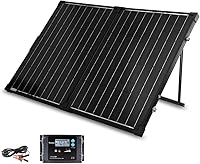
The DOKIO 100W Portable Foldable Solar Panel Kit folds to 19 by 26 by 0.5 in and weighs 6 lb. That light fold is great for carrying, but a tracker mount must hold it open without blocking folds or the back surface.
The DOKIO 200W Portable Foldable Solar Panel Kit weighs 9.7 lb and folds to 20 by 27 by 1.1 in. Its larger face gives tracking more watts to protect, but the mount must be stronger and the swing path must be wider.
Cables matter too. A moving panel can pull on its cable or twist a connector.
A longer, flexible run helps, but it cannot fix a mount that swings into its own wiring.
Rule: only mount a tracker to a panel whose frame stays rigid and whose back, folds and cables stay clear during the full swing.
How to place a tracker so shade does not cancel the gain
Placement matters more than tracking. A perfectly tracked panel in moving shade still loses most of its value.
Find a spot with the longest clear sun window first, then add tracking if it helps.
Walk the site before setup. Note where trees, walls, vehicle roofs and tent flys cast shade at morning, noon and late afternoon.
Choose the spot with shade for the fewest hours.
Face the panel toward the equator for the main daily arc. In the northern hemisphere that means south.
In the southern hemisphere that means north. Tilt it for your season and latitude range.
If you also use a portable solar panel stand with wheels, compare the two setups. Wheels move the whole panel to a new sun patch in seconds.
A tracker only rotates the panel in place.
Rule: pick the clearest spot first, and let a tracker refine the angle inside that spot instead of trying to fix a shady one.
Manual repositioning as the baseline tracker
Manual repositioning is the baseline every tracker must beat. Walking over and turning the panel every hour or two costs no extra gear.
For many campers, that baseline is already good enough.
You can make manual aiming smarter. Set the panel at a strong morning tilt, then move it once at midday and once in late afternoon.
That pattern avoids constant fussing.
A wheeled stand makes manual moves easier. You roll the panel a few feet to escape shade or to catch a better angle.
No motor, no extra power draw and no swing clearance to plan.
Our guide on which way to face solar panels covers the manual rules in more detail. Use those rules first, then decide if a tracker adds enough to justify its gear.
Rule: beat manual aiming on paper before you buy, by counting the hours you would truly miss without a tracker.
Cables, controllers and power limits when the panel moves
A moving panel changes your cable plan. Longer cables give the panel room to swing without pulling on connectors.
Short cables can fight the tracker and strain the panel exit point.
The BougeRV 20 Feet 10AWG Solar Extension Cable gives you a 20 ft run with male and female solar connectors. That extra length helps when the panel sits in sun and the controller or power station stays in shade.
Controllers and input limits still rule the system. The DOKIO kits include a standalone PWM controller for 12V battery charging.
That controller protects against reverse polarity, overcharge, overload and short circuit.
Check your power station input cap before you chase more watts. The 100W kit notes that some stations cap input at 60W.
The 200W kit notes caps at 100 to 150W. A tracker cannot push more power through a cap than the station accepts.
Why cable gauge and connector sealing matter on a tracker
The BougeRV cable uses 10AWG tin-coated pure copper, rated up to 30A and 1000 volts DC. That heavier gauge is meant to minimize power loss compared with 14AWG and 12AWG runs on longer setups.
The tin coating is described as improving corrosion and oxidation resistance and extending service life compared with bare copper.
The connector side matters for outdoor tracking sites. The male connector has an IP67 waterproof ring and a built-in lock that you press on both sides to connect or disconnect without tools.
The cable is certified by TÜV and UL, with XLPE insulation rated from -40°F to 194°F and UV resistance for outdoor arrays.
That rating gap matters when a panel sits in full sun. The listing notes PVC wire can only handle 158°F at maximum, while this dual sheath XLPE design is rated to 194°F.
For a tracker left out all day, the cable also needs to tolerate heat, dust and swing movement at the connector.
The DOKIO kits add their own connection details to check. Both list 9.84 ft cables, monocrystalline silicon cells, 18 volts maximum voltage and 6.1A amperage capacity, with SAE, XT60, DC and alligator clip options depending on the kit.
The 100W kit is listed at 110 watts maximum power and the 200W kit at 220 watts maximum power, so match the extension cable range to the actual panel output before you extend the run.
Rule: plan cable length and controller limits first, because tracking cannot fix a short cable or a low input cap.
Security, wind and daily care for a moving panel
A tracker keeps the panel moving, and moving panels catch more wind. Anchor the base and check the mount every time the wind picks up.
A panel that tips or flaps can break folds, brackets and connectors.
Our guide on how to keep portable solar panels secure covers stakes, weights, tethers and quick checks. Read it before you add a tall tracker mount to a light foldable panel.
Keep the swing path clear. Tent fabric, guy lines, chairs and cable loops can snag an arm or block the panel face.
Walk the full swing path once after setup and again after any wind shift.
Wipe the panel face gently when dust builds. Dust cuts light before the panel even converts it.
Check connectors for dust and moisture after rain, and let a damp connector dry before you trust a shaky connection.
Daily checks that protect a tracked foldable panel
Foldable panels need hinge and kickstand checks after each move. The DOKIO 100W folds to 18.9 by 26 by 0.47 in and the 200W folds to 19.3 by 26.4 by 1.1 in, so brackets that sit near a fold line can become a stress point.
Test the tracker through a full swing with the panel open before you leave it unattended.
USB and controller access also needs a daily check. Both kits include dual USB ports for phones, lamps and small gadgets when connected to a 12V battery, and a separate PWM controller you can replace or upgrade later.
If a bracket covers the controller or USB exit, you lose the convenient charging points the kit was meant to give you.
Rule: secure the base, clear the swing path and inspect mounts after wind, because a moving panel is a wind-catching panel.
What to check before you order a tracker for your panel
Check fit before you buy. Measure the panel, mark its mounting points and test the swing path on paper first.
A tracker that fits on paper can still block folds or cables in real setup.
Measure the panel open and folded. Note the hinge lines, kickstands, cable exit points and any back surface you must keep clear.
Confirm that brackets will not shade the face or stress a fold.
Check power and limits. Find the tracker's power draw, the controller type and the input cap of your battery or power station.
A tracker that draws power all day must earn back more than it uses.
Check the mount against a best 100 watt solar panel mount style option. A simple fixed mount may give you a better tilt and a faster setup than a motorized tracker on the same panel.
If you plan to feed a portable UPS or a power station, check its input limits in the same step. More tracked watts do not help if the station caps input below your panel size.
Rule: order only after panel size, swing path, cable reach, power draw and input caps all fit on one page.
Should you use a portable solar panel tracker for your setup
You should use a portable solar panel tracker only when your setup fits a narrow set of facts. Pick a tracker for fixed, long stays with moving shade or long unattended hours, and pick manual aiming for short trips and foldable panels.
That split covers most buyers.
Pick a tracker if you camp or work in one spot for days, you cannot reposition often, and your panel has a rigid frame with a clear back. Single-axis models suit most portable cases because they stay lighter and simpler.
Pick manual aiming if you carry a foldable panel, move camp often, or sit near the panel through the day. A wheeled stand or a quick hand turn will beat a tracker on weight, cost and setup time.
Pick a bigger panel instead if space allows and input caps accept it. The DOKIO 200W kit gives you more watts to collect without a motor, while the 100W kit stays lighter for short carries.
Final rule: buy the tracker only when unattended hours, a fixed site and a rigid mount all line up, and otherwise aim the panel by hand.
Frequently asked questions
Is a portable solar panel tracker worth it?
It is worth it only when your site gets moving shade and you reposition rarely without it. For a foldable panel you move every hour or two, manual aiming is lighter, cheaper and often gives the same usable energy.
Can a tracker work with a foldable panel?
It can, if the mount holds the folded panel rigid and the tracker does not block the back. Check the folds, kickstands and cable exit points first, because extra brackets can stress a portable frame.
How much gain does tracking give?
Gain depends on sun angle, season and how often you aim by hand. Tracking helps most at low sun angles and in spots where shade from trees or buildings moves during the day.
Should I buy a tracker or a bigger panel?
Compare the gain in watts against the cost, weight and power draw of the tracker. A larger panel can be the simpler fix when space allows, while a tracker suits fixed camps where a bigger panel will not fit.