Which Solar Generators Are Made in the USA?
No product in this guide can be confirmed as made in the USA from the available evidence. Check whether a brand clearly identifies final assembly, parts origin, and the exact model before treating an American-made claim as proven.
On this page (8 sections)
- Are any solar generators in this guide made in the USA?
- Which product suits buyers who need large home backup power?
- Which portable power station suits small devices and travel?
- Which gasoline generator suits lighter backup loads?
- How can you verify a solar generator’s country of origin?
- Does a solar generator need an inverter?
- Is a fuel generator better than a solar generator?
- Which solar generators are made in the USA?
No product in this guide can be confirmed as made in the USA from the available evidence. The safest way to check an American-made solar generator is to verify the exact model's origin statement, final assembly location, and whether the claim covers the complete unit.
"Solar generator" usually means a battery-based portable power station that can be recharged from solar panels. The battery stores energy, and the inverter changes it into usable AC power for compatible devices.
The phrase "made in the USA" can describe different things. It may refer to final assembly, substantial transformation, design, or a particular part.
Those meanings are not interchangeable, so read the wording carefully before you treat a product as American made.
Are any solar generators in this guide made in the USA?
None of the 3 products here has enough origin information to confirm a made-in-USA claim. Their listed specifications explain power, fuel, battery capacity, ports, and included items, but those facts do not guarantee where manufacturing or final assembly happens.
This matters because an American brand name is not the same as American manufacturing. A product may have US support or a US-based brand while using parts or assembly from other countries.
For a broader look at battery capacity, output, ports, and charging methods, use our solar generator guide. If you are comparing battery power with fuel-powered equipment, our inverter generator vs solar generator guide explains the main differences.
What does “made in the USA” actually prove?
A made-in-USA statement should identify what part of the product the claim covers. A complete-unit claim is different from a statement about US assembly, US design, or one component.
Look for:
- The exact model number covered by the claim
- A clear country-of-origin statement
- Whether the wording says made, assembled, designed, or supported in the USA
- Any qualification about imported parts
- A brand or manufacturer contact that can answer model-specific questions
Do not assume that a product is made in the USA because its name includes an American place, an American flag, or a US company name. Those signals may describe branding rather than manufacturing.
Which product suits buyers who need large home backup power?
The Westinghouse 12500 Watt Dual Fuel Home Backup suits residential backup needs when fuel-powered output is more important than solar charging. It is a portable generator, not a battery-based solar generator.
It produces 9,500 running watts and 12,500 peak watts on gasoline, or 8,500 running watts and 11,200 peak watts on propane. The 457cc 4-stroke OHV engine uses gasoline or propane, and the gasoline tank holds 6.6 gallons with a fuel gauge.
The unit has remote, electric, and recoil start. Its outlets include 2 GFCI 120V 5–20R receptacles, a transfer-switch-ready 120V L14-30R receptacle, and an RV-ready 120/240V 14–50R receptacle.
The VFT display shows voltage output, frequency, and lifetime hours. Automatic low-oil shutdown, rubber outlet covers, and a 12V battery charger are useful details for planned backup use.
It measures 27.2 x 26.1 x 26.5 in. The package includes a remote-start key fob, 12V battery charger, oil, oil funnel, tool kit, propane hose, quick-start guide, owner's manual, and warranty.
Choose this type of generator if you need to run larger loads and have a safe outdoor location for fuel-powered equipment. It is not the right match if your priority is silent battery storage, indoor use, or direct solar charging.
For larger backup questions, see Can a UPS Battery Backup Power a Whole House? Made Simple.
A fuel generator and a UPS solve different power problems.
Which portable power station suits small devices and travel?
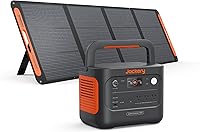
The Jackery Explorer 300 Portable Power Station suits buyers who need compact battery power for smaller electronics, camping, travel, or short outages. Its 292Wh capacity and 300W rated output make it a small portable power station rather than a whole-home backup unit.
It weighs 7.5 lb and has an integrated handle. The unit includes 2 AC outlets, a 100W USB-C PD port, 2 USB-A ports, and a 120W car port.
The Explorer 300 has a 300W rated output and 600W peak surge. Its battery can power devices under 300W total, and it shuts off automatically if overloaded.
Solar charging requires compatible panels, and the solar panel is not included. A 100W solar panel can reach 80% capacity in about 2.8 hours, while a 40W panel can reach 80% in about 7.5 hours under the stated conditions.
The package includes the Jackery Explorer 300, an AC adapter, a car charger cable, and a user guide. It measures 9.1 x 13.4 x 0.8 in when folded for the panel dimensions described in the product data, and the power station's listed dimensions are 15.43 x 9.92 x 11.89 in.
This is the closest match to the everyday meaning of a solar generator in this guide. Still, its specifications do not prove US manufacturing, so verify origin separately if that is your deciding factor.
Read Is a Solar Generator a Battery? for a simple explanation of how battery storage and inverter output work. You can also compare more models in our guide to the best portable power station.
Which gasoline generator suits lighter backup loads?
The WEN Super Quiet 2350-Watt Portable Inverter Generator suits buyers who want a lighter gasoline generator for electronics, camping, hunting, tailgating, or limited backup power. It is not a solar generator because it uses gasoline rather than a rechargeable battery and solar panels.
The 4-stroke 79cc engine produces 1,900 rated watts and 2,350 surge watts. Its inverter output is designed for sensitive electronics such as phones, tablets, televisions, computers, and monitors.
The unit weighs 39 lb and measures 17.3 x 11.5 x 17.5 in. It has 2 three-prong 120V receptacles, 1 12V DC receptacle, and 2 5V USB ports.
A fuel-shutoff feature uses remaining fuel in the carburetor before the generator stops. The product data also describes an eco-mode switch and more than 5.7 hours of half-load runtime with its 1-gallon tank.
Pick this type when quiet gasoline power and portability matter more than solar charging. Pick the Jackery instead when you want battery storage, USB charging, and the option to add a solar panel.
How can you verify a solar generator’s country of origin?
Ask for model-specific proof before relying on an American-made claim. The model number should match the unit you plan to buy, and the answer should distinguish the complete product from individual parts.
A useful verification checklist includes:
- Find the exact model number and brand.
- Look for a country-of-origin statement from the manufacturer.
- Check whether the wording says made, assembled, or designed in the USA.
- Ask whether imported components are used.
- Save the answer and compare it with the product label and manual.
- Do not generalize the answer to other models from the same brand.
If a company only says "American company" or "US-based support," that does not answer the manufacturing question. If the wording says "assembled in the USA with imported parts," record it accurately rather than shortening it to "made in the USA."
Manufacturing origin also does not tell you whether the generator is safe to use indoors, powerful enough for your devices, or easy to maintain. Those questions require a separate check of output, fuel or battery type, ventilation needs, ports, and operating instructions.
Does a solar generator need an inverter?
Yes, a solar generator normally uses an inverter to turn stored battery power into AC power for compatible devices. The battery stores energy as DC power, while the inverter supplies AC output through the unit's AC outlets.
A battery station may also include USB ports and a car port that use different output paths. Check the total watt limit and the needs of each device before connecting several items at once.
The Jackery Explorer 300 has a 300W rated output and 600W peak surge. That makes it useful for smaller electronics, but not for high-draw appliances that exceed its output limit.
Is a fuel generator better than a solar generator?
A fuel generator is usually better for higher sustained output, while a solar generator is better for quiet battery power and simple small-device charging. The right choice depends on your loads, location, runtime needs, and charging access.
The Westinghouse produces far more output than the Jackery or WEN, but it requires gasoline or propane and outdoor operation. The WEN is lighter than the Westinghouse and produces inverter power, but it still needs gasoline.
The Jackery stores 292Wh and can recharge from a compatible solar panel, but its 300W rated output limits the devices it can run. It also does not include a solar panel.
Use a fuel generator for larger residential loads when you can operate it safely outdoors. Use a solar generator for smaller electronics, camping, travel, or quiet backup where battery capacity and recharge time fit your needs.
Which solar generators are made in the USA?
Choose only a model with clear, model-specific origin proof if made-in-USA manufacturing is essential. The 3 products discussed here cannot be confirmed as made in the USA from the available evidence.
For a small battery-based setup, the Jackery Explorer 300 is the relevant product here because it offers 292Wh, 300W rated output, AC outlets, USB ports, a car port, and optional solar charging. For higher output, the Westinghouse and WEN are fuel-powered generators, not solar generators.
Check the exact origin wording before you buy, then compare the power system with your actual loads. If you need to understand whether the battery itself qualifies as a solar generator, start with Is a Solar Generator a Battery?.
Frequently asked questions
Which solar generators are made in the USA?
The products in this guide cannot be confirmed as made in the USA from the available product information. A trustworthy origin check should identify the exact model, final assembly location, and whether the claim applies to the complete unit or only certain parts.
Does an American brand mean a solar generator is made in the USA?
No. An American brand may design, sell, or support a product while manufacturing happens elsewhere.
Check the origin statement for the specific model, because brand location alone does not prove that the generator was made or assembled in the United States.
Are portable power stations and solar generators the same thing?
They can describe the same type of battery-based power station when solar charging is supported. The term solar generator usually refers to a portable power station used with solar panels, while the battery stores energy and the inverter supplies usable AC power.
What should I check before buying an American-made solar generator?
Check the exact model's country-of-origin statement, final assembly location, parts wording, and manufacturer contact information. Also compare capacity, output, charging options, and intended use, because an origin claim does not tell you whether the unit fits your backup-power needs.