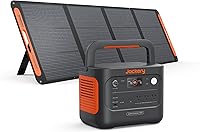
How to Choose a Solar Generator
Choose a solar generator by matching battery capacity and output to the devices you need to run. Then check solar input, charging options, battery type, ports and the difference between portable power stations and fuel generators.
On this page (9 sections)
- What should you check first in a solar generator guide?
- How much battery capacity do you need?
- What output rating should a solar generator have?
- Which charging options matter?
- Which battery type should you choose?
- Which solar generator suits each use?
- Do you need a solar panel with the generator?
- Is a solar generator safe for home backup?
- What is the best way to choose?
A solar generator guide should start with one rule: match battery capacity and output to the devices you need to run. Capacity tells you how long stored energy can last, while output tells you how much power the unit can supply at one time.
If those two points do not fit your devices, the rest of the comparison will not fix the problem. A high wattage label cannot make a small battery run a large appliance for hours, and a large battery cannot help if the output is too low for a motor at startup.
If you are also checking product origin, see solar generators made in the USA. That check comes after the power calculation, because origin does not change how much energy your phone, laptop, refrigerator or other device needs during a trip or outage.
Start by listing the devices you actually plan to use, their running wattage and the hours you need them for. Separated loads are easier to judge than a single headline figure on a box, especially when more than one device will run together.
A small device used for a short session and a motor driven appliance used for hours ask for very different setups. Write each load down, add the running watts, and work out the total watt-hours for the use period before you look at any model.
After that, compare solar input, charging methods, battery chemistry, ports, size and whether you need quiet battery power or a fuel generator. Solar input affects how quickly a battery can recover in daylight, and charging methods matter when weather, travel or home outlet access changes the plan.
Ports determine whether a device can connect at all, and size decides whether you will carry the unit or leave it in one place. Battery chemistry also matters for long term use, because cycle life and weight influence how often a unit can be recharged and how easy it is to move.
The phrase solar generator usually describes a battery power station that can recharge from solar panels. It does not always mean a panel is included, so check the full setup before you choose.
Cables, adapters, panel wattage and the station input limit all need to work together, and a missing item can be bought later only if the connections match. Quiet battery power suits indoor use, camping areas and places where noise matters, provided the unit is used according to its instructions.
A fuel generator suits higher continuous loads and longer runs, but it must stay outdoors and needs fuel storage, oil care and safe exhaust placement. Choosing between those directions early prevents a costly mismatch later.
Size and weight also change who a unit suits in practice. A light station fits a car boot, tent or cupboard, while a heavy home backup unit needs space, a clear outdoor area and help with moving.
Use the guide as a sequence rather than a quick scan of names. Work out the load first, then the runtime, then the charging plan, and only then narrow the field by ports, weight, chemistry and operating location.
A clear checklist at the end helps you test any shortlist against the same questions. Confirm capacity in watt-hours, continuous output in watts, solar input, wall and vehicle charging, included cables, battery type, dimensions and safe placement.
What should you check first in a solar generator guide?
Start with your devices and the time you need to run them. A phone charger, laptop and camera need far less power than a refrigerator, sump pump or large home appliance.
Write down each device, its running wattage and the number of hours you expect to use it. Add the watt-hours together:
watt-hours = watts × hours
For example, a 60W device used for 4 hours needs about 240Wh before conversion losses. A power station with 292Wh of capacity may provide less usable energy than its stated battery size because power conversion uses some energy.
Also separate continuous power from startup power. Motors and compressors can draw more power when they start, so a refrigerator may need higher surge output than its normal running wattage suggests.
If you are comparing battery units for travel, our Portable Power Stations: The Complete Buying Guide covers capacity, ports and common use cases in more detail.
How much battery capacity do you need?
Choose battery capacity based on the largest planned energy load, not the product's headline wattage. Capacity is measured in watt-hours, or Wh, and it mainly affects how long a battery can run your devices.
Use these broad starting points:
| Capacity range | Best suited to |
|---|---|
| Under 300Wh | Phones, cameras, tablets, small lights and short laptop sessions |
| 300–700Wh | Longer camping trips, laptops, cameras, small appliances and basic backup |
| 700–1,500Wh | Larger electronics, longer outages and several charging sessions |
| Above 1,500Wh | Higher energy needs, longer backup periods and selected appliances |
These ranges are only starting points. A 300Wh unit may run a 60W device for several hours, while a much larger device can drain it quickly.
Look for the usable output as well as the headline battery capacity. If the product gives only battery capacity, estimate runtime conservatively and leave room for inverter losses.
How do you calculate solar generator runtime?
Estimate runtime by dividing battery capacity by device wattage, then reduce the result to allow for conversion losses. A simple estimate is:
runtime in hours = watt-hours × 0.85 ÷ device watts
A 292Wh battery running a 60W device would provide an estimated 4.1 hours using that calculation. Actual runtime changes with device behavior, charging losses and the power station's own operating needs.
Do not use a solar generator at its maximum output for every device without checking its limits. Running near the limit can leave less room for startup surges or another device.
What output rating should a solar generator have?
Choose continuous output above the combined running wattage of the devices you plan to use. Then check the peak or surge rating for appliances with motors, compressors or heating elements.
The output rating answers a different question from battery capacity:
- Watts describe how much power the unit can provide at one time.
- Watt-hours describe how much stored energy it has.
- Surge watts describe short startup power.
- Port ratings show what each connection can deliver.
A power station with enough Wh can still fail to run a device if its inverter cannot supply enough watts. Conversely, a high-wattage unit can run a demanding appliance briefly but may have limited runtime if its battery is small.
For a clearer comparison of battery inverters and power stations, see our portable power station vs inverter guide.
Which charging options matter?
Choose a solar generator with at least 2 charging methods if you want dependable use away from home. Solar charging supports off-grid use, while wall and vehicle charging can help when sunlight is limited.
Check these details:
- Solar input wattage and voltage range
- Whether the solar panel is included
- Wall charging time
- Vehicle charging time
- Whether the unit can power devices while charging
- The cables and adapters included
Solar input is not the same as battery capacity. A large battery may take a long time to refill from a small panel, especially in cloudy conditions or when the panel is poorly positioned.
Panel size also affects daily recovery. A 100W panel can recharge a small station more easily than a large home backup battery, but the actual result depends on sunlight, panel angle and the unit's charging limits.
Which battery type should you choose?
Battery chemistry affects cycle life, weight and long-term use. Cycle life describes how many full charge and discharge rounds a battery can handle before its usable capacity falls over time.
A chemistry built for many cycles can suit regular camping, work use or backup duty better than one that fades sooner under frequent charging. Weight matters too, because a battery you cannot carry easily will stay at home and provide no power on a trip.
LiFePO4 batteries are common in newer portable power stations, while other lithium-ion designs may be lighter or used in compact models. That difference can show up in how a unit is carried, how often it is recharged at home and how long it is expected to stay useful.
The exact cell type still needs to be checked in the product specifications, because naming varies between brands. Do not assume that every solar generator uses the same cells just because two units look similar from the outside.
Our guide to what is a LiFePO4 battery explains why this chemistry appears in portable backup products. It helps to understand the trade off behind the label before comparing two stations side by side.
Capacity and chemistry work together in daily use. A station with a long cycle life may still run out quickly if its watt-hour capacity is small, and a larger capacity may be less appealing if the unit is heavy or slow to recharge.
Look at both figures together, and match them to the devices and hours you expect to use away from a wall outlet. Charging habits also affect long term value, so a clear care routine matters as much as the chemistry itself.
Frequent deep discharge, long storage at a low charge level or charging in heat can shorten useful life. Keep the unit dry, store it at the level advised by the maker and check the charge before a trip rather than assuming it is ready.
Solar charging places different demands on the battery from wall charging. A panel may refill a small station over several hours, which means shallower daily cycles in good sun, while a wall charge can restore capacity more quickly before travel.
For outdoor use, also check the enclosure, handle and overall weight. A compact unit that is easy to carry may be more useful than a larger battery that stays at home because it is difficult to move.
Other lithium-ion designs can suit compact models where low weight matters most. They may help a small station fit into a hiking pack, camera bag or camping kit without adding bulk, but cycle life and storage behaviour may differ.
Do not judge chemistry by a single marketing claim. Compare the stated cycle count, the capacity after that cycle count, the weight, the charge time and the warranty terms where they are provided.
The right choice depends on how you will use the station over months and years. For occasional device charging, a compact design with simple care may be enough, while for regular backup or work use, cycle life becomes more important.
Which solar generator suits each use?
The right choice depends on whether you need small device charging, quiet emergency power or high-output home backup. These 3 products show the difference between a compact battery station and fuel-powered generators that are often compared with solar units.
For another battery brand, see our best Bluetti solar generators guide.
Jackery Explorer 300 Portable Power Station,292Wh
The Jackery Explorer 300 suits light portable power needs, such as charging phones, cameras, laptops and other devices below its 300W rated output. It has a 292Wh capacity, 2 AC outlets, a 100W USB-C PD port, 2 USB-A ports and a 120W car port.
The unit weighs 7.5 lb and has an integrated handle, so it fits camping and travel better than a large home backup system. Jackery states that it can reach 80% capacity in about 2.8 hours with a 100W solar panel, while the solar panel is sold separately.
It can also charge from a wall outlet or car port. The included items are the Explorer 300, AC adapter, car charger cable and user guide.
Its 300W rated output is the key limit. Check each device's wattage before connecting it, especially if you plan to run more than one device at once.
Choose the Jackery for portable device charging and shorter backup periods. If you need to power a refrigerator, heater or other high-draw appliance, compare a larger power station with higher output.
WEN Super Quiet 2350-Watt Portable Inverter Generator
The WEN Super Quiet 2350-Watt Portable Inverter Generator suits buyers who need gasoline power with clean inverter output. It produces 2,350 surge watts and 1,900 rated watts, with 2 three-prong 120V receptacles, 1 12V DC receptacle and 2 5V USB ports.
This is not a battery solar generator. It uses gasoline and has a 79cc 4-stroke engine, so it requires outdoor operation and fuel handling.
Its 39 lb weight makes it easier to move than a much larger home generator.
WEN describes the unit as operating at 51 decibels at quarter load. Its fuel shutoff uses remaining carburetor fuel before shutdown, which can help reduce stale fuel inside the carburetor during storage.
The WEN fits buyers who need more output than a compact power station and can safely use gasoline outdoors. For a direct comparison, read our inverter generator vs solar generator guide.
Westinghouse 12500 Watt Dual Fuel Home Backup
The Westinghouse 12500 Watt Dual Fuel Home Backup suits high-output residential backup when you need gasoline or propane operation. It produces 9,500 running watts and 12,500 peak watts on gasoline, or 8,500 running watts and 11,200 peak watts on propane.
It has a 6.6 gallon fuel tank with a fuel gauge and can run for up to 12 hours on that tank. The control panel includes 2 GFCI 120V household receptacles, a transfer-switch-ready 120V L14-30R outlet and an RV-ready 120/240V 14-50R outlet.
The 457cc 4-stroke OHV engine includes automatic low-oil shutdown and a digital hour meter. A VFT display shows voltage output, frequency and lifetime hours.
The included items include a remote start key fob, 12V battery charger, oil, oil funnel, tool kit, propane hose and user manual. The generator has a steel and cast iron construction with rubber components, and its dimensions are 27.2 x 26.1 x 26.5 in.
This is a fuel generator rather than a solar generator, so it produces exhaust and must be used outdoors. For the broader trade-off between battery stations and fuel units, see our portable power station vs generator guide.
Do you need a solar panel with the generator?
You need a compatible solar panel if you want to recharge a battery power station from sunlight. A solar generator may be sold without a panel, so check whether the package includes one before planning an off-grid setup.
Confirm these points:
- The panel's voltage fits the power station's solar input range.
- The panel's wattage does not exceed the input limit.
- The connector matches, or the correct adapter is included.
- The panel can be placed in direct sunlight.
- The cable can reach the station without creating a trip hazard.
A folding panel is easier to carry, while a larger panel can provide more energy in good sunlight. Keep the panel clear of shade and reposition it as the sun moves if you need faster charging.
For refrigerator backup, compare the unit's running and surge output with the refrigerator's requirements. Our guide to the best solar generator for refrigerator focuses on that specific load.
Is a solar generator safe for home backup?
A battery power station can support small devices indoors when it is used according to the manufacturer's instructions. Fuel generators must stay outdoors because engine exhaust can contain carbon monoxide.
Do not connect a fuel generator directly to a wall outlet. Home circuits require the correct transfer equipment and installation by a qualified professional.
Keep any power station dry, away from heat and moisture, and within its stated operating limits. Do not cover vents or place a running unit where airflow is blocked.
A solar UPS is a different setup that can switch between utility power, batteries and solar input. Read [What Is a Solar UPS?
The Essential Guide](/what-is-a-solar-ups/) if you need automatic backup for equipment rather than a portable camping power source.
What is the best way to choose?
Choose the Jackery Explorer 300 for compact device charging and portability. Choose the WEN inverter generator when gasoline power and 1,900 rated watts fit your outdoor setup.
Choose the Westinghouse dual-fuel generator when residential backup needs much higher output and propane flexibility.
The best solar generator guide decision is based on your largest device load, required runtime and charging plan. Start with the wattage, add enough watt-hours for the full use period, then confirm the panel input, ports, safe operating location and transport needs.
Frequently asked questions
What size solar generator do I need?
Choose capacity from the total watt-hours your devices need during one use period. A small power station can suit phones, cameras and laptops, while refrigerators, heaters and other high-draw appliances need more output and a larger battery.
Add extra capacity for conversion losses and changing power demands.
Can a solar generator power a refrigerator?
A solar generator can power a refrigerator if its continuous output handles the running wattage and its surge output handles startup demand. Check the refrigerator's power label and the power station's output limits.
A larger battery also gives more runtime between charges.
Are solar generators the same as portable power stations?
Solar generator is commonly used for a portable power station paired with solar charging, but the terms are not always used consistently. Check the actual battery capacity, AC output, solar input and included cables.
Some products are sold as power stations without solar panels.
Can I use a solar generator indoors?
Battery power stations do not produce engine exhaust, so they can be used indoors when the manufacturer allows it and the unit stays dry and ventilated. Fuel generators must remain outdoors because their exhaust contains carbon monoxide.
Never connect either type to home wiring without the correct equipment.