9 Best Portable Power Stations for Outdoor Use (November 2026)
The best portable power station for outdoors include the Jackery Explorer 300 Portable Power Station for light hiking gear, the Jackery Explorer 1000 v2 Portable Power Station for longer camping trips, and the Anker SOLIX C1000 Portable Power Station for fast recharging.
On this page (10 sections)
- What makes a portable power station good for outdoors?
- The best portable power stations for outdoor use
- How did we compare these outdoor power stations?
- How much capacity do you need for outdoor use?
- Can you recharge an outdoor power station with solar?
- What is a portable UPS, and do you need one outdoors?
- How do output watts and surge watts affect outdoor use?
- Can a portable power station charge an electric vehicle?
- What about generators for outdoor power?
- Which outdoor power station should you buy?
The best portable power station for outdoors overall is the Jackery Explorer 300 for light use. It weighs about 7.5 lb and gives you 292Wh with 300W output for laptops, drones, cameras and lights.
If you need more runtime, the Jackery Explorer 1000 v2 and Anker SOLIX C1000 move you into 1000Wh class with 1500W to 1800W output.
Our score weighs specs, features and buyer feedback against what you are shopping for. We compared capacity, output, weight, battery type, charging speed and ports.
We checked which models suit hiking, camping, RV travel and home backup.
Start with the best portable power station buying guide if you want terms explained first. That guide covers watt-hours, watt output, surge and battery life in plain terms.
Our picks at a glance
-
1
 Best for light hiking gear
Jackery Explorer 300 Portable Power Station
9.6/10 our score
See it on Amazon -
2
 Best for longer camping trips
Jackery Explorer 1000 v2 Portable Power Station
9.5/10 our score
See it on Amazon -
3

- 4
 Check it
BLUETTI Elite 30 V2 Portable Power Station
Best for small loads with high surge - 5
 Check it
HOWEASY Portable Power Station
Best for phones and lights - 6
 Check it
EF ECOFLOW Portable Power Station River
Best for mid-size RV use - 7
 Check it
BLUETTI Elite 300 Portable Power Station
Best for RV and home backup - 8
 Check it
EnginStar Portable Power Station 300W 296Wh Solar
Best for budget 300W use - 9
 Check it
STARYLINE 1000W Portable Power Station 1024Wh LiFePO4
Best for 1000W outdoor loads
What makes a portable power station good for outdoors?
A good outdoor station balances weight, capacity and output. Small stations are easy to carry, but they run out fast.
Large stations run longer, but they are heavy and take more space in a car or tent.
Battery type matters for long-term use. LiFePO4 and LFP batteries usually give more charge cycles than standard lithium ion.
That matters if you camp often or keep the station for backup at home.
Solar recharging matters when you stay off grid for days. Some stations accept up to 600W solar input, while others take only 100W to 200W.
Higher solar input means a faster refill in sun, but a bigger panel costs more and takes more pack space.
Port count also matters outdoors. You may charge phones, a camera, a headlamp, a drone battery and a laptop at once.
Check AC outlets, USB-C PD, USB-A and DC car ports before you choose.
The best portable power stations for outdoor use
These picks cover light hiking, weekend camping, RV travel and serious off-grid backup. Read the trade-off under each card, because the right pick depends on weight and load.
Jackery Explorer 300 Portable Power Station: Best for light hiking gear
- 292Wh LiFePO4
- 300W rated, 600W peak
- 2 AC, USB-C PD 100W, 2 USB-A, car port
- 7.5 lb class, integrated handle
- Solar panel not included
A light 292Wh station for laptops, drones, cameras and lights on short outdoor trips.
Pros
- Light enough to carry on hikes
- 100W USB-C PD
- LiFePO4 with 4000 cycles to 70%
Cons
- 300W limits larger appliances
- Solar panel not included
The Jackery Explorer 300 suits hikers and campers who need power without a heavy pack. At about 7.5 lb, it is the lightest 292Wh option here for carrying on trails or packing with camping gear.
Its 300W rated output with 600W peak surge handles laptops, drones, cameras and lights. You get 2 AC outlets, a 100W USB-C PD port, 2 USB-A ports and a 120W car port for six devices at once.
Jackery says the LiFePO4 battery gives over 4,000 charge cycles before reaching 70% capacity. That could mean more than 11 years of regular use if you store and charge it well.
For solar use, Jackery says a 100W panel can reach 80% in about 2.8 hours. A 40W panel is slower at about 80% in 7.5 hours, so panel size changes your day a lot.
The trade-off is clear against 1000Wh models. This station will not run a fridge, electric pot or space heater for long.
It is best for small gear, not for heavy appliances.
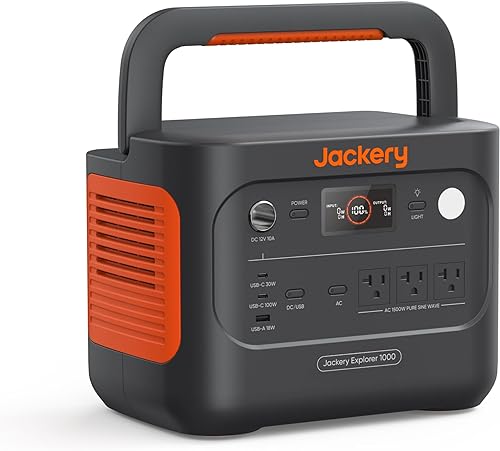
Jackery Explorer 1000 v2 Portable Power Station: Best for longer camping trips
- 1070Wh LFP
- 1500W AC, 3000W surge
- 3 AC, 2 USB-C, USB-A, DC car port
- 23.8 lb, foldable handle
- Solar panel not included
A 1070Wh station for fridges, electric pots and several devices on road trips.
Pros
- 1 hour emergency charge via app
- Strong 1500W output
- Over 4000 cycles
Cons
- Jackery panels only for solar
- Heavier than small picks
The Jackery Explorer 1000 v2 suits campers and road trippers who need more power for fridges and cooking gear. It gives 1070Wh capacity with 1500W AC output and 3000W surge peak.
At 23.8 lb, it is heavy for hiking but fine for car camping and RV trips. A foldable handle helps you move it from tent to car to picnic table.
Jackery says you can charge from 0% to 100% in one hour with emergency charging through the app. It defaults to 1.7 hours to help battery health, so fast charge is a choice you turn on.
The LFP battery is rated for over 70% capacity after 4,000 charge cycles. Jackery frames that as more than 10 years of life for typical use.
Ports include 3 AC outlets, 2 USB-C ports, 1 USB-A port and 1 DC car port, plus LED lights. That mix suits several devices at once on a campsite.
The main limit is solar choice. Jackery says this model works only with Jackery solar panels for solar charging.
If you already own another brand panel, check fit before you buy.
Anker SOLIX C1000 Portable Power Station: Best for fast recharging
- 1056Wh LiFePO4
- 1800W, 2400W peak
- 11 ports
- 600W solar input
- AC and car cables included
A 1056Wh station that reaches 80% in 43 minutes with UltraFast recharging.
Pros
- 80% in 43 minutes
- 600W fast solar
- 3000 cycles over 10 year lifespan
Cons
- 27.6 lb is heavy for hiking
- UltraFast needs app and AC input
The Anker SOLIX C1000 suits people who want fast charging and strong output in a 1000Wh station. It gives 1056Wh capacity with 1800W output and 2400W peak.
Anker says UltraFast recharging can reach 80% in 43 minutes and full charge in under an hour. You need AC input, the Anker app and a smartphone, and it works best between 68 and 122 degrees F.
For solar use, Anker says up to 600W fast solar recharging can fully power the device in about 1.8 hours. That is much faster than smaller solar inputs on other picks here.
The LiFePO4 battery is rated for 3,000 cycles over a 10-year lifespan. Anker also notes 11 versatile ports and SurgePad technology for wide appliance fit.
At 27.6 lb, it is not a hiking pick. It fits car camping, RV use and home backup where you can set it down and leave it there.
Our Anker SOLIX outdoor use guide explains setup and charging in more detail. Read it if you plan to use this model for camping or RV power.
BLUETTI Elite 30 V2 Portable Power Station: Best for small loads with high surge
- 288Wh LFP
- 600W continuous, 1500W lifting
- 10ms UPS
- 380W wall charge, 9 outlets
- 9.4 lb
A 288Wh station with 600W output and 1500W lifting power for small appliances.
Pros
- 600W output for its size
- 10ms UPS
- 0 to 80% in 45 minutes
Cons
- 288Wh runs down fast on big loads
- Solar cables may be needed for some panels
The BLUETTI Elite 30 V2 suits outdoor users who want more output than a small 300Wh station usually gives. It gives 288Wh capacity with 600W continuous output and 1500W surge in Power Lifting Mode.
At 9.4 lb, it is light enough for road trips, beach days and storm backup at home. BLUETTI says it can run camping lights, speakers, car fridges, laptops, CPAP machines and even a small kettle or toaster.
That 600W output is the key point. Other 288Wh to 296Wh picks here top out at 300W, so this model has more headroom for surge loads and small appliances.
Charging is flexible with 8 modes, including AC wall charge up to 380W, solar, car charging and combined AC plus solar. BLUETTI says 0 to 80% takes 45 minutes and 0 to 100% takes 70 minutes.
It also has a 10ms UPS switch for CPAP machines, laptops and routers during outages. That makes it useful at home as well as outdoors.
The trade-off is runtime. With only 288Wh, heavy loads will drain it quickly.
Use the runtime formula and keep high-draw devices short.
HOWEASY Portable Power Station: Best for phones and lights
- 88Wh
- 120W, 240W peak
- 8 output ports
- LED light with 3 modes
- 2.3 lb
A tiny 88Wh station for phones, lights, mini fans and small gear.
Pros
- Only 2.3 lb
- Built-in LED light
- Charges while in use
Cons
- 120W limit
- 88Wh will not run CPAP all night
The HOWEASY portable station suits campers who mainly need phones, lights and small gear charged. It gives 88Wh capacity with 120W output and 240W peak in a 2.3 lb body.
That weight is its best feature outdoors. You can toss it in a day pack, beach bag or glove box without thinking about it.
It measures 6.6 x 4 x 3 inches with a hidden handle.
You get 8 output ports, including 2 AC sockets, 1 USB-C port, 2 QC 3.0 USB ports, 1 USB port and 2 DC ports. An LED display shows status and remaining power.
Built-in LED lighting has 3 modes, including steady light, flash and SOS. That helps at night when you need a lantern and power in one unit.
HOWEASY says cycle life is over 1,500 times. It also supports simultaneous charging, so you can power devices while the station recharges.
The limit is honest and important. HOWEASY says 88.8Wh may not sustain CPAP use all night.
For CPAP, lights and fans, choose a 300Wh or larger model instead.
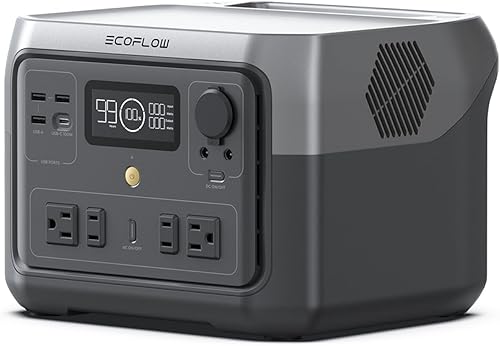
EF ECOFLOW Portable Power Station River: Best for mid-size RV use
- 499Wh LiFePO4
- Up to 1000W output
- 1 hour AC recharge
- 220W solar input
- 13.3 lb
A 499Wh station with 1000W output for camping, RV trips and home backup.
Pros
- 1 hour AC recharge
- 1000W X-Boost output
- LiFePO4 long life
Cons
- 499Wh is mid-range only
- X-Boost loads should be tested first
The EF ECOFLOW RIVER 2 Max 500 suits mid-size outdoor and RV use. It gives 499Wh capacity with up to 1000W output at 13.3 lb.
That output is strong for its size. It can run 11 essential appliances at once according to ECOFLOW, without overloading in normal use.
X-Boost technology helps with devices up to 1000W, but ECOFLOW says to test before use.
Recharging is fast with 1 hour AC recharge using X-Stream fast charging. For solar, ECOFLOW says 220W input can recharge it in as fast as 2.3 hours.
The LiFePO4 battery is rated for over 10 years of use. ECOFLOW also includes BMS protection that monitors voltage, current and temperature.
At 13.3 lb, it sits between hiking picks and full 1000Wh stations. It is heavy for long trails but fine for car camping, RV trips and home backup.
The trade-off is capacity. At 499Wh, it will not match 1000Wh models for multi-day fridge use.
Use it for shorter trips or lower loads.
BLUETTI Elite 300 Portable Power Station: Best for RV and home backup
- 3014Wh LiFePO4
- 2400W, 4800W surge
- TT-30 RV port, 12V/30A DC
- 10ms UPS
- 58 lb
A 3014Wh station for RV appliances, fridges, routers and home backup.
Pros
- Largest capacity here
- RV-ready ports
- 6000+ cycles
Cons
- 58 lb limits portability
- Large size needs storage space
The BLUETTI Elite 300 suits RV owners and home backup users who need large capacity. It gives 3014Wh capacity with 2400W output and 4800W surge.
That is the largest capacity in this group by a wide margin. It can keep refrigerators, routers, lights, TVs and CPAP machines running during outages, according to BLUETTI.
For RV use, it includes a TT-30 RV outlet and 12V/30A DC output. Those ports help run 12V fridges, water pumps and diesel heaters without extra adapters in many setups.
BLUETTI says it charges from 0 to 80% in as fast as 78 minutes. It also has a 10ms UPS switch for computers, routers and home office gear.
At 58 lb, this is not a portable hiking station. It is a power base you store in an RV, garage or home and move only when needed.
The trade-off is size and weight. If you need to carry power on your back, choose a 300Wh model.
If you need days of backup, this class makes sense.
EnginStar Portable Power Station 300W 296Wh Solar: Best for budget 300W use
- 296Wh
- 300W AC output
- 8 output ports
- Pure sine wave AC
- 6.5 lb
A 296Wh station for phones, laptops, cameras and CPAP use on camping trips.
Pros
- Light at 6.5 lb
- Pure sine wave AC
- 3 charging ways
Cons
- 300W limit
- 1000+ cycles, lower than LiFePO4 rivals
The EnginStar R300 suits budget outdoor users who need 300W power in a light body. It gives 296Wh capacity with 300W AC output at 6.5 lb.
You get 8 output ports, including 2 pure sine wave AC outlets, regulated DC outputs and fast USB charging. Pure sine wave output helps protect sensitive devices like laptops.
EnginStar says it can charge phones, laptops, cameras, CPAP machines and drones. That fits typical camping and travel gear.
Charging options include wall outlet, car socket and compatible 12 to 25V solar panels. EnginStar says it can reach 80% in 2 hours at a maximum charging speed of 65W.
The battery is lithium ion with over 1,000 charge cycles. That is lower than LiFePO4 rivals here, so long-term cycle life is a trade-off.
EnginStar also includes a 12 month limited service period from purchase date. Keep that in mind if you plan heavy use over many years.
STARYLINE 1000W Portable Power Station 1024Wh LiFePO4: Best for 1000W outdoor loads
- 1024Wh LiFePO4
- 1000W continuous, 2000W peak
- 3000+ cycles
- Max 300W solar input
- 27.7 lb
A 1024Wh station for lights, routers, mini fridges and laptops off grid.
Pros
- 1024Wh capacity
- 60W PD USB-C
- 3000+ cycles
Cons
- 27.7 lb carry weight
- Solar charging takes 6 to 8 hours
The STARYLINE station suits outdoor users who want 1000W output and 1024Wh capacity at a lower score tier. It gives 1000W continuous output with 1024Wh LiFePO4 capacity.
STARYLINE says it can power lights, routers and mini fridges for 2 to 3 days during outages. It also claims 28 iPhone charges or 8 hours of laptop use, though real runtime depends on device draw.
Ports include 2 AC outlets, 1 60W PD USB-C port and 2 USB-A ports. STARYLINE says it can power 5 devices at once and is Starlink compatible for remote work.
The LiFePO4 battery is rated for 3000+ cycles and retains 80% capacity. STARYLINE frames that as about 6 years of life.
Solar input goes up to 300W max, with an optional 200W panel charging it in 6 to 8 hours on sunny days. That is slower than the Anker SOLIX C1000 at 600W input.
At 27.7 lb, it is for car camping and RV use, not hiking. Choose it if 1000W output and 1024Wh capacity matter more than brand and charge speed.
How did we compare these outdoor power stations?
We compared capacity first, because watt-hours decide runtime. Next we checked continuous output, because that decides which appliances will run.
Peak or surge watts help with motor starts, but they do not replace continuous output.
We also weighed weight and size. A 2.3 lb station and a 58 lb station serve different trips.
One fits a day pack. The other fits an RV storage bay.
Battery type and cycle life came next. LiFePO4 and LFP models here range from 3000 to 6000+ cycles.
That matters if you use the station weekly or keep it for emergencies.
Charging speed and solar input were compared for off-grid use. Some stations charge in about an hour on AC power.
Others need several hours on solar, especially with smaller panels.
Ports and UPS features matter for specific jobs. RV users need TT-30 or high-current DC ports.
Home backup users may need a fast UPS switch for routers and CPAP machines.
How much capacity do you need for outdoor use?
A 100Wh to 300Wh station suits phones, lights, cameras and laptops for a night or weekend. The HOWEASY at 88Wh is at the low end, while the Jackery Explorer 300 and EnginStar at about 292Wh to 296Wh are safer for most small gear.
A 400Wh to 600Wh station suits car camping with a small fridge, fan and several USB devices. The ECOFLOW at 499Wh fits this middle range well.
A 1000Wh station suits fridges, electric pots, power tools and several devices for longer trips. The Jackery Explorer 1000 v2, Anker SOLIX C1000 and STARYLINE all sit in this class.
A 3000Wh station suits RV power and home backup for essentials. The BLUETTI Elite 300 at 3014Wh is in a different class and should not be compared to hiking models.
Use this simple math for runtime. Multiply capacity by 0.85 to 0.9, then divide by device watts.
That gives a rough runtime before inverter loss and real-world draw.
For car-based trips, read our best portable power station for car guide. It covers 12V use, car charging and road trip loads.
Can you recharge an outdoor power station with solar?
Yes, if the panel fits the station input range. Check voltage, current and maximum watts before you connect a panel.
Wrong input can damage the station or stop charging.
Small stations often take 100W to 200W panels. The Jackery Explorer 300 reaches 80% in about 2.8 hours with a 100W panel, according to Jackery.
Mid-size stations can take more solar. The ECOFLOW RIVER 2 Max 500 takes 220W solar input and can recharge in as fast as 2.3 hours, according to ECOFLOW.
Large stations can take even more. The Anker SOLIX C1000 takes up to 600W solar input.
The STARYLINE takes up to 300W max.
If you want a smaller solar setup, our best small power station with solar panel guide covers compact pairings. That helps if pack space matters.
What is a portable UPS, and do you need one outdoors?
A portable UPS is a power station that switches to battery power fast when grid power fails. Speed matters for routers, CPAP machines, computers and home office gear.
The BLUETTI Elite 30 V2 has a 10ms UPS switch. The BLUETTI Elite 300 also has 10ms UPS backup.
ECOFLOW says the RIVER 2 Max 500 switches within 30 milliseconds when grid power stops.
Not every outdoor station here is a UPS. Hiking stations are built mainly for device charging, not for instant backup switching.
Our What Is a Portable UPS? guide explains modes, transfer times and limits. Read it if backup at home matters as much as camping.
How do output watts and surge watts affect outdoor use?
Continuous output watts tell you what the station can run at once. Surge watts help with short starts for motors and compressors.
You need both numbers for fridges, pumps and power tools.
A 300W station suits laptops, lights, drones and small fans. It will not run most space heaters, electric pots or large fridges for long.
A 600W station gives more room. The BLUETTI Elite 30 V2 adds 1500W lifting power for short surge loads.
That helps with small kettles and toasters in some cases.
A 1000W station suits car camping with a fridge and several devices. The ECOFLOW and STARYLINE both offer 1000W continuous output.
A 1500W to 2400W station suits RV and home backup loads. The Jackery Explorer 1000 v2, Anker SOLIX C1000 and BLUETTI Elite 300 cover this range.
Check your device label before you buy. Add up running watts for all devices at once, then leave margin for surge and inverter loss.
Can a portable power station charge an electric vehicle?
A portable power station can charge phones and small devices for an EV trip, but it is not a substitute for an EV charger. EV charging needs high power and specific connectors.
Our portable power station for EV charging guide explains what these stations can and cannot do. It covers Level 1 charging limits and connector needs.
For most drivers, a station is useful as a backup for phones, lights and emergency gear. It is not a practical way to add many miles to an EV battery.
What about generators for outdoor power?
A portable power station is quiet, fume-free and easy to use indoors or in a tent area. A fuel generator can run longer with refueling, but it needs fuel, ventilation and more noise management.
Our best tri fuel portable generator guide covers fuel options for longer trips. Compare fuel cost, runtime and noise before you choose.
For camping, many people prefer a power station for lights, phones and small appliances. For long RV stays or heavy tools, a fuel generator may fit better.
For camping-specific picks, see our best portable power station for camping guide. It focuses on tent and car camping loads.
Which outdoor power station should you buy?
Pick the Jackery Explorer 300 if you want light hiking power for small gear. Pick the HOWEASY only if phones, lights and mini fans are enough.
Pick the BLUETTI Elite 30 V2 if you want 600W output in a 288Wh body. Pick the EnginStar if you want a budget 300W pick with pure sine wave AC.
Pick the Jackery Explorer 1000 v2 for longer camping trips with fridges and cooking gear. Pick the Anker SOLIX C1000 if fast AC and solar charging matter most.
Pick the ECOFLOW RIVER 2 Max 500 for mid-size RV use with 1000W output. Pick the STARYLINE if 1024Wh and 1000W output matter more than charge speed.
Pick the BLUETTI Elite 300 for RV power and home backup. Its 3014Wh capacity and TT-30 port make it a base station, not a hiking carry.
The best portable power station for outdoors depends on your trip. Match capacity to runtime, output to your largest device, and weight to how far you will carry it.
Our top 3 picks at a glance
-
1
Best for light hiking gear
Jackery Explorer 300 Portable Power Station
9.6/10 our score
See it on Amazon -
2
Best for longer camping trips
Jackery Explorer 1000 v2 Portable Power Station
9.5/10 our score
See it on Amazon -
3
Frequently asked questions
What size portable power station do I need outdoors?
Choose by total watt-hours you will use, not by peak watts alone. A 300Wh model suits phones, laptops and lights for a night, while 1000Wh suits fridges and several devices for longer trips.
Can I recharge a power station with solar outdoors?
Yes, if the panel voltage and watts fit the station input. Check the solar input range before you buy, because some brands limit charging to their own panels.
How long will a 1000Wh station run a fridge?
Runtime depends on the fridge draw and start surge. Use capacity times 0.85 to 0.9, then divide by device watts, and leave margin for inverter loss and compressor starts.