Can You Use a Portable Power Station for EV Charging?
Yes, a portable power station can add emergency charge to an EV through a suitable AC outlet, but it usually provides limited range. Check the station's continuous wattage, the vehicle's charging requirements, and the available battery capacity first.
On this page (8 sections)
- Can a portable power station charge an EV?
- What limits EV charging from a portable power station?
- Which portable power stations are practical for emergency EV charging?
- Can a small power station charge an EV?
- How much EV range can you expect?
- How should you set up the charging attempt?
- Is a portable power station better than waiting for a charger?
- What is the practical choice for EV emergencies?
Yes, a portable power station can charge an EV in an emergency, but the result is usually a small range boost rather than a full battery charge. The station must have an AC outlet that supports the vehicle's charging cable, enough continuous wattage, and enough stored energy to make the setup worthwhile.
EV charging also loses energy as power moves from the station's battery through the inverter, cable, and vehicle charger. That means the station's watt-hour rating is not the same as the energy that reaches the car battery.
Can a portable power station charge an EV?
A portable power station can feed an EV through its AC output when the charging cable's requirements fit the station's limits. The vehicle's portable charging cable normally connects to the power station just as it would connect to a suitable household outlet.
The connection is not the same as a fast-charging station. A portable unit usually supplies a modest AC load, so charging takes time and the added driving range may be limited.
Before trying it, check the vehicle manual and charging cable. Confirm the required voltage, amperage, grounding method, and minimum outlet capacity.
The station's continuous output matters more than its short surge rating because EV charging is a sustained load.
For background on choosing a best portable power station, compare battery capacity, continuous AC output, recharge options, and outlet types together.
What limits EV charging from a portable power station?
Battery capacity and continuous output are the 2 main limits. Watt-hours show stored energy, while watts show delivery power.
A station may store enough energy but fail if AC output is too low for the cable. It may have enough output yet run out before the EV gains useful range.
Charging losses reduce delivered energy. Use this estimate for planning: usable EV energy = station watt-hours × conversion efficiency
Results vary by station, cable, vehicle, temperature, and charging behavior. Do not treat the estimate as promised range.
Vehicle efficiency also matters. A car using more energy per mile gains less range from the same station.
Check the vehicle display after charging for a practical future estimate.
What does the outlet need to support?
The AC outlet must support the charging cable's voltage and current without exceeding the station's continuous rating. A pure sine wave AC output is useful for equipment designed for standard household-style AC power, but it does not make every EV charging setup compatible.
A charging cable may draw more power than a small portable station can provide. Some cables also have selectable current settings.
Use only a setting that stays within the station's continuous output and follow both manuals.
Do not use a power strip or a damaged extension cable to increase reach. Keep the connection simple, dry, and easy to monitor.
Which portable power stations are practical for emergency EV charging?
Larger stations with higher AC output and more watt-hours are the practical choices for emergency EV charging. Small stations can still be useful for phones, lights, and roadside communication, but their AC output may be too low for an EV cable.
The products below are included because their stated output and capacity make them useful for comparing emergency power limits. They are not substitutes for a dedicated EV charging station.
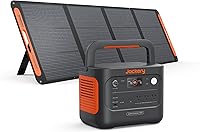
Jackery Solar Generator 1000 v2 and 200W
The Jackery Solar Generator 1000 v2 and 200W has 1,070Wh capacity and 1,500W AC output. That gives far more headroom for a low-power EV attempt than a compact 300W station.
It has 3 pure sine wave AC ports, 2 USB-C ports, 1 USB-A port, 1 DC car port, and LED lights. The package includes the Explorer 1000 v2, a 200W solar panel, a user manual, and an AC charging cable.
Jackery lists a 3,000W surge peak, but EV charging is a continuous load, so 1,500W matters more for planning. At 23.8 lb with a foldable handle, it is easier to move from storage to the vehicle.
The 200W panel can restore energy off grid, though output changes with sunlight. For RV options, see solar generators for RVs.
Jackery states 80% charge in 6 hours with the 200W panel.
For more vehicle-focused comparisons, see the best portable power station for car. Measure your storage space and check the charging cable requirements before ordering.
BLUETTI Portable Power Station AC180
The BLUETTI Portable Power Station AC180 has a 1,152Wh LiFePO4 battery and 1,800W output. Its 2,700W peak setting is higher, but the 1,800W output is the key figure for a sustained charging load.
The AC180 has 8 outlets and supports up to 500W of solar input. BLUETTI states that it can charge from 0% to 80% in 45 minutes and fully charge in 1 hour with 1,440W AC input.
It weighs 37.4 lb and measures 13.39 x 9.72 x 12.48 in. The package includes the power station, AC charging cable, car charging cable, solar charging cable, and user manual.
This is the strongest output option in this group, but it is also the heaviest. Choose it when stored energy and AC output matter more than carrying weight.
The AC180 also supports a UPS function with emergency power delivery in 20 ms. For another model, see our guide to Anker SOLIX UPS use.
That feature helps with connected home equipment, but it does not turn the unit into a DC fast charger for an EV.
Can a small power station charge an EV?
A small station may not be practical for EV charging even if it has an AC outlet. Its output may fall below the cable demand and its battery may drain quickly.
The Jackery Explorer 300 has 292Wh capacity and 300W rated output, with a 600W peak surge. It has 2 AC outlets, a 100W USB-C PD port, 2 USB-A ports, and a 120W car port.
It suits small electronics, cameras, laptops, lights, and communication devices during a roadside problem. Its 300W total output makes it a poor match for many EV cables, so check the lowest available setting first.
Jackery says it can reach 80% capacity in about 2.8 hours with a 100W solar panel, sold separately. The package includes the station, AC adapter, car charger cable, and user guide.
For lighter travel needs, compare the best small portable power station. If you plan to camp with the unit, the best portable power station for camping guide can help you compare weight and recharge needs.
How much EV range can you expect?
Expect a limited emergency range boost, not a full charge. The exact distance depends on usable watt-hours, charging losses, the vehicle's energy use, and how long the station can maintain the load.
For example, a 1,070Wh station does not send all 1,070Wh into the EV battery. Inverter losses and the vehicle's onboard charging system reduce the delivered energy.
A 292Wh station provides a much smaller energy reserve before those losses are counted.
A useful planning method is:
- Check the station's watt-hour capacity.
- Estimate the energy lost during AC conversion.
- Divide the delivered energy by the EV's energy use per mile.
- Leave a safety margin instead of draining the station completely.
Don't plan to reach a distant charger using the highest possible estimate. Aim for enough energy to reach a nearby public charger or a safer stopping place.
How should you set up the charging attempt?
Park safely, place the station on a stable dry surface, and monitor the connection from start to finish. Keep the power station and charging cable away from rain, standing water, excessive heat, and blocked vents.
Turn off unnecessary station outputs before connecting the EV. Use the lowest charging current that works for the vehicle and remains within the station's continuous output.
Watch the station's display for output power, remaining capacity, and warnings. Stop if the station overloads, the cable gets hot, the plug becomes loose, or the vehicle refuses the connection.
An Anker SOLIX outdoor use guide can help with general placement and outdoor power habits, but your EV and station manuals still control the charging setup.
Is a portable power station better than waiting for a charger?
A portable power station is best treated as a backup tool for reaching the next charger, not as a replacement for public or home EV charging. Its value is highest when a small amount of energy can get you out of a roadside problem.
The Jackery Explorer 300 is the easiest to carry but has the lowest capacity and output here. The Jackery Solar Generator 1000 v2 offers a lighter middle ground with 1,070Wh and 1,500W AC output.
The BLUETTI AC180 offers the highest continuous output and largest capacity here, but it weighs 37.4 lb.
For outdoor backup planning, compare the best portable power station for outdoor use. If you need uninterrupted power for home electronics as well, read [What Is a Portable UPS?
The Complete Guide](/what-is-a-portable-ups/).
What is the practical choice for EV emergencies?
Pick the Jackery Solar Generator 1000 v2 for a balance of capacity, output, and carrying weight, or choose the BLUETTI AC180 when higher continuous output matters more than weight. Choose the Jackery Explorer 300 for small devices and roadside communication, not as your main EV charging solution.
Before relying on any station, confirm the EV cable's power draw, choose a compatible AC setting, and plan for a short range boost. The safest goal is enough energy to reach a proper charging point, with reserve power left for communication and basic roadside needs.
Frequently asked questions
Can a portable power station charge an electric vehicle?
Yes, if the power station has a suitable AC outlet and enough continuous output for the vehicle's portable charging cable. It will usually add emergency energy rather than fully charge the battery.
Check the vehicle manual, charging cable requirements, and power station limits before connecting anything.
How much EV range can a portable power station add?
The added range depends on the station's usable watt-hours, charging losses, the vehicle's charging efficiency, and its energy use per mile. A small station may add only a very short buffer, while a larger 1,152Wh station can provide more energy, but neither should be treated like a full home charger.
What size portable power station is needed for EV charging?
Choose a station with an AC output that meets or exceeds the charging cable's demand, then compare its watt-hours with the energy you need. The Jackery Explorer 300 is limited to 300W, while the Jackery Solar Generator 1000 v2 reaches 1,500W and the BLUETTI AC180 reaches 1,800W.
Is it safe to charge an EV from a portable power station?
It can be safe when the power station, charging cable, and vehicle are used within their stated limits. Keep the station dry and ventilated, use an undamaged cable, avoid overloaded outlets, and stop if the station reports a fault, becomes unusually hot, or the connection is unstable.