How Many Solar Panels Do You Need for Your House?
Most homes need about 15 to 25 solar panels, but your exact number depends on yearly electricity use, panel wattage, local sunlight and system losses. Use your power bills and expected solar production to size the array.
On this page (10 sections)
- How many solar panels do I need for my house?
- What information determines how many panels you need?
- How many 400-watt solar panels does a house need?
- How do you calculate solar production for your home?
- How much roof space do solar panels need?
- Should you use portable solar panels for a house?
- Do solar panels need a battery to power a house?
- How should you size a solar array for backup power?
- What mistakes cause homeowners to choose the wrong panel count?
- How many solar panels will I need for my house?
Most homes need about 15 to 25 solar panels, but your exact number depends on annual electricity use, panel wattage, local sunlight and system losses. A smaller, efficient home may need fewer panels, while a home with heavy cooling or heating use may need more.
The best starting point is your electricity history. Find your annual kilowatt-hour use, estimate how much one panel can produce in your area, then check whether your roof has enough usable space.
How many solar panels do I need for my house?
You can estimate the panel count with this formula:
Panels needed = annual electricity use ÷ annual production per panel
For a quick planning example, imagine a home that uses 10,000 kWh per year. If one 400-watt panel produces about 500 kWh per year in that location, the basic estimate is:
10,000 ÷ 500 = 20 panels
This is a planning estimate, not a final electrical design. Shade, roof direction, weather, inverter losses, panel temperature and local solar conditions can change the result.
A solar installer should confirm the final array size, wiring, inverter and roof layout. The [U.S.
Department of Energy's solar guidance](https://www.energy.gov/energysaver/solar-energy) explains why location, orientation and system design affect solar output.
What information determines how many panels you need?
Your electricity use and local solar production matter more than the size of your house alone. Two homes with the same floor area can need very different arrays.
Check these details before estimating:
- Annual electricity use in kWh
- Average monthly use and seasonal peaks
- Panel wattage
- Local sunlight and weather
- Roof direction and pitch
- Shade from trees, buildings or chimneys
- Available roof area
- Expected system losses
- Whether solar will cover all use or only selected loads
Use 12 months of utility bills when possible. If you recently added an electric vehicle, heat pump, pool equipment or central air-conditioning, include the expected extra use instead of relying only on older bills.
A home that uses 600 kWh in a mild month but 1,400 kWh during summer may need an array sized around the annual total and the roof's summer conditions. Seasonal production and seasonal demand do not always match.
How many 400-watt solar panels does a house need?
A 400-watt panel produces 0.4 kilowatts at its rated output, but it will not produce 0.4 kW every hour of every day. Real production depends on sunlight, temperature, shading, panel angle and system equipment.
For rough planning:
| Annual home use | Possible 400-watt panel range |
|---|---|
| 5,000 kWh | 10–15 panels |
| 8,000 kWh | 15–22 panels |
| 10,000 kWh | 18–25 panels |
| 15,000 kWh | 27–38 panels |
These ranges are broad because one panel may produce much more electricity in a sunny region than in a cloudy one. They also assume the roof and system can use the panels effectively.
For more panel-specific guidance, see our best 400 watt solar panels for homes guide. A higher-wattage panel can reduce the number of panels, but the panel dimensions, roof layout and equipment compatibility still matter.
How do you calculate solar production for your home?
Use a local production estimate rather than assuming every panel receives the same number of full-sun hours. Solar calculators and installer proposals can estimate output from your address, roof direction, tilt and shading.
The basic production calculation is:
Panel wattage × expected sunlight hours × days × efficiency adjustment
For example, a 400-watt panel may produce around 1.6 kWh during a day with 4 equivalent peak-sun hours before system losses. That does not mean it will make 1.6 kWh every day, because clouds, shorter winter days and shade reduce output.
The National Renewable Energy Laboratory's PVWatts tool can help estimate production for a location. Treat the result as a planning estimate and have a qualified professional verify the design.
How much roof space do solar panels need?
A typical residential panel may need about 18 to 22 sq ft of roof area, but the exact footprint varies by model. The total array also needs spacing around roof edges, vents, skylights and other obstructions.
As a rough example:
- 15 panels may need about 270–330 sq ft of panel area.
- 20 panels may need about 360–440 sq ft.
- 25 panels may need about 450–550 sq ft.
Usable roof area is usually smaller than the total roof area. Chimneys, dormers, plumbing vents and shade can remove sections from consideration.
Measure each roof plane separately. A south-facing roof may produce more useful electricity than a larger shaded roof, so panel count alone does not tell you whether the array will meet your goal.
Should you use portable solar panels for a house?
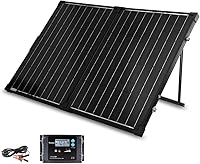
Portable solar panels are best for small backup loads, camping, travel and charging a portable power station. They usually do not replace a roof-mounted home solar system when your goal is to power major household loads throughout the year.
Portable systems can still be useful for keeping phones, lights, small appliances or selected emergency equipment charged. Their value comes from mobility and simple placement, while a fixed array offers more panel area and a permanent connection to home electrical equipment.
If you are new to the category, read what is a portable solar panel before comparing panel types. For home backup use, our guide to the best portable solar panels for home explains where portable equipment fits and where it falls short.
An electric vehicle can also change your energy plan. See portable solar panel for EV charging if you are considering mobile charging rather than a standard home solar installation.
Do solar panels need a battery to power a house?
Solar panels do not always need a battery, especially when the home remains connected to the electric grid. The grid can supply power at night or during periods when solar production is below household demand.
A battery becomes more useful when you want outage backup, evening energy use or greater independence from the grid. Battery capacity should be sized around the loads you want to support and how long you want them to run.
Large household loads such as central air-conditioning, electric water heaters and well pumps may require substantial inverter and battery capacity. List your essential loads before choosing a backup system.
A battery also does not automatically make every home circuit available during an outage. For a related explanation, read [Can a UPS Battery Backup Power a Whole House?
Made Simple](/can-a-ups-battery-backup-power-a-whole-house/).
How should you size a solar array for backup power?
For backup, size the system around essential loads first, not the entire home. Decide which circuits must remain available during an outage, such as refrigeration, lighting, internet equipment, medical equipment or a small heating system.
Write down each load's running watts and starting watts. Motors and compressors can need extra power when they start, so the inverter must handle those peaks.
Then estimate daily energy use:
Watts × hours used ÷ 1,000 = daily kWh
A refrigerator that averages 100 watts for 10 hours of compressor-equivalent operation would use about 1 kWh in that example. Actual use varies, so leave room for uncertainty.
Solar panels recharge the battery when sunlight is available. If several cloudy days are common, you may need more battery capacity, a larger array, a generator or a plan to reduce loads.
What mistakes cause homeowners to choose the wrong panel count?
The most common mistake is using monthly electricity use without checking the full year. Summer cooling and winter heating can create large seasonal changes.
Other errors include:
- Counting roof area that is shaded or obstructed
- Treating panel wattage as guaranteed daily output
- Ignoring inverter and wiring losses
- Forgetting new loads such as an EV or heat pump
- Sizing only for average use instead of peak use
- Assuming a battery can power every appliance
- Choosing a panel count before checking roof layout
- Ignoring local electrical and permitting requirements
A small array may cover part of your bill, while a larger array may be needed for near-total annual offset. Decide whether your goal is lower grid use, outage backup or full annual production before selecting the target.
How many solar panels will I need for my house?
The most reliable estimate comes from 12 months of electricity use, a local production model and a roof layout review. Start with your annual kWh total, divide it by the expected annual output of one panel and then adjust for shade, losses and usable roof space.
Choose a fixed home array when you want broad annual energy production. Choose portable solar panels when you need movable charging for smaller loads or a portable power station.
If your goal is outage protection, list essential circuits separately and size the battery and inverter around those loads. The right panel count is the one that matches your energy use, local sunlight and available roof area.
Frequently asked questions
How many solar panels do I need for an average house?
Many average homes need about 15 to 25 panels when using panels rated near 400 watts, but the right number depends on annual electricity use and local solar production. A home with high air-conditioning demand may need more, while an efficient home in a sunny area may need fewer.
How many solar panels do I need to power my whole house?
To power your whole house over a year, divide your annual electricity use by the expected annual production of one panel, then adjust for system losses and usable roof space. A grid connection or battery may still be needed when solar production is lower than household demand.
How many 400 watt solar panels do I need for a house?
A home using 10,000 kWh per year might need about 18 to 25 panels rated at 400 watts, depending on sunlight and system efficiency. Use local production estimates instead of multiplying panel wattage by a simple daily-hour guess.
Can portable solar panels power a house?
Portable solar panels can help charge a power station or support small loads, but a full house usually needs a larger fixed array, an inverter and suitable electrical equipment. Portable panels are most useful when you need movable backup power or off-grid charging.
Do I need batteries with home solar panels?
You don't always need batteries with grid-connected solar, because the grid can supply power when your panels produce less. Batteries become more useful for outage backup, evening use or homes with limited grid access, but they add cost, space and installation requirements.