Best 1000W Portable Power Stations: Top 9 Picks (November 2026)
The best 1000w portable power stations include the Anker SOLIX C1000 Gen 2 Portable Power Station for fast home backup, the Jackery Explorer 300 Portable Power Station for light travel power, and the Jackery Explorer 1000 v2 Portable Power Station for compact 1,500W output.
On this page (9 sections)
- Best 1000W Portable Power Station picks for different uses
- How do these 1000W power stations compare?
- How we compared these stations
- What size 1000W power station do you need?
- Which ports and outlets matter most?
- How fast should a 1000W station charge?
- Is UPS backup important for your use?
- How do you care for a portable power station?
- Verdict: which 1000W power station should you buy?
The best 1000w portable power station for most buyers is the Anker SOLIX C1000 Gen 2, because it pairs 2,000W output with 1,024Wh capacity and a fast 10 ms UPS switchover. If you want a lighter 1,500W option, look at the Jackery Explorer 1000 v2.
If you want more capacity and expansion, the BLUETTI AC180 is the stronger pick.
We compared these stations by continuous output first, then by capacity, charging speed, port mix and weight. A 1,000W label alone does not tell the full story.
Some picks here go above 1,000W, and some smaller picks sit below it for travel use. For a higher-output option, compare 2000-watt solar generators.
Our score weighs specs, features and buyer feedback against what you are shopping for. Start with the best portable power station guide if you are new to this category.
Use our what size solar generator guide to match solar input to your needs.
Our picks at a glance
-
1
 Best for fast home backup
Anker SOLIX C1000 Gen 2 Portable Power Station
9.7/10 our score
See it on Amazon -
2
 Best for light travel power
Jackery Explorer 300 Portable Power Station
9.6/10 our score
See it on Amazon -
3
 Best for compact 1,500W output
Jackery Explorer 1000 v2 Portable Power Station
9.5/10 our score
See it on Amazon
- 4
 Check it
BLUETTI Portable Power Station AC180
Best for expandable backup - 5
 Check it
BLUETTI Elite 30 V2 Portable Power Station
Best for small 600W backup - 6
 Check it
BLUETTI Elite 10 Mini Portable Power Station
Best for travel and flights - 7
 Check it
GRECELL 1000W Portable Power Station 999Wh
Best for many ports - 8
 Check it
EBL Portable Power Station 1000W Solar Generator
Best for simple 1,000W use - 9
 Check it
DaranEner DARAN Portable Power Station
Best for quiet indoor use
Best 1000W Portable Power Station picks for different uses
The Anker leads for home backup and fast recharging. The Jackery Explorer 1000 v2 wins on compact high output.
Smaller BLUETTI and DARAN picks suit travel and light backup where a full 1,000W station is more than you need.
Anker SOLIX C1000 Gen 2 Portable Power Station: Best for fast home backup
- 2,000W output, 3,000W peak
- 1,024Wh LiFePO4 battery
- 10 ports, 9 total outlets
- 10 ms UPS backup
Fast recharging, strong output and UPS backup make this the top pick for outages, remote work and off-grid basics.
Pros
- 2,000W continuous output
- 49 minute UltraFast recharge
- 10 ms UPS switchover
Cons
- No capacity expansion
- UltraFast speed depends on battery temperature
The Anker SOLIX C1000 Gen 2 suits buyers who want one station for outages, remote work, RV use and tailgating. It delivers 2,000W output with 3,000W peak and 1,024Wh capacity, so it can handle more than a basic 1,000W load.
Anker says HyperFlash tech fully recharges it at 1,600W in 49 minutes when enabled in the app. That speed matters before a storm or between road trips.
Solar recharging takes 1.8 hours with 600W input at 60V max.
The 10 ms UPS switchover helps keep CPAP machines and laptops running. The Anker app adds Time of Use mode for smarter charging and discharging around peak prices.
It has 10 ports and 9 total outlets for up to 10 devices.
The trade off is no capacity expansion. Anker removed that feature to reduce size and weight.
It is also 11.3 kg, so it is portable but not light.
Jackery Explorer 300 Portable Power Station: Best for light travel power
- 292Wh capacity
- 300W output, 600W peak
- LiFePO4 battery
- 2 AC outlets
A very light option for laptops, cameras and small devices when you do not need 1,000W output.
Pros
- Only 7.5 lb class weight
- 100W USB-C PD port
- Over 4,000 charge cycles
Cons
- 300W output is below 1,000W class
- Solar panel not included
The Jackery Explorer 300 is not a 1,000W station. It is here for buyers who value weight over output for hikes and camping.
At 7.5 lb with 292Wh capacity, it is easy to carry and pack with gear.
It gives 300W rated output with 600W peak surge. That covers laptops, drones, cameras and CPAP machines for short periods.
It has 2 AC outlets, a 100W USB-C PD port, 2 USB-A ports and a 120W car port.
Jackery upgraded it with LiFePO4 chemistry for over 4,000 charge cycles. It reaches 80% charge in about 2.8 hours with a 100W solar panel.
A 40W panel takes about 7.5 hours to 80%, which suits slow off grid top ups.
The trade off is clear. You cannot run high draw appliances on 300W.
Choose this for light travel, not for home backup of large loads.
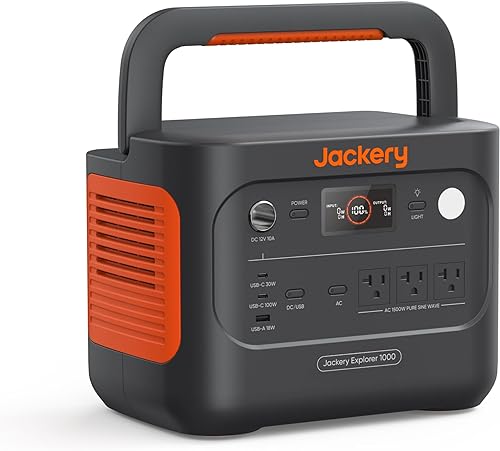
Jackery Explorer 1000 v2 Portable Power Station: Best for compact 1,500W output
- 1,500W output, 3,000W surge
- 1,070Wh capacity
- Three AC ports
- 100W USB-C PD
Higher output than a true 1,000W unit in a compact frame, with fast charging and app control.
Pros
- 1,500W AC output
- One hour emergency charging via app
- LiFePO4 with 4,000 cycles
Cons
- Solar charging compatible only with Jackery panels
- Default charge is 1.7 hours
The Jackery Explorer 1000 v2 suits buyers who want more than 1,000W without a large frame. It gives 1,500W AC output with 3,000W surge and 1,070Wh capacity at only 23.8 lb.
It can power AC units, fridges and electric pots within its limits. It has three pure sine wave AC ports, two USB-C ports, one USB-A port and one DC car port.
PD 100W fast USB-C charging helps laptops charge without extra adapters.
Emergency charging via the Jackery App goes from 0% to 100% in one hour. It defaults to 1.7 hours to protect battery health.
ChargeShield 2.0 tech is meant to make charging safer and smarter.
The trade off is solar compatibility. It works only with Jackery solar panels for solar charging.
The solar panel is not included. That limit matters if you already own other panels.
BLUETTI Portable Power Station AC180: Best for expandable backup
- 1,800W output, 2,700W peak with boost
- 1,152Wh LiFePO4 battery
- 500W solar input
- 20 ms UPS
Strong output, one hour AC charging and expansion battery support for longer outages.
Pros
- Fully charged in 1 hour at 1440W AC input
- 8 outlets
- 5-year warranty
Cons
- Heaviest pick here at 37.4 lb
- Boost mode needed for 2,700W
The BLUETTI AC180 suits buyers who want high output and longer backup. It packs 1,152Wh capacity with 1,800W output and 2,700W peak with a boost.
It charges fully in one hour at 1440W AC input. Solar charging takes 2.8 to 3.3 hours with 500W solar input.
It has 8 outlets for multiple devices, which helps when several appliances run together.
The 20 ms UPS feature makes it useful as home battery backup for essentials. It also supports capacity expansion with B80, B230 and B300 expansion batteries in Power Bank mode.
That expansion path is rare in this group.
The trade off is weight. At 37.4 lb, it is the heaviest pick here.
That weight buys capacity and expansion, but it is harder to move room to room.
BLUETTI Elite 30 V2 Portable Power Station: Best for small 600W backup
- 288Wh capacity
- 600W output, 1,500W surge
- 10 ms UPS
- 9 total outlets
Light and fast charging, with enough output for laptops, CPAP machines and small appliances.
Pros
- 600W continuous output
- 0 to 80% in 45 minutes
- 50% lower power consumption
Cons
- 288Wh limits run time
- Power Lifting Mode needed for 1,500W
The BLUETTI Elite 30 V2 suits buyers who want 600W output in a light frame. It gives 288Wh capacity with 600W continuous output and 1,500W surge in Power Lifting Mode.
At 9.4 lb, it is easy to carry during storms or on road trips. It can run camping lights, speakers, car fridges, laptops and CPAP machines.
Total outlets reach 9, so port count is not the limit here.
It charges 0 to 80% in 45 minutes and 0 to 100% in 70 minutes. AC wall charging goes up to 380W.
The 10 ms UPS switch protects routers and laptops during cuts. App control via Bluetooth or Wi-Fi adds monitoring.
The trade off is capacity. 288Wh means shorter run times than the 1,000Wh picks.
Choose it for portability and speed, not for all night high loads.
BLUETTI Elite 10 Mini Portable Power Station: Best for travel and flights
- 128Wh capacity
- 200W AC outlet
- 10 ms UPS
- Airline friendly size
A palm sized unit that works as a bridge between a power bank and a full power station.
Pros
- Only 4.0 lb
- 100W USB-C fast charging
- LED lighting up to 50 hours
Cons
- 200W output suits small devices only
- 128Wh gives short run times
The BLUETTI Elite 10 Mini suits travel use more than home backup. It is 128Wh with 200W AC output at only 4.0 lb and palm sized dimensions.
The 128Wh size falls in the 100 to 160Wh range, so it can be carried on most major airlines with prior approval, limit 2 per passenger. It has a 200W AC outlet, 100W USB-C fast charging and multiple DC ports for laptops, drones and cameras.
It has a built in 10 ms UPS and 350W bypass output for laptops, routers, security cameras and gaming setups. It charges in 70 minutes at 150W AC, or with 100W solar or 100W car charging.
It also has LED lighting with 3 modes for up to 50 hours. The trade off is simple.
200W and 128Wh limit you to small devices and short run times.
GRECELL 1000W Portable Power Station 999Wh: Best for many ports
- 1,000W output, 2,000W peak
- 999Wh capacity
- 10 ports
- 10W wireless charging
A true 1,000W pick with a wide port mix for charging several devices at once.
Pros
- 999Wh at 17 lb class weight
- 60W USB-C PD port
- MPPT solar controller
Cons
- Battery lasts 2,000+ cycles
- 24-month warranty
The GRECELL 1000W station suits buyers who want a true 1,000W output with many ports. It gives 999Wh capacity with 1,000W continuous power and 2,000W peak.
It has 10 ports including 2 AC sockets, 1 USB-C PD 60W port, 3 USB-A QC 3.0 ports, a 10W wireless pad, a 12V car port and 2 DC outputs. You can use all ports at once if the total load stays under 1,000W.
The LCD shows wattage, battery percentage and estimated runtime.
The LiFePO4 battery lasts 2,000+ charge cycles over a 10-year lifespan claim. The BMS protects against over charge, over discharge, short circuit, overload and extreme temperatures.
MPPT solar tech helps solar charging.
The trade off is charging time and warranty. It does not match the one hour charging of the top picks.
It is backed by a 24-month warranty.
EBL Portable Power Station 1000W Solar Generator: Best for simple 1,000W use
- 1,000W output
- 999Wh capacity
- 10W wireless charger
- Pass-through charging
Straightforward 1,000W output and 999Wh capacity for camping, RV and home backup basics.
Pros
- 1x 120V AC outlet
- 60W PD USB-C port
- BMS safety protection
Cons
- AC charging takes 7 to 8 hours
- 21 lb weight
The EBL 1000W station suits buyers who want simple 1,000W power for camping, RV and home backup basics. It gives 999Wh capacity with 1,000W continuous power.
It has 1 AC outlet, 2 DC ports, 1 car outlet, 1 60W PD USB-C port, multiple USB-A QC3.0 ports and a 10W wireless charger. Pass through charging lets you charge the unit while powering devices.
The LCD can auto sleep after 20 seconds to save energy.
EBL says it can run floodlights for 212 hours and keep a TV on for 56 hours. Those numbers depend on the actual device watts, so use the run time formula for your gear.
Solar charging supports 12 to 26V at 8A max.
The trade off is charge speed. AC charging takes 7 to 8 hours and car charging takes 9 to 11 hours.
At 17.86 lb, it is easy to carry with a folding handle.
DaranEner DARAN Portable Power Station: Best for quiet indoor use
- 288Wh capacity
- 600W output, 1,200W surge
- LiFePO4 battery
- 6 devices at once
Silent, light and enough for CPAP machines, laptops and small tools in a compact frame.
Pros
- Zero noise, no fumes
- Shock-resistant casing
- 100W PD Type-C
Cons
- 288Wh limits longer use
- Solar panel and cables not included
The DARAN station suits buyers who want quiet indoor power at a lower output. It gives 288Wh capacity with 600W output and 1,200W surge.
At 8.86 lb, it fits in backpacks or car trunks. It can charge 6 devices at once with 2 AC outlets, 1 car socket, 1 Type-C and 2 USB-A ports.
It runs laptops, mini fridges, drones, CPAP machines and cameras.
It charges to 80% in 2 hours on AC power. Solar charging recommends a 100W panel.
The solar panel and cables are not included, so budget for those separately if you need solar.
It is silent with zero noise and no fumes, which helps indoor use. The built in LED light has steady, strobe and SOS modes.
The trade off is 288Wh capacity and a 1-year customer service period.
How do these 1000W power stations compare?
Output is the first filter. The Anker gives 2,000W, the Jackery 1000 v2 gives 1,500W and the BLUETTI AC180 gives 1,800W.
The GRECELL and EBL give a true 1,000W. The smaller picks give 600W, 300W or 200W.
Capacity is the second filter. The AC180 leads with 1,152Wh.
The Jackery 1000 v2 has 1,070Wh and the Anker has 1,024Wh. The GRECELL and EBL have 999Wh.
Smaller picks drop to 288Wh or less.
Charging speed separates the group further. The Anker reaches full charge in 49 minutes in UltraFast mode.
The AC180 and Jackery 1000 v2 both reach full charge in about one hour under their fast modes. The EBL takes 7 to 8 hours on AC, which is a different planning category.
Weight also changes how you will use each unit. The Elite 10 Mini is 4.0 lb and the Explorer 300 is 7.1 lb, so both suit backpack travel.
The AC180 is 37.4 lb, so it suits a fixed backup spot more than frequent carrying.
| Product | Best for | Output | Capacity | Weight | Our score |
|---|---|---|---|---|---|
| Anker SOLIX C1000 Gen 2 Portable Power Station | fast home backup | 2,000W | 1,024Wh | 11.3 kg | 9.7 |
| Jackery Explorer 300 Portable Power Station | light travel power | 300W | 292Wh | 7.1 pounds | 9.6 |
| Jackery Explorer 1000 v2 Portable Power Station | compact 1,500W output | 1,500W | 1,070Wh | 23.8 pounds | 9.5 |
| BLUETTI Portable Power Station AC180 | expandable backup | 1,800W | 1,152Wh | 37.4 pounds | 9.4 |
| BLUETTI Elite 30 V2 Portable Power Station | small 600W backup | 600W | 288Wh | 9.5 pounds | 9.3 |
| BLUETTI Elite 10 Mini Portable Power Station | travel and flights | 200W | 128Wh | 4 pounds | 8.8 |
| GRECELL 1000W Portable Power Station 999Wh | many ports | 1,000W | 999Wh | 16 pounds | 8.5 |
| EBL Portable Power Station 1000W Solar Generator | simple 1,000W use | 1,000W | 999Wh | 21 pounds | 8.2 |
| DaranEner DARAN Portable Power Station | quiet indoor use | 600W | 288Wh | 8.7 pounds | 7.9 |
How we compared these stations
We checked specs for output, capacity, peak power, charge time, solar input and port count. We weighted continuous output most because it decides what appliances will run.
We also looked at UPS switch time for backup use. A 10 ms switch helps sensitive gear more than a slower switch.
Weight matters too, because a station you cannot move is less useful in an outage.
We did not test these units hands on. We compared product data and buyer patterns, and we label maker claims as claims.
Our score weighs specs, features and buyer feedback against what you are shopping for.
How did weight and capacity trade off?
Higher capacity usually adds weight. The AC180 pairs 1,152Wh with 37.4 lb.
The Jackery 1000 v2 pairs 1,070Wh with 23.8 lb. The Anker pairs 1,024Wh with 11.3 kg, which is a different balance of size and output.
Smaller units trade capacity for carry ease. The Elite 30 V2 and DARAN both use 288Wh, but they sit near 9 lb.
The Elite 10 Mini drops to 128Wh to reach 4.0 lb and airline friendly size.
Cycle life also shaped our view of long term value. Several picks list 4,000 cycles with LiFePO4 chemistry.
The GRECELL lists 2,000+ cycles. That difference affects how often you might expect to replace the battery over years of use.
What size 1000W power station do you need?
A 1,000W station suits moderate loads, not a whole house. Add up the watts for every device you plan to run at once.
Stay under the continuous output, not the peak number.
Peak power helps start motors. Continuous power is what the station can sustain.
If your total load is close to the limit, choose a higher output model like the Anker or Jackery 1000 v2.
Solar input is another sizing check. The Anker accepts up to 600W solar.
The AC180 accepts up to 500W solar. The Elite 10 Mini accepts up to 100W solar.
Matching panel size to input helps avoid wasted sun hours.
How do you estimate run time?
Use capacity in watt hours times 0.85, then divide by device watts. A 999Wh station running a 100W device gives about 8.5 hours in theory.
Real use varies with inverter loss and device cycling.
Try the same math on a small load. A 288Wh station running a 30W CPAP gives about 8.16 hours using the maker formula.
That shows why low watt devices last far longer than high watt appliances.
When should you size up?
Size up if you want to run a fridge, CPAP and laptop together for many hours. Our best portable power station 3000w guide covers higher output models for larger loads.
For heavy duty needs, see the best industrial portable power station guide.
Which ports and outlets matter most?
AC outlets matter most for appliances and home backup. Look for pure sine wave output for sensitive electronics like laptops and CPAP machines.
USB-C PD ports matter for fast laptop charging. The Jackery picks offer 100W PD.
The GRECELL offers 60W PD. The EBL also offers 60W PD.
For AC focused needs, our best portable power station with ac outlet guide breaks down outlet counts and placement. More ports help only if you will use them at the same time.
How many devices will you charge at once?
Count phones, laptops, lights, cameras and car gear. The Anker has 10 ports.
The GRECELL also has 10 ports. The DARAN charges 6 devices at once.
Wireless charging is a bonus for phones. The GRECELL and EBL both include a 10W wireless pad.
That pad helps when you want cable free top ups at a campsite table.
Do you need wheels or a handle?
Weight decides how you move the station. The Anker is 11.3 kg.
The BLUETTI AC180 is 37.4 lb. Our best portable power station on wheels guide helps if you move it often.
How fast should a 1000W station charge?
Fast charging helps before storms and between trips. The Anker recharges in 49 minutes with UltraFast mode.
The BLUETTI AC180 charges in one hour at 1440W AC input.
The Jackery 1000 v2 charges in one hour in emergency mode via the app. It defaults to 1.7 hours to protect battery health.
The EBL takes 7 to 8 hours on AC, so plan ahead.
Charging mode choices matter for battery care. Some makers default to a slower charge to protect the battery.
You may need to enable fast mode in the app each time.
What solar input do you need?
Check max solar watts and voltage before you buy panels. The Anker takes 600W solar.
The BLUETTI AC180 takes 500W solar. The Jackery 1000 v2 works only with Jackery panels.
Can you charge while you use it?
Many models support pass through charging. The GRECELL and EBL support it.
The Jackery Explorer 300 can charge devices while it recharges. Check the model before you rely on it.
Is UPS backup important for your use?
UPS backup matters if you need power during a sudden outage. The Anker and BLUETTI Elite models use 10 ms switchover.
The BLUETTI AC180 uses 20 ms.
A portable UPS works differently from a full home UPS. Our [What Is a Portable UPS?
The Complete Guide](/what-is-a-portable-ups/) explains the gap between the two. For indoor use, see our best portable power station for indoor use guide.
What gear benefits most from UPS?
Laptops, routers, security cameras and CPAP machines benefit most. A 10 ms switch helps avoid data loss and shutdowns.
Always check total watts before you plug in critical gear.
What are the limits of portable UPS?
Portable UPS backup lasts only as long as the battery lasts. It is not a whole home system.
Use it for essentials, not for every circuit in the house.
How do you care for a portable power station?
Store it at about half charge if you will not use it for months. Recharge every 1 to 2 months to keep the battery healthy.
The DARAN maker gives that exact advice.
Keep vents clear and store it in a cool, dry place. Avoid extreme heat and cold during use and storage.
Use the included cables and follow the voltage limits for solar input.
How many cycles should you expect?
LiFePO4 batteries last longer than older chemistries. The Anker and Jackery 1000 v2 list 4,000 cycles.
The Jackery Explorer 300 also lists over 4,000 cycles. The GRECELL lists 2,000+ cycles.
When should you calibrate the battery?
Some makers suggest two full charge and discharge cycles after you receive the unit. The DARAN maker suggests that step.
It can help the battery display read more accurately.
Verdict: which 1000W power station should you buy?
Pick the Anker SOLIX C1000 Gen 2 if you want the best all around 1,000W class station for home backup, camping and remote work. Its 2,000W output, 1,024Wh capacity and 10 ms UPS give you the most headroom here.
Pick the Jackery Explorer 1000 v2 if you want 1,500W output at 23.8 lb with fast app controlled charging. Pick the BLUETTI AC180 if you want 1,152Wh and expansion battery support.
Pick a smaller model only if weight matters more than output. The Jackery Explorer 300, BLUETTI Elite 30 V2, Elite 10 Mini and DARAN suit light travel and small device backup.
They do not replace a true 1,000W station for larger loads.
Next, confirm your total watts, solar input and port needs. Then compare the top picks above by the job you need done most.
Our top 3 picks at a glance
-
1
Best for fast home backup
Anker SOLIX C1000 Gen 2 Portable Power Station
9.7/10 our score
See it on Amazon -
2
Best for light travel power
Jackery Explorer 300 Portable Power Station
9.6/10 our score
See it on Amazon -
3
Best for compact 1,500W output
Jackery Explorer 1000 v2 Portable Power Station
9.5/10 our score
See it on Amazon
Frequently asked questions
What does 1000W mean on a portable power station?
It means the unit can deliver 1,000 watts of continuous AC power at one time. Check the total watts of every device you plug in together, because the station shuts off if the combined load is too high.
Capacity in watt hours tells you how long that power can last.
How long will a 999Wh station run a fridge?
Use 999Wh times 0.85, then divide by the fridge watts. A 100W fridge would run about 8.5 hours in theory.
Real run time changes with compressor cycling, start surge and inverter losses, so treat the math as an estimate.
Can a portable power station replace a generator?
Yes for quiet, indoor and short term power needs. It has no fuel or fumes and can run indoors.
It cannot match a fuel generator for multi day heavy loads unless you have solar input or wall charging available.
What is UPS backup on these stations?
UPS backup switches to battery power when wall power fails. Faster switch times, such as 10 ms, help keep laptops, routers and CPAP machines running.
Check the switch time and total output before you rely on it for sensitive gear.