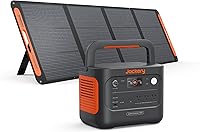
9 Best LiFePO4 Portable Power Stations (November 2026)
The best LiFePO4 portable power stations include the Anker SOLIX C1000 Gen 2 Portable Power for fast home backup, the Jackery Explorer 300 Portable Power Station for lightweight camping, and the Jackery Explorer 1000 v2 Portable Power Station for quiet emergency charging.
On this page (5 sections)
- Which LiFePO4 power station is best for each use?
- What should you compare before buying a LiFePO4 power station?
- How should you use and care for a LiFePO4 power station?
- Which is the best LiFePO4 power station for you?
- Buy for your planned use, not for the largest numbers on the page. That keeps weight, cost and setup in balance.
The best LiFePO4 power station for most backup needs is the Anker SOLIX C1000 Gen 2, with 1,024Wh, 2,000W output, 600W solar input and a 10 ms UPS mode.
Choose the Jackery Explorer 300 when low weight matters most, or the Anker SOLIX S2000 for the longest battery runtime in this group.
LiFePO4 chemistry is useful for buyers who want a portable battery for outages, camping, RV use or solar charging.
It suits people who want stored energy without fuel, exhaust or engine noise during a power cut.
Our LiFePO4 battery guide explains the chemistry and the trade-offs in plain language.
Read it before you compare stations if you are new to watt-hours, cycle life or solar charging.
The right pick depends on 4 numbers: battery capacity in watt-hours, continuous output in watts, peak or surge output, and solar input.
Capacity suits the question of how long a device may run.
Continuous output suits the question of whether a device can run at all.
Peak output suits brief startup draws from some appliances and motors.
Solar input suits how quickly the battery can be refilled away from a wall outlet.
Port layout, weight and UPS response also matter when the station will support a home office or medical device.
A home office needs the right mix of AC, USB and DC connections for laptops, routers and phones.
A medical device needs a UPS response that matches the equipment and a clear plan for testing before an outage.
Capacity tells you how long a load can run in theory.
Continuous output tells you whether the station can run that load at all without shutting down.
Peak power helps with brief startup draws, but it does not raise the continuous limit for the rest of the session.
Solar input tells you how fast you can refill away from a wall outlet.
It only helps when the panel, cable and station limits match.
Our score weighs specs, features and buyer feedback against what you're shopping for.
We also consider whether the station suits daily carrying, fixed home backup, RV use or occasional emergency use.
A light station is easier to move but gives shorter sessions.
A larger station gives more energy but needs space in a vehicle or storage area.
Check the total wattage of everything you plan to plug in at once.
Leave headroom for startup draws and for the station's own use while it runs.
Add the running watts for each device before you compare models.
Then check capacity against the length of the outage or trip you want to cover.
If the watts fit but the watt-hours are small, expect a short session.
If the watt-hours are large but the watts are low, expect high-draw appliances to stay off limits.
That simple pair of checks prevents most mismatches between a station and its planned loads.
Our picks at a glance
-
1

-
2
 Best for lightweight camping
Jackery Explorer 300 Portable Power Station
9.6/10 our score
See it on Amazon -
3
 Best for quiet emergency charging
Jackery Explorer 1000 v2 Portable Power Station
9.5/10 our score
See it on Amazon
- 4
 Check it
BLUETTI Portable Power Station AC180
Best for high AC output - 5
 Check it
BLUETTI Elite 30 V2 Portable Power Station
Best for compact UPS backup - 6
 Check it
DYNESS Portable Power Station 300W
Best for simple small-device backup - 7
 Check it
Anker SOLIX S2000 Portable Power Station
Best for long refrigerator backup - 8
 Check it
DaranEner DARAN Portable Power Station
Best for compact multi-port use - 9
 Check it
STARYLINE 1000W Portable Power Station 1024Wh LiFePO4
Best for Starlink-style remote work
Which LiFePO4 power station is best for each use?
The best LiFePO4 power station depends on whether you value fast charging, low weight, high output, long runtime or solar flexibility. The 9 picks below cover different load sizes instead of treating one station as right for every buyer.
Anker SOLIX C1000 Gen 2 Portable Power: Best for fast home backup
- 1,024Wh LiFePO4 battery
- 2,000W output and 3,000W peak
- 49-minute full recharge at 1,600W
- 600W solar input
The C1000 Gen 2 combines high output, fast AC charging, solar input and a 10 ms UPS mode in a portable 1,024Wh station.
Pros
- Fast AC recharge
- 10 ms UPS backup
- 4,000 cycles to at least 80% capacity
Cons
- No expansion feature
- Solar panels are not included
The Anker SOLIX C1000 Gen 2 is the strongest all-around pick for home backup and camping.
Its 1,024Wh battery and 2,000W output cover more demanding loads than the compact stations, while the 3,000W peak rating gives extra starting power for compatible devices.
Anker lists a full recharge in 49 minutes at 1,600W when UltraFast Charging is enabled in the app.
It also accepts up to 600W of solar input at 60V maximum, with a stated 1.8-hour solar recharge time.
The station has 10 ports and a 10 ms UPS mode for laptops and CPAP machines.
Anker states that the battery retains at least 80% capacity after 4,000 cycles.
That cycle claim matters if you plan frequent backup use rather than occasional storage.
The main trade-off is that the C1000 Gen 2 does not support expansion.
If you need more storage later, compare our guide to expandable portable power stations before choosing.
Jackery Explorer 300 Portable Power Station: Best for lightweight camping
- 292Wh capacity
- 300W output and 600W peak
- 7.1 lb weight
- 100W solar charging support
The Explorer 300 is the easiest station here to carry, with enough output for laptops, cameras, drones and other small devices.
Pros
- Lightweight design
- 6 output device connections
- Over 4,000 cycles before 70% capacity
Cons
- Smallest capacity here
- Solar panel not included
The Jackery Explorer 300 is the easiest pick to carry.
It weighs 7.1 lb and stores 292Wh, with a 300W rated output and 600W peak output.
Its ports cover 2 AC outlets, USB-C, 2 USB-A ports and a 120W car port.
That makes it a good match for laptops, cameras, drones, phones and small camping loads.
The mix suits a tent or picnic setup where several small devices need power at the same time.
It also suits a home emergency kit for phones, lights and a laptop during a short outage.
Jackery says the LiFePO4 battery supports more than 4,000 charge cycles before reaching 70% capacity.
That long cycle claim suits buyers who plan regular use across many camping seasons.
Solar charging can use a 100W panel, but the panel is not included.
Choose this station when you need a small backup battery that can move between a car, tent and home emergency kit.
Its lower output and capacity make it a poor match for high-draw appliances.
Keep the total draw under 300W for steady use.
Short device sessions suit it better than all-night appliance runs.
Jackery Explorer 1000 v2 Portable Power Station: Best for quiet emergency charging
- 1,070Wh capacity
- 1,500W output and 3,000W surge
- 1-hour emergency charging mode
- 30 dB quiet overnight mode
The Explorer 1000 v2 offers a strong capacity-to-weight balance, app-controlled charging modes and a 10-year lifespan claim based on 4,000 cycles.
Pros
- 1,070Wh capacity
- Quiet overnight charging mode
- 100W USB-C ports
Cons
- Solar charging works only with Jackery solar panels
- Solar panel not included
The Jackery Explorer 1000 v2 balances a 1,070Wh battery with a 1,500W output and a 23.8 lb body.
It suits emergency backup, road trips and camping where 292Wh is too little but a 35 lb station feels excessive.
The Jackery app offers a 1-hour emergency charging mode, a default 1.7-hour mode and a 30 dB quiet overnight mode.
It also has 3 pure sine wave AC ports, 2 USB-C ports, 1 USB-A port and a car port.
Jackery states that its LFP battery keeps more than 70% of its original capacity after 4,000 cycles.
Solar charging is limited to Jackery solar panels, so check your panel plans before choosing it.
That limit is the key trade-off for solar buyers who already own other panels.
For a broader look at battery stations in this size class, see our guide to the best portable battery power stations.
BLUETTI Portable Power Station AC180: Best for high AC output
- 1,152Wh LiFePO4 battery
- 1,800W output and 2,700W peak
- 500W solar input
- 20 ms UPS response
The AC180 is a good fit when your backup plan needs more than 1,000W of continuous AC output and up to 500W of solar charging.
Pros
- 1,800W output
- 8 outlets
- Expansion support with compatible BLUETTI batteries
Cons
- Heavier at 37.4 lb
- Larger than the small portable picks
The BLUETTI AC180 is the best match here when you need higher continuous AC output.
It delivers 1,800W, reaches 2,700W through its power-lifting mode, and stores 1,152Wh.
BLUETTI lists 8 outlets, a 500W solar input and a 20 ms UPS response.
It can also connect with compatible B80, B230 or B300 expansion batteries in Power Bank mode.
That expansion support suits home backup plans where session length may grow later.
The AC180 weighs 37.4 lb, so it is less convenient for frequent carrying than the Jackery Explorer 300 or BLUETTI Elite 30 V2.
Its included cables cover AC, car and solar charging.
That full cable set helps with setup at home, on a road trip or at a campsite.
Choose it for higher-output backup, especially when your appliances need more than 1,500W.
For camping, that output gives more room for shared loads such as lights, coolers and chargers.
For lighter loads, the extra size and weight may not be worthwhile.
Check cable and battery compatibility before adding an expansion pack.
BLUETTI Elite 30 V2 Portable Power Station: Best for compact UPS backup
- 288Wh capacity
- 600W output and 1,500W lifting power
- 10 ms UPS
- 8 charging modes
The Elite 30 V2 keeps the footprint and weight low while adding 10 ms UPS backup, several charging methods and 600W continuous output.
Pros
- Compact 9.5 lb design
- 45-minute 0% to 80% charge
- Bluetooth and Wi-Fi app control
Cons
- 288Wh capacity limits runtime
- Solar charging cable needs vary by panel
The BLUETTI Elite 30 V2 is a compact UPS choice with 288Wh, 600W continuous output and 1,500W lifting power.
At 9.5 lb, it is easy to move between a desk, car and campsite.
It supports AC, car, lead-acid battery and solar charging, plus combined AC and solar input up to 380W.
BLUETTI lists 0% to 80% charging in 45 minutes and a 10 ms UPS switchover.
The station also supports Bluetooth and Wi-Fi app control.
App control suits monitoring charge level and settings without walking to the unit each time.
Its small battery limits long appliance runtime, but it fits short sessions for laptops, routers, lights and other moderate loads.
That makes it a practical fit for a desk backup or a small camping setup.
Pick this model when compact size and UPS response matter more than capacity.
Its 600W output is still much higher than the 300W class stations.
Confirm solar cable needs for your panel before a trip.
DYNESS Portable Power Station 300W: Best for simple small-device backup
- 256Wh LiFePO4 battery
- 300W output and 600W starting power
- 6 output ports
- 18V 60W to 100W solar panel support
The DYNESS 300W suits laptops, routers, cameras and mini fridges when you want a compact station with AC, USB and DC outputs.
Pros
- Small footprint
- Several charging options
- Pass-through charging
Cons
- 300W output limit
- Solar panel not included
The DYNESS Portable Power Station 300W is a simple small backup option with a 256Wh LiFePO4 battery.
It provides 300W continuous output and 600W starting power for laptops, routers, cameras, mini fridges and small appliances.
Its 6 output ports include 1 AC outlet, USB-C, USB-A, 2 DC outputs and a car outlet.
The range of ports suits charging phones and laptops while running a small appliance at the same time.
The 9.3 x 5 x 6.8 in size makes it easy to store in a vehicle or emergency kit.
DYNESS supports most 18V 60W to 100W solar panels and says a full charge takes about 3.5 to 4 hours through AC, solar or car charging.
Dual-input charging can reduce that time to about 2 hours.
That faster option suits a wall outlet plus a panel at camp or at home.
Choose it for small loads and straightforward charging.
Stay below the 300W total output limit when connecting devices.
It suits short sessions rather than long appliance runs.
Anker SOLIX S2000 Portable Power Station: Best for long refrigerator backup
- 2,010Wh LiFePO4 battery
- 1,500W output and 3,000W peak
- Up to 35 hours of refrigerator backup
- 400W solar input
The S2000 gives you the largest battery in this roundup, with front and rear outlets and a stated 35-hour refrigerator backup scenario.
Pros
- Largest capacity here
- 10,000-cycle LFP claim
- Under 10 ms UPS switchover
Cons
- No 12V DC port
- Heavier than smaller stations
The Anker SOLIX S2000 is the best LiFePO4 power station here for long refrigerator backup.
Its 2,010Wh battery is the largest in the group, and Anker gives a 35-hour refrigerator backup scenario under stated test conditions.
It produces 1,500W continuously and 3,000W at peak.
The station supports up to 400W of solar input and has 8 outlets arranged on the front and rear.
The S2000 weighs 35.7 lb and has no 12V DC port.
Anker also states a 10,000-cycle LFP battery and an under-10 ms UPS switchover.
Choose it when watt-hours matter more than low weight.
That trade suits home backup where the station can stay in one place.
For a station that fits in a smaller setup, compare the best portable power station guide.
Front and rear outlets help keep always-on loads separate from everyday plugs.
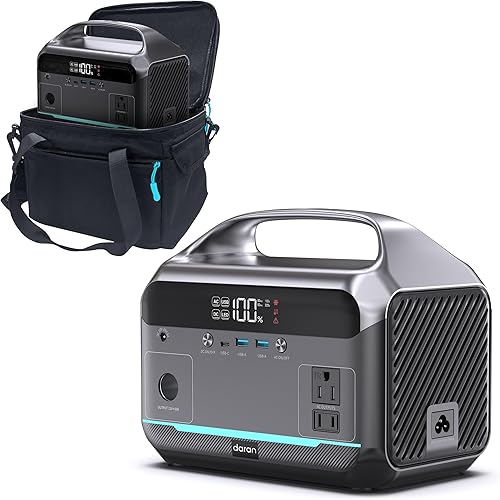
DaranEner DARAN Portable Power Station: Best for compact multi-port use
- 288Wh LiFePO4 battery
- 350W output and 600W peak
- 7-port design
- 2.1-hour fast charging
The DaranEner DARAN adds two AC outlets, USB ports and DC input in an 8.2 lb package for small emergency and travel loads.
Pros
- 350W rated output
- 7-port layout
- Storage bag included
Cons
- Solar panels and car cable sold separately
- Smaller capacity than the large stations
The DaranEner DARAN offers a useful middle ground between a compact travel battery and a larger home backup station.
It has 288Wh, 350W rated output and 600W peak power in an 8.2 lb body.
Its 7-port design includes 2 AC outlets, a 60W USB-C port, 2 USB-A ports and DC input and output.
DaranEner also lists an LCD, rear LED modes and battery protection for overcharge, over-discharge, short circuit, temperature and cell balancing.
The station supports wall, car and solar charging.
Solar panels and car charging cables are sold separately, so account for those parts in your setup.
Choose it for phones, tablets, laptops, a mini fridge or a projector that stays within the 350W limit.
The mix suits a family camping trip where several devices charge through one unit.
It is less suited to long outage coverage than the 1,000Wh and 2,000Wh picks.
The storage bag and compact size help for travel and emergency kits.
STARYLINE 1000W Portable Power Station 1024Wh LiFePO4: Best for Starlink-style remote work
- 1,024Wh LiFePO4 battery
- 1,000W output and 2,000W peak
- 300W solar input
- 60W USB-C PD output
The STARYLINE combines 1,024Wh with a 1,000W output and solar support for camping, RV use and remote work setups.
Pros
- Large battery for its output class
- 300W solar input
- 27.7 lb weight
Cons
- Lower score reflects less documented detail
- Runtime depends heavily on connected loads
The STARYLINE 1000W Portable Power Station 1024Wh LiFePO4 gives you a large battery with a lower continuous output than the top 1,000Wh picks. It stores 1,024Wh and supplies 1,000W continuously, with 2,000W peak power.
The station has 2 AC outlets, a 60W USB-C PD port and 2 USB-A ports. STARYLINE describes it as compatible with Starlink and suitable for remote work, camping, RV travel and home emergencies.
It accepts up to 300W of solar input, and a 200W panel is described as fully charging it in 6 to 8 hours in sunny conditions. The unit weighs 27.7 lb and has an integrated handle.
Choose it when battery capacity and remote-work ports matter, but your appliances do not need 1,500W or more. For a Starlink Mini setup, compare our guide to the best portable power stations for Starlink Mini.
What should you compare before buying a LiFePO4 power station?
Compare battery capacity first, then match continuous output to the devices you plan to run. A station with 1,000Wh can still shut down if one connected appliance exceeds its watt limit.
How much LiFePO4 capacity do you need?
Capacity is measured in watt-hours. A 256Wh to 292Wh station is suited to short laptop, phone, router and camera sessions, while the 1,024Wh to 1,152Wh picks give more room for longer outages.
The 2,010Wh Anker SOLIX S2000 is the better fit when refrigerator runtime is the main goal. Actual runtime changes with the device's power draw, inverter use and operating conditions.
How much output do your devices need?
Continuous output is the number to match against the running wattage of your devices. Peak output helps with some startup loads, but it does not turn a 300W station into a 1,500W station.
For a small office, total the laptop, monitor, router and other devices. For camping, check heating elements, kettles, coolers and cooking appliances separately because they often need more power than electronics.
Does solar input matter?
Solar input matters when you want to recharge away from a wall outlet. The C1000 Gen 2 accepts up to 600W, the AC180 accepts 500W, the S2000 accepts 400W and the STARYLINE accepts 300W.
Panel compatibility is not universal. The Jackery Explorer 1000 v2 is described as compatible only with Jackery solar panels, while other models specify voltage, wattage or cable requirements.
Do you need UPS backup?
UPS mode helps keep selected equipment running during a power cut. The C1000 Gen 2 and Elite 30 V2 list 10 ms switchover, the S2000 lists under 10 ms, and the AC180 lists 20 ms.
UPS use is a separate buying decision from camping power. Confirm the station's supported mode and the device's power draw before using it for a CPAP machine, router or work computer.
Should you buy an expandable station?
Expansion can help when your load grows later, but it adds compatibility and cable questions.
The BLUETTI AC180 supports compatible B80, B230 and B300 batteries, while the Anker C1000 Gen 2 does not support expansion.
Expansion is most useful when you expect longer sessions at home or in an RV.
It is less useful if you mainly need a station you can carry often.
Extra batteries add weight, cost and cable management. They also need the right connection mode for your station.
Check the exact battery names and cables before you plan to expand. A battery that fits one model may not fit another.
If you want a station that can grow over time, compare the models in our expandable power station guide.
If you are building a removable battery setup, a LiFePO4 battery box may be a better fit than a self-contained station.
A battery box suits custom builds with separate inverters and wiring.
A self-contained station suits simpler plug-and-play backup.
Choose based on how much setup work you want to do.
How should you use and care for a LiFePO4 power station?
Use the station below its continuous output, keep the vents clear and use the correct charging input for your model.
Before an outage or trip, charge it fully, check the cables and confirm that your planned devices stay within the watt limit.
Test your main loads at home first. That shows whether the station can start them and how fast the battery drains.
For storage, follow the product instructions and check the battery at the suggested interval.
DaranEner recommends fully charging its station every 1 to 2 months during long storage.
Store it in a cool, dry place away from direct heat. Avoid leaving it in a hot vehicle for long periods.
Solar charging works best when the panel, cable and station limits match.
Place panels where they receive steady sunlight, and avoid assuming that a panel's advertised wattage will be available in every weather or roof position.
Clean panel surfaces gently and keep cables off the ground where possible. Check connectors before each use for damage or loose contact.
Keep the station's vents unblocked so fans can work properly. Do not stack items on top of it while it charges or runs.
Use the app or display to check charge level before you start. That helps you plan which devices to run first.
A power station is not the same as a fuel generator. It has no fuel tank or engine, but its stored energy is limited by capacity, connected load and recharge access.
For home backup, label the plugs you plan to use. That makes setup faster during a power cut.
For camping, pack the charging cables with the station. A missing cable can leave a full battery with no way to refill it.
If a device will not start, remove one load at a time. Check the wattage before you try a different outlet or port.
Follow the manual for cleaning, transport and disposal steps. Those steps protect the battery and keep the warranty terms intact.
Which is the best LiFePO4 power station for you?
The Anker SOLIX C1000 Gen 2 is the best overall choice when you want fast charging, 2,000W output, solar input and UPS backup in one station.
The Jackery Explorer 300 is the better small carry option, while the Anker SOLIX S2000 is the stronger choice for long refrigerator backup.
Choose the BLUETTI AC180 for higher AC output and expansion support.
Choose the BLUETTI Elite 30 V2 or DYNESS 300W when your loads are smaller and portability matters more than long runtime.
The Jackery Explorer 1000 v2 sits between those groups. It gives 1,070Wh and 1,500W output in a 23.8 lb body for road trips and emergency backup.
The DaranEner DARAN and STARYLINE suit buyers who want more ports or a larger battery without moving to the largest station.
Before you decide, list your main devices and their running watts. Add them together and compare that total with the station's continuous output.
Then check capacity against how long you need each device to run. A station can have enough watts but still run out of energy quickly.
Check solar limits if you plan to recharge off grid. Panel compatibility and cable needs differ by model.
Check UPS response if you plan to support a computer, router or medical device during a cut. Not every station lists the same mode.
For a broader comparison of station sizes, ports and use cases, continue with our complete portable power station buying guide.
If you need a station with a specific battery add-on, check the best EcoFlow extra battery guide before you decide.
Measure your storage space and weigh how often you will carry it. The best station is the one that fits your space and your loads.
Buy for your planned use, not for the largest numbers on the page. That keeps weight, cost and setup in balance.
Our top 3 picks at a glance
-
1
-
2
Best for lightweight camping
Jackery Explorer 300 Portable Power Station
9.6/10 our score
See it on Amazon -
3
Best for quiet emergency charging
Jackery Explorer 1000 v2 Portable Power Station
9.5/10 our score
See it on Amazon
Frequently asked questions
What is the best LiFePO4 power station for most people?
The Anker SOLIX C1000 Gen 2 is the best LiFePO4 power station for most backup plans because it combines 1,024Wh, 2,000W output, 600W solar input and a 10 ms UPS mode.
Choose a smaller station for easy carrying, or a 2,010Wh model when refrigerator runtime matters more than weight.
Are LiFePO4 power stations good for solar charging?
Yes, LiFePO4 power stations pair well with solar charging because they store energy in a long-cycle battery format. The useful match depends on the station's solar input limits, voltage range and cable requirements.
Check the panel and station limits before connecting them.
How much capacity do I need in a LiFePO4 power station?
A 250Wh to 300Wh station fits phones, laptops, cameras, routers and other small loads. Around 1,000Wh suits longer outages, camping and several devices, while 2,000Wh gives more room for refrigerator backup.
Capacity does not replace output.
Check both watt-hours and watts.
Can a LiFePO4 power station work as a UPS?
Some can. The Anker SOLIX C1000 Gen 2 and S2000 list under 10 ms UPS switchover, while the BLUETTI AC180 lists 20 ms and the Elite 30 V2 lists 10 ms.
Confirm the device's UPS mode and the load's power needs before relying on it for critical equipment.
How should I choose between a small and large power station?
Choose a small LiFePO4 station when portability and short device sessions matter most. Choose a larger model when you need more watt-hours, higher AC output or longer refrigerator and home-office backup.
Measure the storage area and check the station's weight before buying.